One article takes you to know glossiness, reflectance and fog shadow
Recognize Gloss
Visual appearance can determine how a person perceives a product. Perception is subjective. A key measurement parameter used to define and quantify the overall visual quality of a product is gloss.
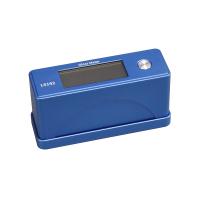
Gloss is measured by emitting a light beam of constant intensity from a fixed angle to the surface being measured, and then monitoring the amount of light reflected at the same angle. This specular reflection is measured using a gloss meter.
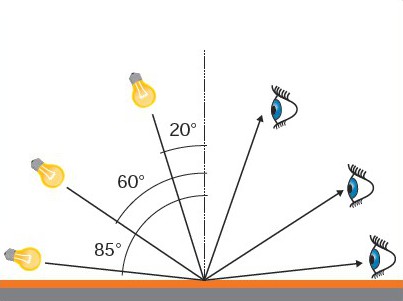
Different surfaces require different reflection angles.
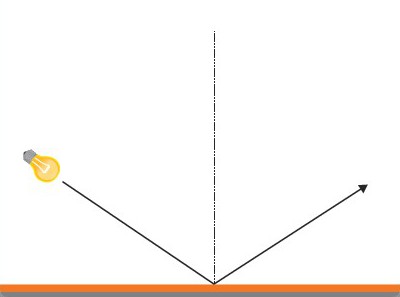
high gloss
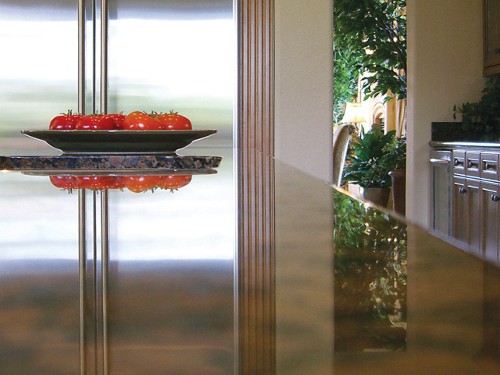
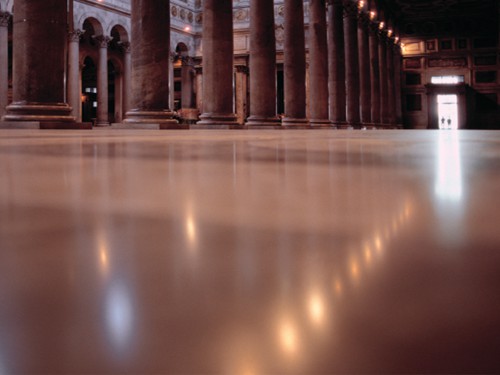
Brilliant or highly polished surfaces reflect clear images. This unique reflection is caused by incident light surface reflections in the specular direction.

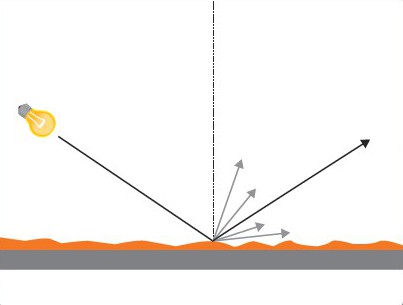
semi-gloss and matte
Semi-gloss and matte surfaces reflect significantly less image and reduced intensity.
Light on semi-gloss and matte surfaces is not only reflected in the specular direction but also scattered, causing reflected images to appear diffuse.

choose the right angle
Gloss measurement is based on the surface reflection of light relative to a polished glass reference standard, measured in Gloss Units (GU). The amount of light reflected on a surface depends on the angle of incidence and the nature of the surface. Gloss is categorized as matte, semi or high gloss.
In order to determine a more suitable measurement angle, start measuring with a gloss meter set at an incident angle of 60°.
If the result is between 10 - 70GU, the coating is called "semi-gloss" and should be measured using a 60° angle. If the result is less than 10GU, the product is "low gloss" and should be measured using an 85° angle. If greater than 70GU, the product is called "high gloss" and should be measured using an angle of 20°.
When measuring gloss on anodized metals, all three angles should be recorded (20, 60 and 85°) to ensure a complete understanding of the specular reflectance between the coating and the metal substrate.
| Gloss range | 60° value | by measurement |
|---|---|---|
| high gloss | > 70GU | 20° |
| semi-gloss | 10 - 70GU | 60° |
| low/dull | < 10GU | 85° |
%Reflectivity
The Glossmeter Unit (GU) scale is linear, with different measurement ranges for each angle of incidence; 0 - 2000GU(20°), 0 - 1000GU(60°), 0 - 160GU(85°).
% Reflectance is compared with the light energy sent and received by the gloss meter, and the value is expressed as a percentage of the full measurement range of the angle of incidence, and the value is displayed as a percentage relative to the selected angle of incidence.
For example:
Since the measurement range is 0-2000GU for a 20° gloss meter, a value of 1000GU at 20° will be expressed as 50% 20, and 500GU will be expressed as 25% 20.
The measurement range at 60° is 0 - 1000GU, a value of 500GU at 60° will be expressed as 50%60.
The shinier the surface, the closer the value will be to 100%.
Materials with a high index of refraction, such as clear plastics or varnishes, may have the above 100GU measurement. Highly reflective metals can have gloss values as high as 2000GU. In addition, due to multiple reflections in bulk materials, the measured value can increase for transparent materials. In all these cases, the measurement results are usually expressed in % reflectance.
fog shadow
Fog can cause reflection contrast to drop and halos to appear around light sources, all of which can greatly degrade visuals.
Haze according to ASTM D4039, within the Elcometer 480 instrument, is defined as the numerical difference between the specular reflectance at 60°C and 20°C.
This is expressed in Haze Units (HU).
- 1What is Haze meter? Application and selection guide
- 2Gloss inspection method of slurry inks
- 3Principle and Application of Glossiness Tester
- 4Working Principle and Application of Metal Gloss Meter
- 5Basic principle and application analysis of insulating paint gloss Detector
- 6Working principle and application analysis of film Glossmeter
- 7Principle and application analysis of microporous gloss meter
- 8 FZ/T 01097 Analysis of fabric gloss test method
- 9Evaluation and Application of Optical Properties of Powder coatings
-
![QILI MN-B reflection blackness meter]() QILI MN-B reflection blackness meter$ 525.00
QILI MN-B reflection blackness meter$ 525.00 -
![KSJ WGG60-Y4 high-precision Glossiness Meter, special for thin film industry, built-in lithium battery]()
-
![CHINA LS192 high-precision Glossmeter 60 °/1000GU Measurement]()
-
![CHNSPEC DG60 MAX single angle gloss meter 2000GU/60 °]()
-
![CHNSPEC G60Pro single angle gloss meter Measurement verification Glossmeter]()
-
![CHNSPEC DG60 SE 60 degree Glossmeter self-calibrated small and beautiful]()