Discovery of prehistoric fish UTBI-001
In April 1998, Dr. Mark Erdmann started using the stowaway tidbit temperature logger UTBI-001 from Massachusetts to record the temperature of seawater at several locations and depths in Manado, Sulawesi.
Initially, he monitored coral reef health in northern Indonesia using biological indicators of marine crustacean species. The temperature data UTBI-001 is important for explaining changes in species abundance and distribution. Lace was deployed at several sites from a depth of 40 meters in the intertidal zone.
However, his research took a dramatic turn last year when he and his wife noticed a bigfin fish at the Manado fish market. This coelacanth belongs to an ancient lineage of fish closely related to the first land vertebrates.
This group of fish was thought to be extinct 80 million years ago, but in 1938 a living coelacanth was found in Net East London, South Africa. At the time, it was hailed as one of the greatest animal discoveries of the 20th century. Fourteen years later, another coelacanth was caught on the Comoros Islands in the Mozambique Channel. Since then, nearly 200 people may have been trapped in the Comoros, and the animals have even been filmed using submersibles.
This is considered a possible population of the world, unfortunately, the population is rapidly declining. It is estimated that only 200 to 300 years ago the fish remained. The discovery of another population 10,000 km away would hold promise, while opening up a host of evolutionary and biogeographical questions. However, Dr. Erdmann has been unable to obtain the market for the fish he sees. He took three pictures. Is that really a coelacanth? Did it come from Indonesian waters? Is it a different species? Could there be a population living in the area?
Dr. Erdmann immediately started looking to learn from the fishermen who caught the fish where it came from, and if others had ever been found. His hope is to eventually acquire another coelacanth that can be preserved and studied. After interviewing dozens of fishermen from surrounding villages in northern Sulawesi, he found two people living on a small island Manado claimed could have been past. And, in fact, it was fishermen who caught the "animals" Dr. Erdmann saw in Manado. They were all sharks. Fishermen set large gillnets to make a living at the bottom of a young volcanic island. Nets are usually placed at a depth of 200 to 300 meters.
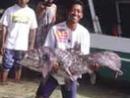
In the Comoros, it is probably usually at depths of 100 to 300 metres. These fish also seem to prefer water temperatures between 12º and 18°C. Dr. Erdmann attaches tidbits to fisherman's nets to determine the depth they will set their nets at and the proper temperature for these fish. In fact they. The temperature was determined to be 15°C. For months he continued to monitor the temperature in the depths where the fishermen were set, but nothing could be found. Then on the morning of July 30, 1998, a group of fishermen pulled up to his house to announce that they had caught a living coelacanth. Dr. Erdmann photographs fish in water.
Due to the temperature of the warm water near the surface and the trauma of the catch, the fish die within hours. Tissue samples were studied and 1.2m, 25kg fish were frozen. After thawing, it was preserved and exhibited in Jakarta.
The discovery of this Indonesian coelacanth was announced in the September 24, 1998 issue of Nature magazine, where it appeared in a photo on the cover. Also appeared in the December 1998 issue of National Geographic, and it was included in Discover magazine's Advanced Science 1998 story. Molecular genetic analysis is currently being done on tissue data taken from this fish and comparisons may be made to the Comoros. These results will be submitted to the journal Nature for publication.
Dr Erdmann continues to monitor the water temperature around Manado and Tua Manado (volcanic island) regularly tracking the bottom water temperature for the Shark Trivia Fishermen's Network. Ultimately, he hopes to be able to determine that fish are likely to occur at certain temperatures within the UTBI-001 range. They're also planning a diving mission next spring to try to observe the fish in their natural habitat and hopefully estimate their populations.
Since publishing the discovery, Dr Erdmann has received reports of possible sightings from other parts of Indonesia. He plans to visit many of these areas to identify habitats similar to those deemed suitable for possible implementation. One measurement would be temperature at a depth of 100 to 300 meters. This is usually accomplished by attaching a temperature logger to fishing line and nets. Because of their reliability, small size, and relatively low cost, trivia are well suited for this type of investigation, since there is little logistical support involved, and conditions can cause instruments to be lost frequently.
Regarding the monitoring work on coral reefs, the remaining tidbits record the temperature for one to three months. Using fishnets, devices are connected to the network and deployed at dusk and retrieved at dawn. Ultimately, coral reef monitoring research should help us understand what types of coral reefs are under stress, and how to better manage and protect them. With the study of coelacanths, Dr. Erdmann hopes to determine whether other populations exist, as well as learn more about their habitats.
Dr. Erdmann pointed out that he has been very satisfied with the tidbit Recorder, especially the HOBO ware Pro software, tidbits installed at 3m, 20m, and 40m depths since June 1998. The temperature time series data set around Bunaken Island has provided a very good Good to keep track of changes in water temperature, which have led to massive coral bleaching in the area since last November.
- 1蝙蝠疾病的揭秘-U12-006(UX120-006M)温湿度记录器
- 2Building EQ Evaluation - U12-012 Temperature and Humidity Light Recorder
- 3ONSETHOBO ZW Series Wireless Temperature and Humidity Recorder Wireless Monitoring of Temperature and Humidity at the National Archives in Washington
- 4Jamaican Coffee Storage U12-011
- 5Process monitoring of drying building solutions ONSETHOBO U12-011/UX100-003, UX100-011
- 6ONSETHOBO U12-012 for storage of Marilyn Monroe logo gowns
- 7Coral Reef Health Research U22-001
- 8Vineyard frost protection U30-GSM
- 9Vitamin producers ensure mass with UX100-003 temperature mapping