Onset's U22-001 for fresh water reduction cause analysis
Background of the project
The Freshwater Trust and its partners seek to restore habitat to benefit federal summer steelhead and spring chinooks on Rudio Creek, an ecologically important North Fork tributary of the John Day River in central Oregon. This project is unique because the Johns River is the second longest free-flowing river in the United States.
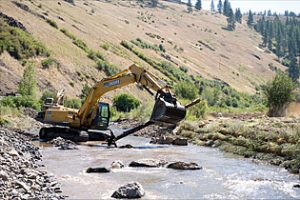
In the mid 1900's, early Rudio Creek was straightened and channeled to create livestock grazing. This channelization, coupled with the development of agriculture in the floodplain throughout the mid-1900s, resulted in the loss of beaver dam complexes and creek riparian hardwoods. The result is a high-energy system with reduced storage habitat diversity and colder water, and stream temperatures as high as 80ºF in late summer, creating significant barriers to fish survival and reproduction.
Project Objectives
The overall goal of the Rudio Creek Farms Habitat Restoration project is to significantly improve habitat for summer rainbow trout and spring chinook. The project's goal is to achieve this by reducing stream temperature, increasing pond habitat for native fish, adding habitat complexity, creating floodplain connections and adding riparian vegetation. The project will restore the Rudio Creek Historic Channel location, construct large timber habitat structures, and restore riparian vegetation. Restoration sites will mimic conditions as much as possible and will result in habitat conditions that support healthy fish populations and a larger population of beavers.
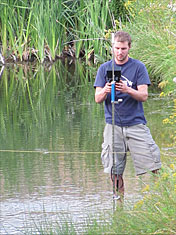
Onset's HOBO Series® temperature loggers use
Three natural springs on the west side of the valley are now only passively connected (via groundwater migration) to Rudio Creek, which provides only minimal impact on temperature. The project will create connections between active springs and creeks, potentially providing three new cold water streams while also creating additional rivers. The Freshwater Trust uses Onset's HOBO series water temperature loggers UTBI-001, U22-001, UA-001-08, UA-001-64, UA-002-08, UA-002-64 Rudio Creek to merge every spring, to help Collect temperature data preprocessing and preflow. Water temperature loggers U22-001 will be placed in both project areas and will be attached to rebar embedded in the stream. After deployment, Onset's HOBO Optical Data Download Base U-DTW-1 will be used for easy download of all data. The data will be collected every 30 minutes and downloaded approximately four times per year. HOBO ware®Pro BHW-PRO-CD and Excel will be used to graph flow velocity and flow and temperature data. These data will be used to assess the effectiveness of the project to directly connect Spring Creek and reduce its temperature. Temperature data collected from these water temperature loggers U22-001 will be used to compare the current thermal dynamics of Channel Creek and the achieved post thermal regime. This analysis will allow Freshwater Trust to assess the extent to which connected springs and streams are effective at reducing stream temperatures. Onset's HOBO series of water temperature loggers U22-001 were selected for this project because of their proven records providing high quality, reliable data due to the long-term existence of the product.
- 1OnsetHobo UX90-004M Temperature Logger for Feasibility Improvement of Demand Side Management Projects
- 2UA-001-64 temperature Recorder for gender prediction of small returnees
- 3Building Efficiency Monitoring U12-011/UX100-003/UX100-011
- 4ONSETHOBO UX100-003 Temperature Logger for Building-Phase Change Material Temperature Monitoring
- 5Temperature monitoring of building automation system by temperature Recorder UX100-014
- 6Effects of temperature Recorder UTBI-001 on river ecological restoration in the Northwest Pacific
- 7Food transportation temperature monitoring U12-015-02
- 8Building temperature monitoring U12-006 (UX120-006M)