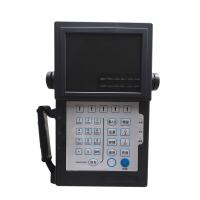
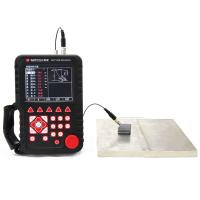
Application of Ultrasonic Flaw Detector in Weld Flaw Detection
A large number of steel structures are used in plant construction and equipment installation. The welding quality of steel structures is very important. Non-destructive testing is an important method to ensure the welding quality of steel structures. Conventional methods of non-destructive testing include direct macroscopic inspection with naked eyes and instrumental testing such as radiographic flaw detection, ultrasonic flaw detection, magnetic particle flaw detection, penetrant flaw detection, and eddy current flaw detection. Ultrasonic flaw detection has the characteristics of large detection distance, small size and light weight of the flaw detection device, which is easy to carry to the scene for flaw detection, fast detection speed, and only consumes coupling agent and wear probe in flaw detection, and the total detection cost is low. At present, the construction industry market This method is mainly used for detection.
After receiving the flaw detection task, you must first understand the technical requirements of the drawings for welding quality. At present, the acceptance standard of steel structure is implemented according to GB50205-95 "Code for Construction and Acceptance of Steel Structure Engineering". Secondly, the timing of flaw detection should be clear. The carbon structural steel should be welded to the ambient temperature after the weld is cooled to the ambient temperature, and the low-alloy structural steel should be welded for 24 hours after the weld is completed. In addition, you should also know the thickness of the base metal of the workpiece to be tested, the type of joint and the type of groove. So far, most of the welds that I have encountered in actual work that require flaw detection are the joint types of butt welds in the middle plate. Generally, the thickness of the base metal is between 8-16mm, and the groove types include Type I, Single V-type, X-type and other forms. After figuring out the above things, the preparation work before the flaw detection can be carried out.
Before each flaw detection operation, it is necessary to use standard test blocks (CSK-IA, CSK-ⅢA) to calibrate the comprehensive performance of the instrument and calibrate the panel curve to ensure the accuracy of flaw detection results.
1. Repairing of the detection surface: The spatter, scale, pits and rust on the welding work surface should be removed, and the finish is generally lower than ▽4. The trimming width of the flaw detection surface on both sides of the weld is generally greater than or equal to 2KT+50mm, (K: probe K value, T: workpiece thickness). Generally, the probe with a K value of 2.5 is selected according to the base material of the weldment. For example, if the base metal thickness of the workpiece to be tested is 10mm, then it should be ground 100mm on both sides of the weld.
2. Due to the thin thickness of the base metal, the detection direction is carried out on one side and both sides.
3. Since the plate thickness is less than 20mm, the horizontal positioning method is used to adjust the scanning speed of the instrument.
4. Rough flaw detection and fine flaw detection are used in the flaw detection operation. In order to get a general understanding of the presence or absence of defects and their distribution, quantification, and positioning are precise flaw detection. Several scanning methods such as zigzag scanning, left and right scanning, front and rear scanning, corner scanning, and surrounding scanning are used to find various defects and determine the nature of defects.
5. Record the detection results, and evaluate and analyze internal defects if found. The classification of the internal defects of the welded butt joint shall comply with the provisions of the current national standard GB11345-89 "Manual ultrasonic flaw detection method and classification of flaw detection results of steel welds" to judge whether the weld is qualified. If any defect exceeding the standard is found, a rectification notice shall be issued to the workshop, ordering it to undergo re-inspection after rectification until it is qualified.


- 1Application of Ultrasonic Flaw Detector
- 2Basic Principle Characteristics and Application Analysis of Flaw Detector for Casting
- 3The working principle and application of eddy current Flaw Detector
- 4Ultrasonic Flaw Detectors: the right-hand man for nondestructive detection
- 5The role and application of ultrasonic flaw Detector
- 6What is an ultrasonic flaw Detector?
- 7What is an ultrasonic pulse echo system?
- 8Ultrasonic flaw detection defect judgment
珀泰@sisi
- 9Method for calibrating ultrasonic straight probe, dual crystal probe and oblique probe