5 Tips for Measuring Cotton Moisture
Cotton has long been a very important plant for farmers around the world. As one of the most widely used textile fibers in the world, cotton is the cornerstone not only of agriculture, but of every industry that requires cotton fiber. Last year alone, the U.S. produced 13.2 million bales of cotton from 7.7 million acres of harvested cotton, according to the USDA.
As a crop, cotton can be difficult to grow. Farmers need a host of specialized tools to harvest and process cotton, and to deal with threats to their crops. From boll weevils to cotton aphids to spider mites, there's no shortage of threats that can ruin a cotton harvest.
However, with perseverance and some modern technology, farmers can overcome many challenges and ensure that the cotton survives to harvest. That leaves the question of how farmers can ensure the cotton they grow is of good quality.
In order to maximize cotton yield and quality during harvest, it cannot be overstated how important it is to ensure that the moisture content of the cotton is strictly controlled. If the cotton gets too wet during harvest, it can stick to the machinery, causing a clog and potentially serious damage to the cotton baler and gin. If cotton is too dry, its fibers can be damaged during harvest, potentially destroying its usefulness.
With that in mind, we've put together some simple tips for measuring moisture in cotton:
Tip #1: Use a Hygrometer
Manual methods of checking cotton %MC are impractical when tens of acres of cotton (or more) are harvested. Simple touch testing does not provide quantifiable measurements of cotton moisture content.
Oven drying tests, highly accurate if done correctly, take too long to complete to measure moisture in cotton in time for harvest or ginning. By the time you get one measurement from enough cotton samples to say you have a good idea of the cotton's moisture content, the rest of the cotton may have seen a significant change in %MC!
Moisture meters for cotton, on the other hand, can provide reliable measurements of the moisture content of your cotton in seconds, not hours.
Tip #2: When to Measure Moisture
Generally speaking, the important moment to measure cotton moisture is when it is harvested, when it is ginned again. You can also check the moisture of the cotton before selling to tell how much of the cotton's weight comes from the moisture.
Checking the moisture before running the cotton through the gin will ensure high quality long staples by letting you know if the cotton needs to be dry or wet. Checking for moisture during the sale lets your buyers know they are getting a fair market price and won't be charged for too much water.
Tip #3: Choose the Right Electrode for the Job
Cotton comes in many different forms at different stages of the cotton harvest. From lint and seed cotton to large, fluffy bales of white cotton, it's important to have the right measuring equipment for the job.
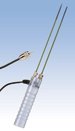 When you need to test moisture in lint or seed cotton, a small cup-type electrode such as the 52-E/C electrode may be a better electrode type to use. With this electrode, you simply place a cotton sample in the cup, press it down firmly with your finger (even though the sample will still overflow the cup afterwards), and press the read button on the Moisture Meter.
It is important to remember that tests performed on seed cotton may not be as accurate as lint tests. This is due to the fact that the seeds present in cotton may have a higher moisture content than lint, and the randomness of the number of seeds in any given sample.
In order to test a bale, you need to use an extension electrode to penetrate the inside of the bale to test for moisture. The 30-E/C electrode is perfect for this purpose because it has two insulated pins that are 24 cm (9 1/2 in.) long. The insulation on the pins allows them to penetrate into the deepest part of the bale and give you a depth-specific moisture reading instead of the surface moisture on the bale.
In particularly tightly packed bales, a heavy duty electrode made of rebar may be required to penetrate the bale to obtain a reading.
For measuring cotton that has been processed into yarn, shorter electrodes with multiple points of contact, such as the 37-E/C, are better suited to obtain reliable readings.
Tip #4: Desirable Cotton Moisture
Cotton has a desirable moisture content of between 6.5% and 8% when its moisture is measured before ginning, according to information cited by the USDA. At this %MC the quality of the yarn processed from cotton will be higher than if the moisture content of the cotton is significantly reduced.
Cotton wetter than 8% MC can easily stick to machines, causing clogs that hamper production and even destroy expensive equipment.
Tip #5: Check the Calibration of Your Meter
Properly maintained and cared for, a well-made hygrometer from a reliable manufacturer is a tool you can rely on for years to come. However, it's still important to check the calibration of your meter regularly to ensure you're getting accurate results.
There are several ways to check meter calibration, including:
Use a reference meter. Take an unused meter and compare the moisture readings between the two cotton samples.
Use the Moisture Content Standard (MCS). These handy little devices allow you to test the accuracy of your meter by providing a consistent resistance value. If the meter returns a result other than the MCS value, you will know the meter's calibration is off.
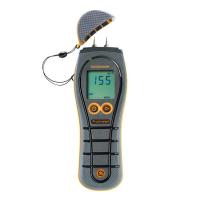
Use built-in calibration checks. Some hygrometers, like Delmhorst's C-2000 meter, have a built-in calibration check. With the push of a button, the meter can run a check and you'll know instantly if it's working properly.

- 1Three common problems with Moisture Meters
- 2How to tell if the hygrometer is calibrated?
- 3Three Factors That Affect Hygrometer Readings
- 4How can hygrometers help with property damage insurance claims?
- 5How to choose a good hygrometer electrode for repair work?
- 6Hygrometer electrodes make your life easier
- 7How do I locate a leak with a Delmhorst needle-free Moisture Meter?
- 8How to use a total hygrometer to save time and cost?