How to choose the right moisture analyzer electrode?
For testing moisture distribution in wood and other building materials, few tools are as effective as a pin Moisture Meter. These handy little devices can detect very quickly with incredible precision and accuracy.
However, with wood, concrete, or other construction materials, the basic pins that come with a given hygrometer may not always be sufficient for a given job. This is where specialized electrodes are used.
What are electrodes?
Regarding hygrometers, electrodes are accessories for hygrometers that can be used to enhance the functionality of said meter. Some electrodes are made for specific tasks, while others can be used for a variety of tasks.
Every manufacturer of hygrometers on the market has many different types of electrodes. Today, we'll offer some tips for choosing the right electrode for your situation or job:
Tip #1: Check compatibility with the manufacturer
One of the biggest problems some hygrometer users have when finding the right electrode is matching the electrode to the hygrometer in the first place. For some manufacturers, not every electrode is compatible with every hygrometer. Checking the recommended hygrometer/electrode combination with the hygrometer manufacturer can help minimize this particular difficulty.
As a side note, the Delmhorst hygrometer and electrodes are designed with a universal connector, so any Delmhorst electrode will work with any Delmhorst hygrometer that has an electrode connector.
Tip #2: Use a meter/electrode combination calibrated for the material being tested
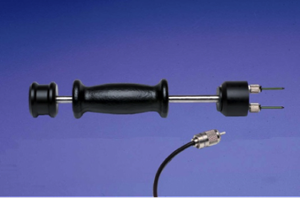 Even if the electrode can be connected to the meter you want to use, it is important to make sure that the meter itself is calibrated to measure moisture in the type of material you are testing.
For example, an electrode designed to check moisture in hay will produce more reliable results when connected to a Moisture Meter that has been calibrated for hay, rather than a Moisture Meter calibrated for wood. If you hook up a meter for wood calibration to a hay sensor, the readings will be well qualitative, not quantitative.
Tip #3: Consider Electrode Durability
Chances are you plan to use electrodes and you'll want to use it for your work. Choosing hygrometer electrodes designed for durability can help prevent headaches.
When choosing durability, also consider electrode design. Electrodes with longer leads, such as the 1235/18 18" long hay electrode, are usually designed to penetrate more loosely packed materials such as hay. Although tough, this electrode is not suitable for use on wood as the tip is blunt and the shaft of the electrode will experience more force.
For penetrating hardwood, an electrode with a sharp contact needle, such as a 26-ES electrode, is usually better and more durable.
Tip #4: Consider Electrode Design
Some electrodes are built for very specific purposes. Therefore, these electrodes may have very different design features than the standard.
For example, 19-E/STC electrodes look very different from standard electrodes. Where most other blades have two or more small, sharp pins, the 19-E/STC has two 5-inch long blades with a 35° angled bend near the midpoint. The reason for the difference in shape from the standard is that the blade of this electrode can more easily enter between the wall and the substrate to check for moisture, thereby minimizing the need to remove the base moulding.
Other features to check include the insulation of the electrodes. For example, 26-ES electrodes are insulated except for the tips of the electrode pins. This allows a wood Moisture Meter using the 26-ES electrode to measure moisture only at the depth of the needle tip, which can be a huge help when trying to determine the exact distribution of moisture in a plank or hardwood floor. Access to the subfloor.

- 1What are the different modes in a Moisture Meter?
- 2How Moisture Meters Can Help Solve Pest Problems
- 3Negative effects of moisture on leather products
- 4Analysis of moisture measurement in concrete
- 5How do I locate a leak with a Delmhorst needle-free Moisture Meter?
- 6How to repair a broken Delmhorst Moisture Meter?
- 7Moisture meter type and application