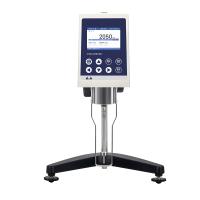
Comparison of Several Common Viscosity Testing Tools
This article introduces the advantages and disadvantages of several common viscosity measurement tools, such as Zion cup, laboratory Rotational Viscometer, falling ball or piston viscometer, and vibration viscometer.


Efflux cups (including Zahn cups)
Efflux is defined as "flowing out of a specific substance or particle." A cup of this nature might be more like a Zahn Cup, Shell Cup, or Ford Cup. In short, you fill the cup with liquid, let it drain through a hole in the bottom, and usually use a stopwatch to measure how long it takes the fluid to drain. The "seconds" it takes to drain indicates the viscosity of the fluid.
benefit
Cheap
takes little time
Little to no maintenance, (basically making sure it's clean and in good condition)
shortcoming
Accuracy depends on humans, causing it to vary by up to 30%
it can be subjective
There are differences between cup manufacturers
Inefficient use of time (dependence on labor)
unresponsive
Laboratory viscometer (usually a Rotational Viscometer)
A Rotational Viscometer works on the principle that the torque required to turn an object in a fluid is a function of the viscosity of that fluid. They typically measure the torque (magnitude of force) required to spin a disk in a fluid at a known velocity.
benefit
very accurate measurements
shortcoming
This is an offline process. (often requires removing material from the process, allowing for temperature variations, which can lead to inaccuracies)
Inefficient use of time (dependence on labor)
Requires maintenance from batch to batch
unresponsive
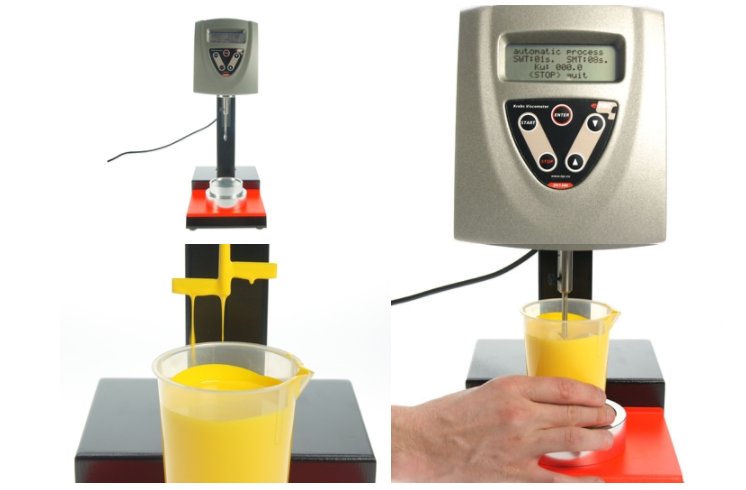
Falling Object (Ball or Piston) Viscometer
In short, a piston (or sphere) of known size and density is lifted and released into the fluid. The amount of time it takes to release from a specific point in the cylinder gives you one type of resistance, which is fluid viscosity.
benefit
This is very important when dealing with non-Newtonian fluids, which include most fluids used in printing and coating today. Read our blog series, beginning with "How Newtons Affect Your Coating Process..." for more discussion on Newtonian and non-Newtonian fluids.
High shear device (when using a mechanical device to induce shear, you can better represent the shear stress that the fluid is applying in the process)
Ability to read small changes in viscosity
Rugged, (designed for industrial environments)
Suitable for various applications
Can be used online (during the process), with real-time feedback
Unaffected by flow rate or external vibrations
shortcoming
can be maintenance intensive
Parts intensive, (replacing parts can be costly)
Vibration Viscometer
Sometimes called a "tuning fork" viscometer, a vibrating viscometer works by generating sound waves. A stainless steel sensor element is submerged in a fluid and moved back and forth microscopically at high frequency. When the sensor surface shears the liquid, energy is lost into the fluid due to its viscosity. The energy expended is precisely measured by microprocessor-controlled electronics and converted back to viscosity. The higher the viscosity, the greater the energy loss, so the higher the reading.
benefit
There is no "moving" part
little maintenance
Can be used online (during the process), with real-time feedback
Rugged, (designed for industrial environments)
shortcoming
Often affected by machine or external vibrations
Some require a pressurized solvent flush for cleaning
If a part fails, the entire viscometer usually needs to be replaced

- 1Rotational viscometer - principle, classification, application and calibrating
- 2Application of NDJ-8S digital Rotational Viscometer in viscosity measurement of cosmetic raw materials
- 3NDJ-5S digital Rotational Viscometer accurate measurement of natural oil viscosity
- 4Application of HBDV-1H swirl/spin High Temperature Viscometer in Viscosity Determination of Plastic Particles
- 5Rotational viscometer selection guide: How to choose the right viscosity equipment for you?
- 6Principle, type and accuracy control of Rotational Viscometer
- 7Which Viscometer to Choose for Licorice Extract Viscosity Testing? How to Test?
- 8Application of Rotational viscometer in Waterborne Polyurethane Adhesive
- 9Application of Rotational Viscometer in cellulose material