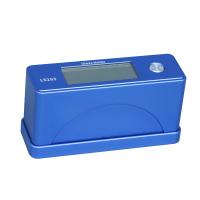
How to choose a Gloss meter?
Gloss is a physical quantity used to evaluate the ability of a material surface to reflect light under a set of geometric conditions. Thus, it expresses reflective properties with direction selection. Gloss can be divided into several categories according to the characteristics of the gloss. We usually say gloss refers to "specular gloss", so the gloss meter is sometimes called a specular gloss meter. Gloss is completely different from the concept of "smoothness" or "roughness" in the machining industry, which is the evaluation of the microscopic roughness of the material surface. When we use a gloss meter, we often don't know how to choose the angle of gloss measurement. All light sources are reflected from the surface, and the magnitude of the reflected light is called the surface gloss value. Gloss values are measured in Gloss Units (GU), which correspond to a standard value close to 100 GU. Gloss can be broken down into three general ranges: low gloss, semi-gloss, and high gloss. All angles are calculated from vertical angles. Each range is measured in its own angle. To know which angle is suitable for measurement, it is best to start with 60 degrees. If the result is between 10 and 70 GU, you can call the coating a semi-gloss and measure at that angle. If the result is less than 10GU, the product is called low gloss and should be measured at 85 degrees. If the result is above 70GU, the product has a high gloss and is measured at 20 degrees.
In order for a product to look refined in the eyes of the customer, it is important to impart a high finish to the product and gloss plays an important role in this. Once the polished stone or coating has been applied to the product, a gloss meter can be used to remove any unevenness in the luster. Gloss meters actually measure the gloss factor of various surfaces and record the amount of light reflected and scattered on different surfaces.
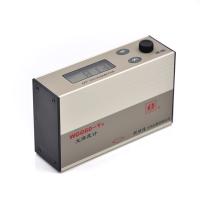
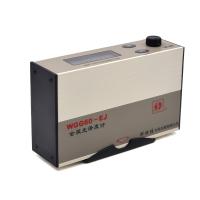
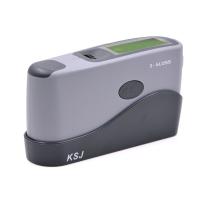
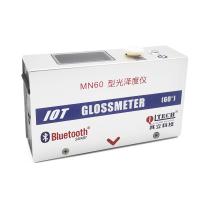
How to choose a gloss meter?
The surface to be tested for gloss should be flat and approximately 2" x 0.5" so that the gloss meter can be properly positioned. Most products have different categories. Some products may fall in the semi-gloss range, some may be mat, some may have a low gloss, while others such as automotive or metal may have a very high gloss. There are mainly three kinds of gloss, namely 20 degree, 60 degree and 85 degree gloss meter. However, some industries have a different angle, which are basically ceramics, film, vinyl and paper. Some manufacturers make a wide variety of products, from mats to glossy surfaces, which requires a universal gloss meter and measures all three angles.
low gloss
For improved resolution of low gloss, use an angle of 85° to record gloss on product surfaces, which is recommended for those surfaces that measure less than 10 GU at 60°. This angle has a larger measurement point that averages out differences in gloss on slightly uneven or textured surfaces.
semi-gloss
It is important to remember that gloss can be measured using a standard measurement angle of 60°. This angle is used as a reference angle for various products. B has extremely high gloss and better measurements can be obtained with complementary angles of 85° or 20° for low gloss and high gloss.
high gloss
For improved resolution on high-gloss surfaces, angles are measured using an acute angle of 20°. Surfaces of objects measuring 70 GU and above are typically measured using this geometry. The 20° angle is sensitive to haze, an effect that has an effect on the appearance of the surface.
Industry Based Gloss Meters
All walks of life measure the gloss of products to ensure quality, and it also has a great impact on customers. Some products are designed to combine a matte finish with a high gloss finish. The surface quality of a product can be judged by measuring gloss and monitoring it to highlight issues such as abnormal gloss early on.

- 1Principle and Application of Glossiness Tester
- 2Working Principle and Application of Metal Gloss Meter
- 3Basic principle and application analysis of insulating paint gloss Detector
- 4Working principle and application analysis of film Glossmeter
- 5Principle and application analysis of microporous gloss meter
- 6 FZ/T 01097 Analysis of fabric gloss test method
- 7Evaluation and Application of Optical Properties of Powder coatings
- 8Coating coatings - Determination of surface gloss and Gloss meter
- 9The Importance and Method of Gloss Measurement of Paint Film