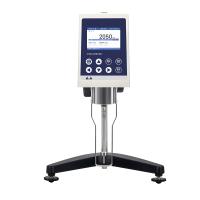
What is the Difference Between Dynamic and Motion Viscosity?
At first glance, viscosity may seem like a fairly simple concept. It helps describe how thick or runny a product is. It doesn't matter?
Actually, there are several different terms that fall under the heading of viscosity. These terms are derived from how viscosity is measured. When people talk about viscosity, they're talking about one of two things: kinematic viscosity or dynamic viscosity.
It is not easy to find much information on the difference between dynamic viscosity and kinematic viscosity. Here's my attempt at clarifying these two main concepts.
One method is to measure the fluid's resistance to flow when an external force is applied. This is dynamic viscosity.
Another method is to measure the resistive flow of a fluid under the weight of gravity. The result is kinematic viscosity. In other words, kinematic viscosity is a measure of a fluid's inherent resistance to flow with no external force acting on it other than gravity.
To further complicate my attempts to simplify these concepts, two fluids with the same dynamic viscosity can have different kinematic viscosities. This is because the kinematic results depend on the density of the fluid. Density is not a factor of dynamic viscosity.
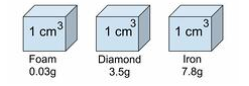
Density is the ratio of the mass (or weight) of the sample divided by the volume of the sample. Think of a block of ice and a block of steel. They may be the same size, but the steel cube weighs more than the ice cube. Therefore, we say that steel is denser than ice.
The mass (or weight) of a fluid is determined by gravity. In kinematic measurement methods, gravity is the force acting on the sample.
Measuring Dynamic Viscosity
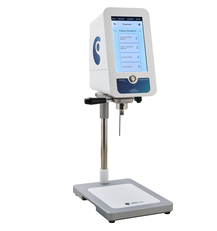
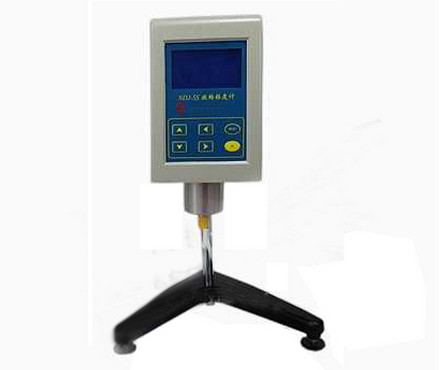
Rotational viscometers are one of the more commonly used types of instruments used to measure dynamic viscosity. These instruments rotate a probe in a liquid sample. Viscosity is determined by measuring the force or torque required to turn the probe.
Rotational viscometers are especially suitable for measuring non-Newtonian liquids. Non-Newtonian liquids change viscosity when exposed to different conditions. For example, some of these liquids exhibit an increase in viscosity as the applied force increases, while other non-Newtonian liquids decrease in viscosity as the applied force increases.
A Rotational Viscometer adjusts the speed at which the probe turns as it moves through the liquid. A viscometer detects a change in the viscosity of a sample as the velocity (sometimes called the shear rate) changes.
The unit of measurement for dynamic viscosity is Centipoise (cP).
Measuring Kinematic Viscosity
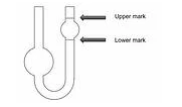
There are several ways to find the kinematic viscosity of a fluid, but a common method is to determine the time it takes a fluid to flow through a capillary. Convert time directly to kinematic viscosity using the calibration constants provided for the specific tube.
The unit of measurement for kinematic viscosity is Centistokes (cSt).
The basic difference between dynamic viscosity measurement and kinematic viscosity measurement is density. Density actually provides a way to convert between kinematic and dynamic viscosity measurements. The conversion formula is:
Kinematic (cSt) x Density = Dynamic (cP)
Dynamics (cP) / Density = Kinematics (cSt)
For a given sample with a density greater than 1, the dynamic viscosity will always be the higher number.
When should you use dynamic viscosity measurement?
Dynamic viscosity is tested when you want to know the internal resistance of a fluid or the force required to move one plane of a liquid to another.
The measurement of dynamic viscosity is useful for liquids that change their apparent properties when force or pressure is applied. These liquids are called non-Newtonian fluids. Non-Newtonian fluids are sensitive to changes in the amount of force applied to them, and can sometimes even change their viscosity permanently if a constant force is applied to them over a period of time.
An example of the importance of dynamic viscosity measurement is to indicate the proper flow characteristics of tomato paste. The product needs to have a low viscosity when it's runny so you can get it out of the bottle, but needs to be thick (or not tend to be runny) when sitting on a burger. Testing the viscosity of the ketchup at different speeds (corresponding to different force levels) will help to ensure that the ketchup behaves as such.
Another application is the design of pump systems. Since the viscosity of non-Newtonian liquids changes with the speed of motion, pressure and pump speed have a serious effect on the specification of the correct pump, pressure and pipe size. Testing the product at different speeds will help guide the design of the pump system.
When should kinematic viscosity measurements be used?
This measurement is primarily used for Newtonian liquids - liquids that do not change viscosity with changes in applied force (shear rate).
Testing lubricants is an important application. Using this test method, it is possible to determine the change in viscosity at different temperatures and under different environmental conditions. With this information, changes in lubrication effectiveness can be assessed.
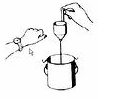
Some other products suitable for kinematic methods are blood and plasma, paints, polymers and asphalt.
Viscosity measurements for Newtonian fluids can be done using a Rotational Viscometer (via the conversion formula listed above). However, it is simpler to use capillary instruments. In some cases, capillary-based instruments are more accurate for determining kinematic viscosity.
When you need to determine the viscosity properties of a liquid that has not been exposed to external physical forces (in other words, when gravity is the force acting on the liquid), motion should be the method of choice.
Summary
The intrinsic viscosity of a Newtonian fluid doesn't change as you vary the force you apply to the liquid. This intrinsic viscosity can be easily and accurately measured with a capillary-type device that uses gravity to move the fluid.
On the other hand, non-Newtonian fluids exhibit large viscosity changes based on applied force. These tests require instruments such as Rotational Viscometers, which measure changes over time and over a range of applied forces.
Describe these two types of liquids:
Dynamic Viscosity: Viscosity related to external forces applied to a non-Newtonian fluid.
Kinematic Viscosity: The intrinsic viscosity of a Newtonian fluid that does not change with applied force.




- 1Rotational viscometer - principle, classification, application and calibrating
- 2Application of NDJ-8S digital Rotational Viscometer in viscosity measurement of cosmetic raw materials
- 3NDJ-5S digital Rotational Viscometer accurate measurement of natural oil viscosity
- 4Application of HBDV-1H swirl/spin High Temperature Viscometer in Viscosity Determination of Plastic Particles
- 5Rotational viscometer selection guide: How to choose the right viscosity equipment for you?
- 6Principle, type and accuracy control of Rotational Viscometer
- 7Which Viscometer to Choose for Licorice Extract Viscosity Testing? How to Test?
- 8Application of Rotational viscometer in Waterborne Polyurethane Adhesive
- 9Application of Rotational Viscometer in cellulose material