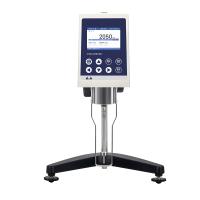
The importance of viscosity measurement in food production and processing
Good food is increasingly important to consumers. In this industrial segment, manufacturing products that meet the high demands of end users poses a challenge to analysts. Therefore, the relevant measurements need to be fast and accurate, and should not be too expensive. This applies in particular to physically measured variables such as viscosity.
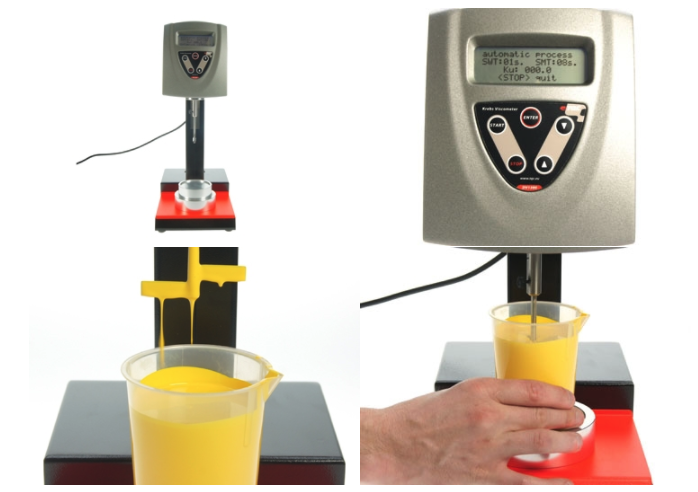
Understanding viscosity plays an important role in any industrial field involving liquid media.
For example, viscosity plays an important role in almost all production stages in the food sector. For example, large volumes of liquid media need to be carefully pumped through pipes. The viscosity of the field ranges from water to paste.
 In industrial food processing, different types of sugars, such as glucose syrup, are often used to sweeten foods and beverages. Many types of syrups are obtained from the enzymatic degradation of starch and are important products of the starch industry. Since syrups are viscous, they are often used as binders in food production, such as chocolate cereal mixes or sauces. Viscosity and fluidity are highly dependent on the cohesiveness of the starch contained in the food. Starches have different properties, depending on temperature and environment. For example, it has a solidifying effect when the temperature is raised. However, when boiled, it has a liquefying effect. When it cools again, it has a solidification effect again. These conditions are characterized by viscosity. Even with soups, achieve the correct consistency by adding a thickener. Temperature dependent viscosity plays an important role in determining the flow properties of sauces, dips, mayonnaise and liquid additives used for quality control.
This measured variable is important at most stages of production as viscosity changes the flowability of liquid food products and affects product appearance and consistency.
Viscosity is also an important control variable in the quality control of incoming liquid raw materials, which can differentiate raw materials of different qualities and eliminate problems during further processing. Depending on the application, random measurements in the laboratory are sufficient for the production of raw materials, but in some cases measurements are required on-site or continuously and selectively (on-line measurements). In many cases it is necessary to save and transfer measured values. Therefore, some companies offer viscometers with RS-232 interface and PC software. For example, PCE Instruments offers models for the food, chemical and cosmetic industries that measure viscosity between 3 and 13,000,000 mPas with an accuracy of ±1%.
As you can see, quick and easy viscosity determination is very important for quality and process control.
How do you measure viscosity?
A viscometer is a device that measures the toughness (viscosity) of a liquid and defines it as a physical measurement variable to make it comparable. Viscometers differ in their measuring principle and the type of viscosity they measure (dynamic or kinematic viscosity).
Roughly speaking, there are the following types of viscometers: capillary viscometer, Rotational Viscometer, falling body viscometer, process viscometer, viscosity Flow Cup.
These different types of viscometers are used depending on the application, quantity and measurement range of the sample.
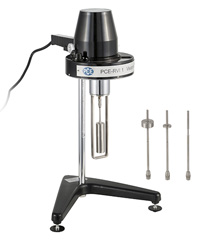
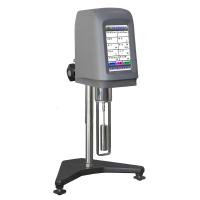
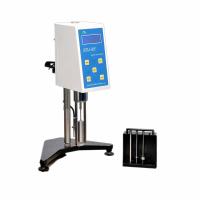
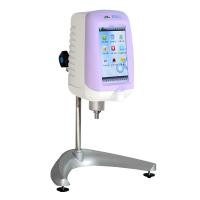
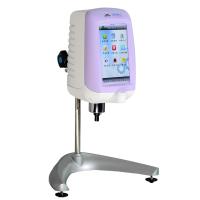
For most viscosity measurements in quality control, samples are taken randomly and the dynamic viscosity is accurately and quickly measured by a Rotational Viscometer. A Rotational Viscometer does this by measuring the mechanical resistance of a liquid against the rotational motion of a spindle (as a rotating solid). Viscosity values are derived from the resulting torque in relation to the spindle geometry. The Rotational Viscometer also measures the temperature of the sample liquid and displays it in the LC display with further parameters such as the spindle speed, the selected spindle or the set measuring range. The Rotational Viscometers PCE-RVI 1, PCE-RVI 2 and PCE-RVI 3 are small but robust units that can be used for almost any liquid medium. Immerse the stainless steel sensor in the liquid to be measured and get the measurement result immediately. The probe tip needs to be completely covered with liquid. The size of the container and the volume of the liquid do not matter.



- 1Rotational viscometer - principle, classification, application and calibrating
- 2Application of NDJ-8S digital Rotational Viscometer in viscosity measurement of cosmetic raw materials
- 3NDJ-5S digital Rotational Viscometer accurate measurement of natural oil viscosity
- 4Application of HBDV-1H swirl/spin High Temperature Viscometer in Viscosity Determination of Plastic Particles
- 5Rotational viscometer selection guide: How to choose the right viscosity equipment for you?
- 6Principle, type and accuracy control of Rotational Viscometer
- 7Which Viscometer to Choose for Licorice Extract Viscosity Testing? How to Test?
- 8Application of Rotational viscometer in Waterborne Polyurethane Adhesive
- 9Application of Rotational Viscometer in cellulose material