Tu-4 Viscosity Cup Determination of Resin Viscosity
1. Definition
Viscosity is the ability of a liquid to interact with its molecules under the action of external forces (pressure, gravity, shear force) to hinder the relative movement of its molecules, that is, the resistance of liquid flow.
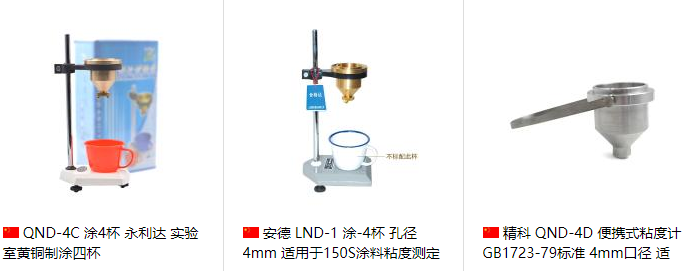
2. Measurement method
(1) Standard GB/T 1723-1993 paint viscosity determination method.
(2) Principle The viscosity measured by Tu 1 and Tu-4 Viscosity Cups is the conditional viscosity, that is, the time for a certain amount of sample to flow out of a hole with a specified diameter under a certain humidity; the viscosity measured by the falling ball viscometer is the conditional viscosity , which is the time required for a steel ball of a certain specification to fall vertically through the upper and lower scale marks of the glass tube containing the sample at a certain temperature.
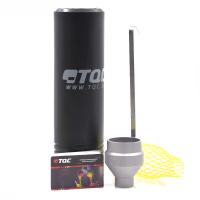
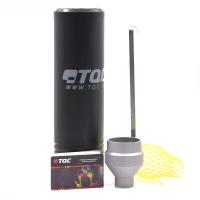
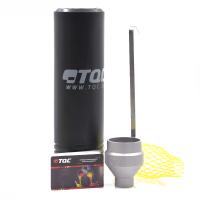
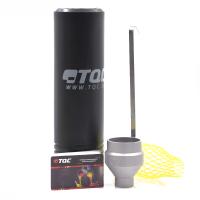
(3) Operate the Tu-4 Viscosity Cup (see Figure 2-6). Wipe the viscometer clean, dry it or blow it dry with cold wind, keep the leak nozzle of the viscometer clean, and stir the sample evenly. Unless otherwise specified, adjust the sample temperature to 23°C or 25°C. Put the viscometer in the horizontal position, place a 150mL JC cup under the leak of the viscometer , block the leak with your fingers, fill the sample into the viscometer, and drive the air bubbles and excess samples out of the groove with a glass rod or glass plate . Quickly remove the finger, start the stopwatch at the same time, stop the stopwatch immediately when the sample is just interrupted , and the stopwatch reading is the outflow time of the sample.


- 1Coating viscosity determination - viscosity cup Yiwen
- 2Measuring method of coating viscosity
- 3Zahn Cup Method for Determination of Coating Viscosity
- 4The calibration method of 4 viscosity cup
- 5Application of Viscosity Cup in Printing ink viscosity measurement
- 6How to measure the viscosity of paints with Ford Viscosity Cup?
- 7The difference between different viscosity cup viscosity
- 8Method for Determination of Coating Viscosity by Zain Cup
- 9Common Methods for Determination of Coating Viscosity