What are the commonly used main equipment for emulsion paint production?
The equipment for latex paint production depends on the process and scale, especially the pigment dispersion equipment. The main production equipment that a latex paint production plant should have are as follows:
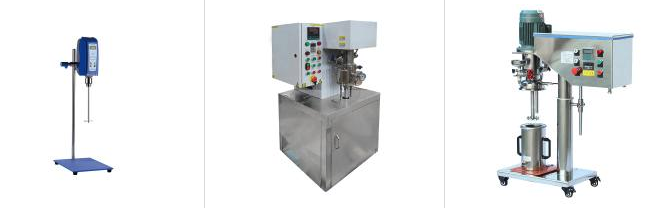
(1) Mixing equipment.
Mixing tanks are pre-mixing equipment for preparing pigment pastes. In the mixing tank, the pigments and fillers are fully wetted with water with the help of additives and become a slurry suitable for dispersion. The equipment needs to be equipped with a stirrer, and the stirring type is preferably a dispersing disc type, with low , medium, high speed, or infinitely variable speed, and the stirring speed range is 300~200o/min. The equipment with a volume of more than 1000 should be fixed and installed, which is relatively safe; the mixing tank with a volume of less than 1000 can be made into a movable tank, that is, rollers are installed at the bottom of the tank, which can be moved manually, which is more flexible.
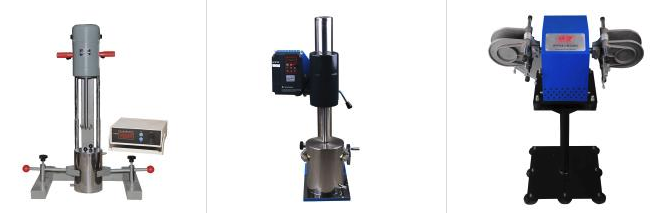
(2) Decentralized equipment.
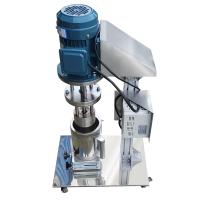
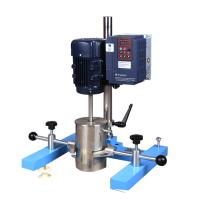
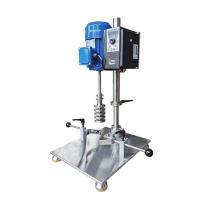
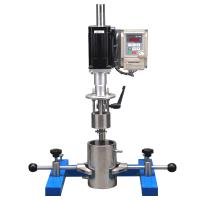
There are many types of pigment dispersing equipment, one of which can be selected arbitrarily according to the designer's wishes: high-speed dispersing machine, colloid mill, sand mill, three-roll machine and ball mill , etc. This is the place where the agglomerated pigments and fillers are reduced to primary particles ( primary particles provided by pigment and filler manufacturers) in the form of slurry, and it is an important equipment . According to the quality of the pigment slurry obtained in the production, according to the arrangement order of the above equipment, that is, the ball mill is the best, and in terms of production efficiency, the arrangement order of the above equipment is descending, that is, the high-speed disperser is the highest, and the ball mill is the lowest. Pigment dispersing equipment is all setting equipment, which can be purchased from paint machinery and equipment manufacturing factories.
(3) Paint mixing equipment.
The work of mixing pigment paste, emulsion and additives, and adding color paste (or paint) for color matching is done in the paint mixing tank. The size of the paint mixing tank is similar to that of the mixing tank, and the stirring device is similar to the two, but its volume should be larger than that of the mixing tank. Sometimes, the paint tank and the mixing tank are combined into the same equipment, which is the case when using high-speed dispersion process.
(4) Conveying equipment.
For small and medium-sized production lines, raw materials are generally transported , and rail-mounted cranes are used for up-and-down transportation. For large-scale factories with conditions , for liquid raw materials with a large amount of feeding, such as water, emulsion, thickener HEC pre-solution And pigment slurry, etc. are transported by pipeline. The power is the transfer pump. In addition to water and low-viscosity additives, Diaphragm Pumps can be used for delivery pumps. If there is no air source condition, an electric Diaphragm Pump can be selected; if there is an air source condition, a pneumatic Diaphragm Pump or an electric Diaphragm Pump can be selected arbitrarily. For pre-solutions such as pigment paste and thickener HEC, gear pumps and thick paste pumps (screw pumps) can also be selected.
(5) Filtration equipment.
After the latex paint is prepared, it should be filtered before packaging. Filtration equipment includes diffuse vibrating screen, bag filter (atmospheric pressure), or airtight pressurized bag filter, which can speed up the filtration speed. The filter screen is usually 80~150 mesh stainless steel or nylon, silk filter cloth.
(6) Meter.
Both the measurement of raw materials and the packaging of finished products require the use of electronic scales or scales . In addition, in professional large and medium-sized paint factories, automatic canning equipment , and water and liquid materials are measured by flow meters and other instruments during pipeline transportation.



- 1A Brief Discussion on the Difference between Disperser and Stirrer
- 2Several Common Coating Dispersers
- 3Inspection Contents of Chemical Plant Disperser
- 4The difference between Disperser ordinary and explosion-proof type
- 5Disperser stirring speed formula
- 6What's wrong with Disperser stirring?
- 7Main Structure of Vacuum Defoaming Disperser
- 8What oil is used in Latex paint Disperser?
- 9How to make a Disperser bucket holder?