Determination of livering time
1. Scope and Description
At the curing temperature of the powder coating, the entire gelation time, expressed in minutes or seconds. It is a simple method to evaluate the reactivity and curing reaction speed of powder coatings .
In general, short gelation time, fast curing, high reactivity, and poor appearance of the coating film, on the contrary, long gelation time, slow curing , if there is not enough baking time, the physical and mechanical properties of the coating film will be deteriorated. not good. This method is not applicable to powder coatings with a gelling time of less than 15s.
2. Apparatus and Materials
(1) The heating block is composed of an electric heating steel block of sufficient quality (to keep the temperature stable), that is, it should be able to make the selected temperature within the range of 130-230"C within 1"C, this temperature It should be able to be controlled with a thermostat. The heating block has a circular polished pit with a diameter of (16 ± 0.1) mm and a radius of curvature of (10 ± 0.1) mm, located at the center of the upper surface for placing the sample to be tested . The heating block should also have a hole of sufficient diameter to place the temperature Detector, which should be close to the center of one side of the heating block, extend below the upper surface horizontally to the center of the heating block, and its terminal should not exceed 2mm from the center of the pit. A suitable heating block is shown in Figure 4-6.
Note: The heating block needs to be thermally insulated. A 500W heating device can be used.
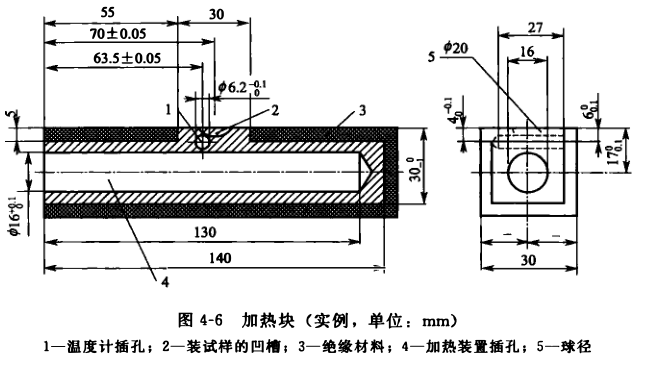
(2) The temperature Detector should have a sufficient measuring range, and the reading value should be accurate to 1°C.
(3) A measuring spoon with a capacity of (0.25 ± O.Ol) mL is used to transfer the sample to the well of the heating block.
(4) The timer is accurate to ls.
(5) The stirrer is of appropriate size, made of non-thermally conductive material, and one end is pointed.
(6) The scraper is made of a material softer than the heating block, and is used to remove the sample on the heating block without scratching its surface.
(7) Checking substance A test substance with a known melting point, used to check the temperature of the heating block. For checking the temperature of 180°C, D-camphor is a suitable material.
(8) Release agents such as polytetrafluoroethylene aerosol dispersions.
3. Measurement method
(1) Unless otherwise specified or otherwise agreed by the parties concerned, the test is to be carried out at (180±1)°C. Place the heating block at room temperature without ventilation, raise the heating block to the specified temperature and keep it stable for at least 10min. A check of the surface temperature of the heating block can be carried out by placing a small piece of the substance with the desired melting point on the Heating Plate. If necessary, treat the pits and the upper surface of the Heating Plate with a release agent according to the manufacturer's instructions .
(2) Use a measuring spoon to move 0.25mL of the sample to be tested to the pit of the heating block, start the timer stir the molten material with a stirrer in a small circular motion. When the material starts to thicken, while keeping stirring, raise the stirrer from the melt by about 10mm every 2-3s. If it rises, the wires formed will become brittle and break and can no longer be drawn into wires from the melt , stop timing and record the time, accurate to ls. This time is the gel time of the sample.
(3) Immediately scrape off the test sample from the heating block with a scraper, taking care not to scratch the surface of the heating block.
4. Results presentation
Re-sample and repeat the above measurement, if the difference between the two test results does not exceed 5% of the minimum value, then the arithmetic mean is the final test result, expressed in s, and accurate to 1s; if the difference between the two measurement results exceeds the minimum 5% of the value, a third measurement is required and the arithmetic mean of the three results is calculated.
5. Reference standards
National standard GB/T 16995-1997.

- 1Determination of thermal plasticity Resin melt flow rate
- 2Molecular weight and distribution characteristics of polyester resin in thermosetting powder coatings
- 3Density Determination Method and Application
- 4Determination method of cone-plate viscometer and its application
- 5Thermal plasticity polyvinyl chloride (PVC) powder coatings in highway engineering: technical requirements and inspection methods
- 6Determination of compatibility of powder coatings: methods, effects and applications
- 7Evaluation of flowability of powder coatings: key factors and significance
- 8Evaluation and Application of Optical Properties of Powder coatings
- 9Importance of powder coatings curing degree and detection method