From digital thermometers to infrared thermometers: temperature measurement selection guide
Digital thermometers are cheap and respond quickly. Infrared thermometers are excellent for measuring moving or extremely hot objects. However, among the many instruments available for testing and measuring temperature, these are just two possible choices. Features and prices vary from simple labels to complex thermal imagers. To ensure you get the functionality you need, review the options below.
labels and crayons
Used to measure surface temperature. Labels and crayons change color or darken to indicate temperature. Permanent record of maximum temperature using irreversible tags.
glass thermometer
Accurate, economical and reliable thermometer with a liquid fill (mercury or alcohol) in a graduated glass tube. As the temperature rises, the liquid rises. NIST traceable models are available.
Bimetallic thermometer
These economical thermometers require no power, just read the measurement from a dial. Thermometers contain a bimetallic element that moves the needle as the temperature changes.
Digital Thermometer
These indicators are compact, easy-to-use thermometers that display temperature. The probe is usually a stainless steel sheath with a thermistor or diode sensor.
Thermocouple table
The instrument amplifies, linearizes, and displays the millivolt signal produced by the two different leads of the thermocouple probe, which is proportional to the temperature gradient between the measuring and reference junctions. The probe is resistant to mechanical shock. Use the probe within 2000 feet of the instrument.
Thermistor meter
Thermistors have increased sensitivity and accuracy over the biological range of 32 to 212°F (0 to 100°C). The probe is wrapped around a ceramic element whose electrical resistance typically decreases with increasing temperature.
Platinum RTD Meter
These instruments have very good accuracy, stability and repeatability over a wide temperature range. The characteristic resistance of a probe increases with temperature. The three-wire probe reduces the effect of lead length resistance on the measurement, resulting in a more accurate indication of temperature.
Infrared Thermometer
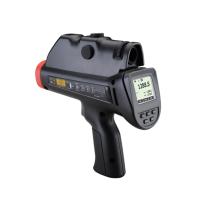
Provides a quick response to surface temperature and can provide clues to issues such as equipment failure, over-tightened motors, leaking plumbing systems, or food at risk of spoiling. These tools are ideal when objects are fast moving, difficult to reach, extremely hot or subject to contamination. Models are available for close and long distance measurements.
thermal imager
Infrared thermography, or thermal imaging, is a non-contact technology that measures infrared wavelengths to determine the temperature from a safe distance. Thermal imaging cameras display images using different colors to represent different temperatures. These images allow you to quickly and easily visualize surface temperatures and identify hot spots. Hot spots or elevated temperatures usually indicate a problem or impending failure.
Temperature Controller
Temperature controller types include on/off control and PID (proportional-integral-derivative) control. Choose from output types including SPST relay, SPDT relay, SSR, pulse output for SSR, and analog output.
probe
Includes handheld probes and industrial probes for thermocouple, RTD and thermistor instruments.
Recorders and Data Loggers
Use these instruments for temperature recording, data logging and data acquisition. Single or multiple input devices are available in portable or desktop versions.
calibrator
The instrument calibrates temperature devices, RTDs, thermocouples, transmitters, thermal switches, and more.