What is the difference between the geometry of a Spectrophotometer 45/0 and a sphere?
Have you ever heard someone say they measure color with a spherical or 45/0 Colorimeter or Spectrophotometer ? Did you know there are two types of geometry? what is the difference?
Two common geometry types used to measure pure colors (colors without metallic or other mica/pearl effect pigments) are 45/0 and spherical, which are very different instruments, each measuring color individually. 45/0 is an example of a specular exclusion (abb. SPEX) instrument, and a common type of sphere used for color matching is called "specular inclusion" (abb. SPIN). The difference has to do with whether the specular reflection (or glossy reflection) of the light source is collected during color measurement and used to calculate the color of the object. Sometimes this light needs to be collected, sometimes not. That doesn't mean one measure of gloss the other doesn't. Neither instrument can measure gloss alone as part of color measurement. To actually measure gloss, a separate gloss meter needs to be added to the design of the Spectrophotometer , making these types of devices true "2-in-1" instruments. The spectral guide is capable of measuring 60-degree gloss at the same time as measuring color. This means gloss actually matters for 45/0 (excluding specular), but not for spheres (including specular). Let's see what this means in a practical sense.
Imagine a customer has sent a panel, part or sample for you to match. We call it a standard. However, the standard is flat gloss, and customers want semi-gloss. The sphere instrument may help you match the standard, and you may come up with a formula that the sphere instrument says is a good match, however, the match and the standard are not what they appear to be visually. why is it like this? This is due to diffuse illumination in spherical instruments and light scattering on the surface of the flat glossy standard. If the client really wants the same pigmentation pack, and they also use spherical instruments, then this is a perfectly acceptable solution. However, if the customer really wants matches that look the same on the outside, the 45/0 instrument would be the better tool. Also, why is this? If you get a chance to look inside each instrument, you will see a big difference. The spherical instrument will appear bright, white and highly reflective. When the measurement button is pressed and the instrument's illumination is triggered, light will reflect off the surface of the highly reflective sphere and continue to reflect and reflect until the illumination source is turned off after the measurement. In a 45/0 instrument, the interior is dark, non-reflective, and all light from the illumination source is trapped or trapped.
This wall is painted maple in fall gloss. Then, place vertical masking tape to apply a semi-gloss sheer effect, creating a striped effect.
Data was collected for two parts, matte and semi-gloss, using the 45/0 and spherical instruments. Each instrument uses the matte streak as a standard and compares the glossy streak.
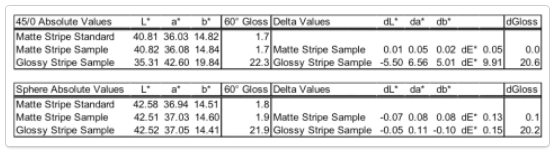
Glossy streaks (which are the case for every color) visually appear darker and richer than matte streaks. This effect produces two different colors. The sphere cannot "see" the difference the eye sees. Glossiness results can show significant differences when using specular contained spheres. A 45/0 Spectrophotometer sees color the same way the eye does, where gloss and texture are factors that affect our perception of color.
So, which results are correct and which are wrong? Of course, this depends on the project goals. If a client is asking for a visual color match, and the gloss stripe needs to look the same as the matte, then 45/0 would be a great tool. The question "Do they match?" depends on the opinion of the viewer or customer. In the case above, the client would say no, they don't match visually, but that's the purpose of the project.
Also keep in mind that some sphere instruments have a "Specular Exclusion" setting, the purpose of which is to simulate 45/0 geometry by "trapping" and excluding glossiness entirely. However, this trick only works for high-gloss smooth sample matches. In other cases, Glossy Trap captures only a portion of glossy reflections. On very rough or textured samples, the "Specular Exclude" ball ends up producing results somewhere between what the eye sees (45/0) and the "Specular Include" ball. If the customer wishes to obtain different gloss results, or requires texture matching, only instruments with 45/0 specular exclusion will work due to light scattering on rough and textured surfaces. The safe solution is to measure with a 45/0 when the visual color is green as seen by the eye and need to match, and when you need tint color matching or color independent of gloss, measure with a spherical mirror.


- 1Application of Flame Atomic Absorption Spectrophotometry in Detection of Food Talc Powder
- 2Talking about the performance test of epoxy resin film coated on PET
- 3Spectrophotometer principle, structure and application do you know geometry?
- 4Principle, characteristics and application of ultraviolet Spectrophotometer
- 5Spectrophotometer Color Measurement Fundamentals
- 6Differences between visible, ultraviolet-visible, infrared, fluorescent and atomic absorption Spectrophotometer s
- 7Detection of nicotine content by Spectrophotometer
- 8How to detect the color difference of fluorescent color-changing materials?
- 9Liquid color difference detection solution
-
![YueFeng 752N Ultraviolet-visible Spectrophotometer]()
-
![YueFeng 721 Single beam of light Visible Spectrophotometer Test Transmittance/Absorbance]()
-
![JINGHUA H300 Dual beam of light Spectrophotometer Wavelength range 190nm-1100nm]()
-
![HUXI Nano-900 UV-Visible, ultra-micro Spectrophotometer Light spectrum instrument]()
-
![JINGHUA JH752 Benchtop UV-Visible Spectrophotometer Bandwidth 4nm]()
-
![YUEFENG FP6428 Flame photometer Na/Ca]() YUEFENG FP6428 Flame photometer Na/Ca$ 1450.00
YUEFENG FP6428 Flame photometer Na/Ca$ 1450.00