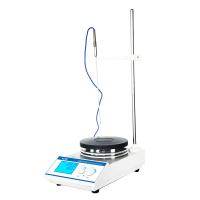
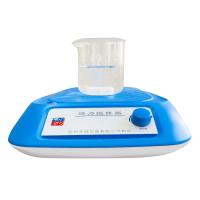
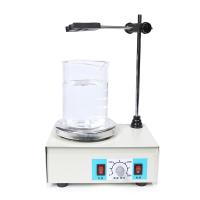
How to choose a stirring rod for a magnetic stirrer?
Using a magnetic stirrer requires little setup and is a convenient option, especially when low viscosity fluid mixing is involved. Although the setup is simple, you do have a few decisions to make, one decision being which stir stick (also known as a stir flea) to use. They come in all sizes, shapes, and materials, and there are actually so many options to consider.
What shape stir bar should you use?
The table below describes various stir bar shapes, each suitable for different applications.
round | 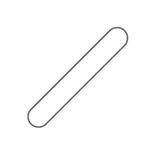 | This is a common stir bar used in a variety of applications and is often used in flat-bottomed containers. |
slide | 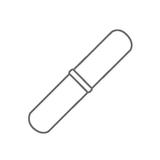 | These have a pivot around the center. They are designed to hold up well in containers with curved or uneven bottoms. The ring helps reduce vibration and wear, and reduces the effects of friction from contact with the container. |
ball (spherical) | 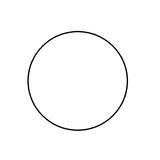 | These are typically used in small volume containers such as tubes and vials. |
oval (oval) | 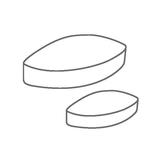 | Oval or oval stir bars are excellent for ensuring uniform mixing in round bottom beakers. |
cross | 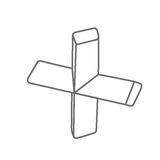 | This type is very useful for high-speed stable stirring. The cross shape results in additional turbulence for better mixing. The rod is located at the bottom of the container, so it can also be used to stir the sediment. |
crown (crosshead) | 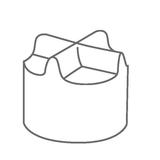 | The crown stir bar is ideal for use in cuvettes or test tubes. They can also be used in other containers, so if you need to switch between the two types, this might be a good choice. |
bone | 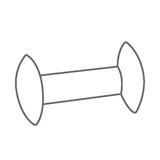 | The unique shape of these rods allows them to create a lot of turbulence at low speeds. They are an excellent choice for vaulted bottom containers and offer great stability. |
triangle (prismatic) | 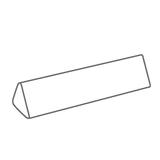 | These rods provide a lot of turbulence even at low speeds. The shape means they act as scrapers so are great for dissolving or preventing settling. |
What size stir bar is good?
When selecting the appropriate size strip for your application, consider the following key factors:
Amount of liquid to stir
For smaller volumes and containers, the guide bar needs to be small enough that it does not hit the side of the container when it is rotated. For larger volumes, you will need to use a larger stir bar. This results in more movement and improves mixing efficiency.
Container shape and opening size
The shape of the container and the size of the opening may affect the size of the stir bar you choose. For example, with a round bottom flask, even though the container's widest diameter is relatively large, a smaller stem is required to ensure that the sides near the bottom of the flask do not get stuck.
Some containers may have small openings that prevent the required rod from being installed. Considering the small size of most rebar, this is rare, but if it does occur, a size reduction may be required.
Dimensions of the internal drive magnet
The size of the magnet inside the stirrer (which can be referred to as the drive magnet) is very important when choosing a stir bar size. The length of the rod should be approximately equal to the size of the magnet to avoid rotation. Spinning occurs when the rod loses its connection with the stirrer's internal magnets and the rod stops spinning completely.
The stir bar is significantly longer than the built-in magnet, which may reduce the maximum speed at which the stir bar spins. This increases resistance without providing proportionally stronger magnetic coupling.
Some manufacturer's specifications will tell you the maximum recommended length of a stir bar for use with a magnetic stirrer.
What material should the stirring rod be?
A stir bar consists of two main components, the actual magnet and the coating. Both materials may be different.
magnetic components
Magnetic components are usually made of ALCINO, an alloy of aluminum (Al), nickel (Ni) and cobalt (Co), suitable for most applications. There are stir bars that use sa cobalt, which creates a stronger coupling to the stirrer's internal magnet and reduces the chance of the stir bar spinning. These rods provide increased torque and can be used in applications with larger volumes or high viscosity liquids.
coating
Stir bars are usually coated with PTFE, which can withstand high temperatures and are usually chemically inert. For very high temperature applications and where PTFE is not chemically compatible, glass coatings are available as an option. These are also suitable for highly abrasive materials.
Tips for Using a Stirrer
Once you've chosen the right column, here are some tips to ensure you get great results.
For a good coupling, choose a container with a thinner bottom to better reduce the distance between the guide plate and the drive magnet.
Place the container in the middle of the stirrer plate and place the stir bar in the center of the container. This will help with the connection and keep the stir stick from getting stuck on the side of the container.
Slowly increase stirring speed to avoid swirling.



- 1Comparison and Application of Magnetic Stirring and Mechanical Stirring
- 2Application and Selection Guide of Electromagnetic Stirrer in Laboratory
- 3Describe 4 Common Stirrers in detail
- 4Principle and Application of Water Bath Magnetic Stirrer
- 5What is a mixer? Applications, advantages and disadvantages of mixers
- 6How to prepare polymer blended solid film materials?
- 7Agitators and their classification
裴梦琛 - 《西北大学》
- 8Testing Factors Affecting the Drying Properties of Plastic Water-based Gravure Ink with Agitator
- 9What are the characteristics of an overhead mixer?
-
![DaDi 85-2 digital temperature control magneticstirrer]()
-
![HUXI HMS-203D magneticstirrer]() HUXI HMS-203D magneticstirrer$ 251.00
HUXI HMS-203D magneticstirrer$ 251.00 -
![Qiwei CL-R magneticstirrer 1000ml]() Qiwei CL-R magneticstirrer 1000ml$ 103.00
Qiwei CL-R magneticstirrer 1000ml$ 103.00 -
![DADI CJJ78-1 Magnetic Stirrer]() DADI CJJ78-1 Magnetic Stirrer$ 101.00
DADI CJJ78-1 Magnetic Stirrer$ 101.00 -
![RONGHUA HJ-6 Six Head Magnetic Heating Stirrer]()
-
![RONGHUA Instrument 99-1A Dual digital display high power thermostatic magnetic heating Stirrer]()