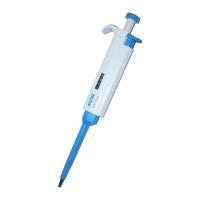
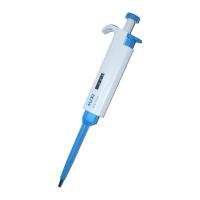
How to use a micropipette for liquid handling?
Liquid handling is one of the widely used techniques in biological laboratories. The importance of precision and ease of use in liquid handling cannot be overemphasized in routine laboratory operations. While it's relatively easy to handle large volumes of liquid (like liters) using graduated cylinders, beakers, etc., handling small amounts becomes tricky and often tedious. Several sensitive techniques, such as PCR, ELISA, etc., require precise handling of tiny liquid volumes, such as a few microliters. This is where micropipettes come in.
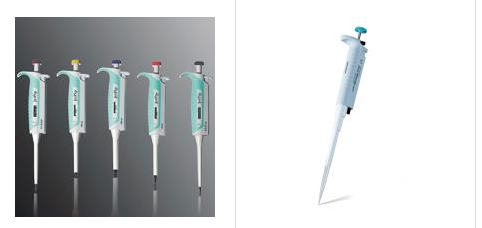
The invention of the micropipette made routine liquid handling in the laboratory simple and convenient, while maintaining the precision and accuracy required by standard protocols.
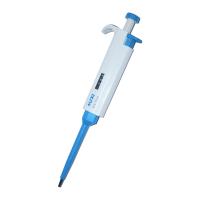
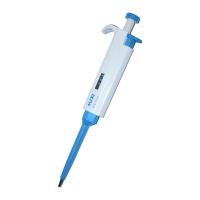
The microvolume is typically constructed with a plastic body to which a disposable plastic microtip can be attached. Disposable plastic tips prevent cross-contamination. Essentially, a modern micropipette, known as a piston-stroke pipette, consists of a plunger button attached to a plunger rod that the user uses to measure the amount of liquid being drawn. The plunger rod extends to the shaft and tip ejector. These accessories, together with the tip eject button, allow the use of disposable plastic microtips. Piston stroke pipettes work on one of the following principles - air cushion principle or positive displacement principle. In micropipettes that work on the air-cushion principle, an air support is created between the piston and the liquid aspirated in the liquid handling chamber. Manipulation of the air mount using a piston allows fluid to be aspirated or expelled from the microtip. In micropipettes using the positive displacement principle, special tips are used. These tips have their own plunger and work like a syringe. The user can control the plunger on the tip with the aid of the plunger of the micropipette.
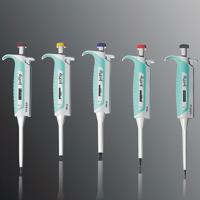
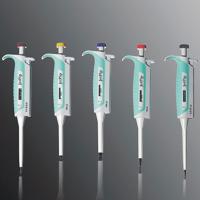
There are a wide variety of pipettes, all designed to meet specific laboratory needs. Micropipettes can be of the fixed volume type, in which only a certain volume of liquid can be aspirated or dispensed. Alternatively, it can be a variable volume type that can handle a range of liquid volumes, such as 0.2 to 20 microliters or 100 to 1000 microliters, etc. Another widely used category is the multichannel micropipette. These micropipettes are very convenient in experiments that use microplates and require multiple replicates of the same experiment. Electronic micropipettes are very commonly used due to their ease of use and greater precision due to the elimination of human error. Some other micropipettes include standard and locking micropipettes and volumetric handling micropipettes.
To ensure accurate volume handling and the longevity of the instrument, pipettes require regular calibration. Users need to be made aware of the standard operating procedures involved in using micropipettes to avoid human error.
- 1How should I store the correct micropipette?
- 2Pipette Tips - Technique and Pipette Maintenance
- 3Four ways to use an electronic pipette
- 4How to store micropipettes properly?
- 5Structure, principle, usage and calibration maintenance of micropipette
- 6Pipette uses common sense - Dlab
- 7Pipette uses little common sense