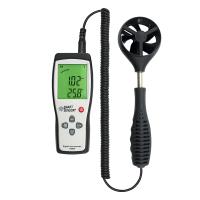
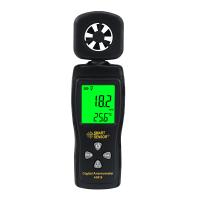
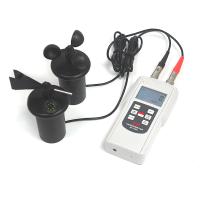
Share several different types of anemometers
Hen you hear weather forecasts and warnings of how fast the wind is going to hit, have you ever stopped to think about how they measure it? Wind isn't something that's easy to see, so it's hard to time a stopwatch like it's measuring the speed of an Olympic sprinter or race car! Luckily, scientists are pretty creative people, and they've come up with some pretty clever ways to measure wind speed using a small tool called an anemometer. Let's take a closer look at how they work!
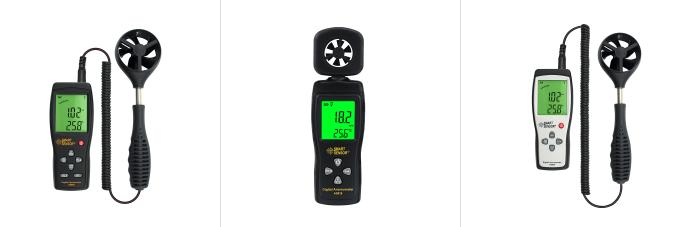
Thoughts on Anemometers
Wind turbines are considered unsafe by some because high winds and storms can cause them to spin dangerously fast. Not really: all large wind turbines have brakes that stop them from spinning if the wind blows too hard (they also have anemometers built in to measure speed). But it is true that the stronger the wind, the faster the wind turbines turn and generate more electricity. There, you can learn how a basic anemometer works.
Let's say you built yourself a tiny desktop wind turbine and hooked it up to a generator (actually, the motor is wired backwards so it generates current as it spins its central shaft). The faster the rotor blades spin, the faster the generator spins and the more current it will produce. So if you measure current, you have a basic way of measuring wind speed. You need to calibrate an instrument like this before using it, of course. In other words, you need to know how much current is produced by several winds of known speed. This will help you figure out the mathematical relationship between wind speed and current, so you can figure out the unknown wind speed by simply measuring the current.
mechanical anemometer
Some simple anemometers work exactly this way. They are nothing more than a generator housed in a sealed metal cylinder from which the shaft of the generator protrudes upwards. On top of the axle, there are several large cups that keep the wind out and allow the generator to spin. A propeller anemometer works in much the same way. Like micro wind turbines, they use small propellers to power generators instead of spinning cups. Some anemometers have cups or propellers that look like small fans. As the wind blows, it spins the fan blades and a tiny generator attached to them, which works similarly to a bicycle dynamo. The generator is connected to an electronic circuit that provides an instant readout of wind speed on a digital display.
Some cup anemometers do not use a generator, but instead count how many times the cup or fan blades rotate per second. In a typical design, some fan blades have tiny magnets mounted to them, and with each revolution they pass over a magnetic Detector called a reed switch. When a magnet is near, the reed switch closes and produces a brief pulse of current, then opens again when the magnet is gone. This anemometer effectively generates a series of electrical pulses proportional to wind speed. Calculate how often the pulses come in, and you can then calculate the wind speed.
Ultrasonic Anemometer
As you probably know, sound travels by moving air molecules back and forth. Obviously, wind speed affects how fast sound travels. If you were to yell at a friend who is standing up against you, their voices would be heard a little earlier than if there was no wind. Likewise, if they shout, you'll hear them later - because the sound waves they create need to fight the wind to reach you. The same idea is cleverly used in ultrasonic anemometers, which measure wind speed using high-frequency sound (usually in the range that humans can hear).
Ultrasonic anemometers have two or three pairs of sound transmitters and receivers mounted perpendicular to each other. Standing in the wind, each transmitter continuously emits a high-frequency sound to its respective receiver. Electronic circuitry inside measures the time it takes for sound to travel from each transmitter to the corresponding receiver. Depending on how the wind is blowing, it affects some beams more than others, slowing them down or speeding them up very quickly. Circuitry measures the difference in beam speed and uses that to calculate the wind speed.
Laser Interferometer Anemometer
You can use a beam of light instead of ultrasound for a similar but more accurate measurement. The basic principle is called interferometry, and it can be used to measure a variety of different things with incredible precision. How does it work? Shoot the laser beam, then split it in half using a half-silvered mirror (the mirror is partially silvered so it lets half the light through, and reflects the rest away). You keep one part of the beam intact (let's call it the reference beam) and let the other part of the beam (called the measurement beam) be affected by the object you want to measure. Whatever it is, slightly changes the phase (mode of vibration) of the light waves in the measurement beam, but does not affect the light waves in the reference beam (which travel along separate paths). You have now recombined the two laser beams. The measurement beam will be slightly out of sync with the reference beam, creating strange patterns of light where they meet and overlap, a set of interference fringes. By measuring the spacing of the fringes, the effect on the measuring beam can be calculated.
When measuring air velocity, you simply pass the measuring beam through the chamber in which the air is moving. For example, you could fire it through part of a wind tunnel, or through a duct where airflow is being studied. Of course, you'll need to calibrate your setup first so you can understand the relationship between wind speed and the changes you observe in the interference fringes. Once this is done, you can use a laser anemometer to measure the velocity of any unknown airflow.
Doppler Laser Anemometer
Given its high precision nature, you will use laser interferometers to make very accurate measurements in the lab. But some laser anemometers are robust enough for wider use outdoors. They fire one or more safe infrared laser beams directly into the air (used as a reference beam) and detect beams that bounce back from dust particles, water droplets, etc. (i.e. measuring beams). The movement of the wind causes the surrounding airborne particles to vibrate, so the frequency of the measurement beam changes slightly compared to the reference beam. The change in frequency is called a Doppler shift. It's like the way a fire truck siren changes pitch from a high pitch to a low pitch as you zip along. By measuring the frequency shift, you can accurately measure the velocity (in this case wind speed) that caused it.
Hot Wire Anemometer
How many other ways of measuring wind could there be? Surprisingly, there are many. If you're familiar with the concept of wind chill, you know that wind cools things in a very predictable way, making them cooler. Therefore, measuring the amount of cooling that wind produces on an object at a certain temperature is an indirect way to calculate wind speed. Essentially, this is how a hot wire anemometer works. It uses electrically heated wires (similar to the filaments or thin heating elements in old-fashioned light bulbs) that the wind blows through. As the wire cools, its resistance changes; measurements can be taken (using an electrical circuit called a Wheatstone bridge) to work out the amount of cooling and wind speed. Hot wire anemometers are particularly useful for measuring turbulent flow and are widely used in engineering to measure fluid flow in jet engines.
- 1How does an anemometer measure wind speed?
- 2Frequently Asked Questions in Light Resistance Testing ISO 105 B02 and AATCC 16
-
![SMART SENSOR SMART SENSOR AS856 Anemometer]()
-
![SMART SENSOR AS836 split anemometer]()
-
![SMART SENSOR AS816 Anemometer (Mini)]()
-
![AMITTARI AA-136C Three Cup Anemometer]()
-
![AMITTARI AA-136V impeller anemometer]() AMITTARI AA-136V impeller anemometer$ 167.00
AMITTARI AA-136V impeller anemometer$ 167.00