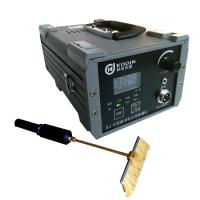
Application of EDM Leak Detector on Coated Steel and Concrete Substrates
There are two main types of porosity Detectors: low pressure (sponge) Testers and high pressure (JEEP) Testers. According to nearly all coating standards, you can use a low pressure Tester to test coatings up to 20 mils (500 µm) thick. If it's thicker than that, go to a high voltage Tester. A high-voltage Tester can be used down to 10 mils, but if a low-voltage Tester is available, I generally don't recommend it.

Using a Low Pressure (Sponge) Tester
Sponge Testers are relatively simple to use. Ground them, then spread a damp sponge (wet but not dripping) over the surface. Although paint standards limit the use of sponge Testers to 20 mils, I have run the sponge Tester and high pressure Tester side by side on 50 mil paint and found the same leak.
On thicker coats (10 to 20 mils), use a surfactant or wetting agent to ensure that water does not "close up" the leak due to surface tension .
Here's another trick that isn't in any of the standards I 've used when leak testing small areas, such as inside valves: Grab the sponge Tester with one hand and use a damp finger with the other to find any pinholes. On some models, you might get some shock, but you're the inspector, so live with that. NOTE: This trick only works with low voltage Testers.
With battery-operated Detectors, sponge Testers typically cost between $375 and $450. The ASTM standard calls for 67.5 volts. The ISO standard uses either 9 volts or 90 volts. Several low-voltage Testers on the market have user-selectable voltages that meet all three.
Hipot Testers typically cost between $2,800 and $5,000, and features can vary widely. Better to work with someone experienced at the time of purchase to make sure you get the model and features you want. Most high voltage Testers top out at 35,000 to 40,000 volts, but 90 percent of users rarely need more than 10,000 volts. (See How to Choose a Good Value Monitoring Tool for more information on tool selection).
Choosing a High Voltage Tester
There are two types of high voltage leak Testers: DC and pulse.
Direct DC is usually less expensive and works well on dry paint. Because a DC Tester runs a constant current through the coating surface, it can apply a current into the coating that is fed back to the probe rod, thereby detecting "false" defects. These meters have a sensitivity knob to adjust the mA setting that will trigger the meter to beep. For most paints, the default settings are generally suitable. However, if you hear a "beep" (or "jeep" sound) from the gauges and no spark, you may need to change the setting.
Pulse type meters are more versatile and can be used in wet environments even if moisture condenses on the coating. Electrical pulses are generated between 20 and 60 cps. Each electrical pulse is "on" for a period of 20 to 200 microseconds. They do not require a sensitivity knob. While pulse-type gauges have the advantage of being able to work in wet conditions, both gauges require proper training to work in most cases.
Tips for Testing Coated Concrete
It is usually simple to use high voltage Detectors on steel or conductive substrates. If you're testing for leaks on concrete paint , it can be a little tricky.
I don't have any experience in very dry, desert environments, but usually enough moisture and salt are present in concrete to make it conductive. When testing pipelines, inspectors sometimes just drag a grounding cable to the surface because both soil and concrete can conduct electricity. But proper grounding is always good.
In order to create a proper foundation for porosity -tested concrete, I generally recommend the following steps:
If possible, ground the Detector to the rebar into the concrete.
If rebar is not available, the steel is usually bolted directly to the concrete. You can ground the Detector to bare steel.
If testing a slab without rebar, drive a piece of rebar into the ground at least to the depth of the slab and abut the slab. It helps if you're sure the soil is wet. Use this as a basis.
Another method of grounding is to lay a 2"x2" plain metal window screen flat on the concrete surface. Place wet sandbags over the entire metal surface, then connect the ground wire to the shield. A wet bag placed over the shielded wire ensures tight contact between the shielded wire and the concrete surface. This method of grounding is usually sufficient for low voltage "wet sponge" Testers or high voltage "spark-type" porosity Detectors.
Check the Detector's electrical grounding by touching the brush to the bare concrete substrate and watch for an audible signal. No audible signal means insufficient grounding, need to get a better ground or increase signal sensitivity.
As with metal, follow the specs first. Next, go to Product Data and Application Bulletins; then to Paint Manufacturers.
If you still don't have a voltage setting, don't use the setting suggested for steel. A good method is to find several areas at different distances from the ground that represent the coating to be tested. A pore is formed and the voltage required to generate the spark is determined, which is twice the thickness of the entire coating.
For example, if the coating is 100 mils thick, the spark should "jump" 200 mils across the surface and then down to the substrate. If the resistance increases with distance from ground, you need to increase the test voltage, or better yet move the ground point.
Some concrete paint manufacturers are now making conductive primers. By using one of these primers, you can follow the steps to porosity test metal substrates. However, since they are much more expensive than standard primers, they are rarely used unless the importance of the leave-free finish is beyond description.
- 1Holiday Detector Coating thickness and reference voltage comparison table
- 2Method for testing the impact resistance of anti-corrosion coatings by coating impact testing machine
- 3How to detect the leakage of the anti-corrosion layer?
- 4Test principle of electric spark leak Detector
- 5Pinhole and Pore Detection: Spots in Armor
- 6How does Holiday Detector work in coating leak detection control?