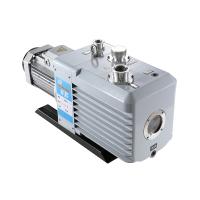
How to choose the right Vacuum Pump for a rotary evaporator?
Using a pump to apply a vacuum is both helpful and necessary in most rotary evaporator applications, as it reduces the pressure within the system. This lowers the boiling temperature of the solvent, resulting in faster evaporation and safer rotary evaporator operation.
When composing a rotary evaporator unit, not just any pump will do the job. You might even come across rotovap packages that come with a pump, but we've discussed at length why these bundles are generally not a good idea (mainly because you end up paying more than you need).
In rotary evaporator applications, often the goal is to get production as fast as possible. When it comes to pumps, there is often a "bigger is better" mentality, where the assumption is that the higher the flow rate, the faster the production rate. However, this can lead to problems such as pump damage and inefficiency. Also, there are other factors to consider, not just flow rate.
In this article, we examine the potential implications of using the wrong pump for a given application and the factors to consider when selecting a pump.
Potential consequences of using the wrong pump
Inappropriate pumps have some major negative effects:
damaged pump
Security risks
solvent loss
inefficient process
Let's look at it in more detail.
1. Damage to the pump
Not allowing liquid to pass through the pump is a big no-no. This can happen if the flow rate is too high or if the cooler does not have enough cooling capacity. In either case, if the solvent doesn't have a chance to condense in the condenser, it will go to the Vacuum Pump. At the very least, this will cause excessive wear and tear on the pump, which will greatly reduce the service life of the pump. It could even flood the pump, causing irreparable damage.
2. Security risks
In some cases, pump overflow can cause solvent to spray out the back of the pump. This could pose a fire safety hazard (for example, if your solvent is ethanol) or a health risk (for example, when using corrosive or carcinogenic solvents).
3. Solvent loss
In the rotary evaporator process, you can usually recover solvents of fairly high purity and reuse them. If your solvent does not have time to condense into the collection bottle, your solvent recovery will be reduced. Solvent that has entered the pump cannot be recovered.
4. Inefficient process
So far we have discussed the impact on your application of using a pump with too high a flow rate. However, there is also a major downside to using an underpowered pump: you end up with a slow, inefficient process.
Factors to Consider When Buying a Water Pump
We've discussed the potential downsides of using the wrong pump, so what factors should influence your decision? Answering the following questions will help you choose the right pump:
How much vacuum pressure do you need?
The solvent you are using and its corresponding boiling point will be the main determining factor in determining the vacuum pressure you need.
Depending on the boiling point of the solvent and the temperature you want to set the bath at, you may need more or less vacuum.
For example, your bath will require a higher vacuum at 30°C than at 40°C for a given solvent. A solvent with a boiling point of 60°C requires a higher vacuum than a solvent with a boiling point of 50°C for a given bath temperature.
What pump speed do you need?
Pump speed (which affects flow rate (also known as evacuation rate or clearance)) is also a major concern. As mentioned earlier, speeds that are too high for a given application can cause damage to the pump as well as other issues such as safety hazards and product carryover. In practical terms aside, pumps with higher flow rates tend to be more expensive, and you'll undoubtedly want to avoid paying more than you need.
Flask size is an important determinant of required pump speed. The larger the flask, the greater the air displacement required and the greater the flow required. For example, a flow rate of 50 L/min may be suitable for a 20 L flask, while a flow rate of 70 L/min may be more suitable for a 50 L flask. Also keep in mind that not all pumps are created equal. Due to pump curves and design factors, a pump speed that is sufficient for one pump may not be suitable for another pump.
If you already own a pump and are wondering if you can use it for your application, there are two things to consider when it comes to pump speed. Setting a lower pumping speed (and therefore, a lower flow rate) will allow the solvent vapors to dwell longer in the condenser. However, many pumps are fixed speed, so this is not an option.
If your pump is oversized for the application, there is another option. You can reduce the pump flow by adding a long length of vacuum hose between the condenser and the pump. The inside diameter of the hose should be smaller than the inside diameter of the existing hose. The additional airflow resistance will slow down the rate at which air can exit the system. Of course, there will be some trial and error in finding the right length of hose that will keep the pump from overfilling but won't slow down the process too much.
pump curve
When considering flow, you also need to consider the pressure at which the pump will be used. When the pump is running at or near its minimum pressure, the flow will decrease. For example, take the VP18R Vacuum Pump model as an example, which has a flow rate of 18 L/min and a minimum pressure of 20 mbar. When approaching minimum pressure, the pump will not be able to vent at 18 L/min.
Are your solvents compatible with pump materials?
As solvent vapor flows through the pump, it is important that the pump material is compatible with that solvent. Ideally, pumps used in rotavapor installations should be oil-free and chemically resistant to ensure they last as long as possible. A commonly used pump for this purpose is a Diaphragm Pump (or Diaphragm Pump).
What are your vacuum control preferences?
For many rotavapor applications, vacuum levels need to be controlled to create a safer, more efficient setup. By controlling the vacuum level, you can precisely regulate the pressure in the system to achieve the desired evaporation rate. This level of control also helps you avoid collisions and foaming, and gives you better solvent-product separations.
Some rotary evaporators have built-in vacuum controllers, in which case you may not need a pump with its own controller. If you do need a pump with a controller, you can choose from analog and digital controllers, the latter usually being more expensive.
- 1Types of Vacuum Pumps
- 2How to choose a suitable rotary evaporator for distillation and purification experiments?
- 3How to protect samples when using a rotary evaporator?
- 4How to choose a rotary evaporation Vacuum Pump?
- 5What is the composition system of the rotary evaporator?
- 6Why can't a rotary evaporator maintain a vacuum and how to deal with it?
- 7Why is rotary evaporation more efficient than standard distillation?
- 8How does a rotary evaporator work?
- 9How do I decide whether to use a fume hood on a rotary evaporator?
-
![HUXI HR-21A Rotary evaporator 22ml/min]() HUXI HR-21A Rotary evaporator 22ml/min$ 1293.00
HUXI HR-21A Rotary evaporator 22ml/min$ 1293.00 -
![HUXI HR-21M Rotary evaporator 22ml/min]() HUXI HR-21M Rotary evaporator 22ml/min$ 1042.00
HUXI HR-21M Rotary evaporator 22ml/min$ 1042.00 -
![RONGHUA 2XZ-25B DC Rotary Vane Vacuumpump 25L/S]()
-
![YIHENG BRE-50 Rotary evaporator volume 50L]()
-
![YIHENG BRE-20 Rotary evaporator volume 20L]()
-
![YIHENG BRE-10 Rotary evaporator volume 10L]()