How does a rotary evaporator work?
How does a rotary evaporator work?
A rotary evaporator is a type of evaporator that is widely used in chemical laboratories. It is suitable for reflux operation, rapid evaporation of a large amount of solvents, concentration of trace components and reaction processes that require stirring, especially for continuous distillation of a large amount of volatile solvents under reduced pressure.
Rotary evaporator, also known as rotary evaporator, is mainly a common laboratory equipment, including: motor, distillation bottle, heating pot, condenser tube, etc.
1. Evaporating flasks are eggplant-shaped or round-bottomed flasks with standard ground connections. The return coil condenser tubing is connected to a pressure reducing pump.
2. There is a three-way piston between the condenser tube and the decompression pump. The evaporating flask can be removed when the system is connected to atmosphere. Also, the solvent will be transferred. When the system is connected to the pressure reducing pump, the system should be under reduced pressure.
3. During the working process, the pressure should be reduced first, and then the motor should be turned to rotate the evaporating bottle. Finally, the machine should be stopped and ventilated to prevent the distillation bottle from falling during rotation.
As a heat source for evaporation, a constant temperature Water Tank should always be provided. Electronically controlled, the flask rotates at a constant speed at a suitable speed to increase the evaporation area. The evaporation flask was brought to a negative pressure state by a Vacuum Pump.
In a nutshell, the principle of a rotary evaporator is that the electronically controlled retort rotates at a constant speed at a good rate to increase the evaporation area. At the same time, the evaporating flask is placed in a negative pressure state through a Vacuum Pump. The evaporating flask is heated in a Water Bath and rotated at a constant temperature, and then the solution in the bottle is evaporated by thermal diffusion under negative pressure in the rotating flask, and the evaporation system can be sealed to a pressure of 400 to 600 mm Hg; Distilling flask The solvent in can be heated to the boiling point of the solvent by a heating bath. And can be rotated at a speed of 50 to 160rpm to form a solvent film. Increase the evaporation area. In addition, hot vapors can be quickly liquefied by efficient coolers to speed up evaporation. The above is the introduction of the working principle of the rotary evaporator.
What is the structure of a rotary evaporator?
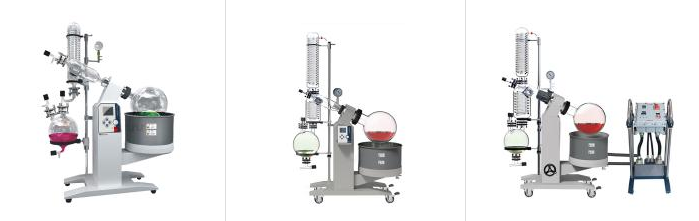
Now that we have explained the working principle of the rotary evaporator, let's take a look at its structure, which is mainly composed of six parts: condensation tube, collection bottle, evaporation tube, rotary motor, vacuum system and tub. The condensing tube uses double serpentine tubes to condense, and condensing agents (such as dry ice and acetone) are added to condense the sample; the collection bottle effectively recovers the condensed sample, and the sample is cooled and collected through the collection bottle. The evaporating tube is firstly used as a sample rotation support shaft, and secondly the sample is sucked out by the evaporating tube vacuum system. The rotary motor drives the evaporating flask containing the sample through the rotation of the motor. The vacuum system is used to reduce the pressure of the rotary evaporator system;
- 1How to choose a suitable rotary evaporator for distillation and purification experiments?
- 2How to protect samples when using a rotary evaporator?
- 3How to choose a rotary evaporation Vacuum Pump?
- 4What is the composition system of the rotary evaporator?
- 5Why can't a rotary evaporator maintain a vacuum and how to deal with it?
- 6Why is rotary evaporation more efficient than standard distillation?
- 7How do I decide whether to use a fume hood on a rotary evaporator?
- 8How to clean the rotary evaporator?
- 9How to speed up the rotary evaporation process of the rotary evaporator?
-
![HUXI HR-21A Rotary evaporator 22ml/min]() HUXI HR-21A Rotary evaporator 22ml/min$ 1293.00
HUXI HR-21A Rotary evaporator 22ml/min$ 1293.00 -
![HUXI HR-21M Rotary evaporator 22ml/min]() HUXI HR-21M Rotary evaporator 22ml/min$ 1042.00
HUXI HR-21M Rotary evaporator 22ml/min$ 1042.00 -
![YIHENG BRE-50 Rotary evaporator volume 50L]()
-
![YIHENG BRE-20 Rotary evaporator volume 20L]()
-
![YIHENG BRE-10 Rotary evaporator volume 10L]()
-
![YIHENG BRE-05 Rotary evaporator volume 5L]()


