What is the composition system of the rotary evaporator?
If you do not have extensive experience with a rotary evaporator, you may not be familiar with the overall setup and the role each part plays in the application of the equipment. A rotary evaporator is a fairly complex piece of equipment in itself, and additional items are required to ensure proper functioning.
The main purpose of the rotary evaporator is to increase the evaporation rate of the solvent. It does this in three ways:
The vacuum lowers the pressure in the system, lowering the boiling temperature of the solvent.
Spinning increases the surface area of the solvent.
The solvent was heated in a Water Bath.
To work efficiently, a rotary evaporator system typically includes the following major components:
Rotary evaporator and glassware
Chiller or other coolant source
Vacuum Pump
Vacuum Controller or Regulator
tubing connecting parts
In this article, we'll break down this complex device into its individual components and explain the role each component plays in the overall setup.
Rotary evaporator and glassware
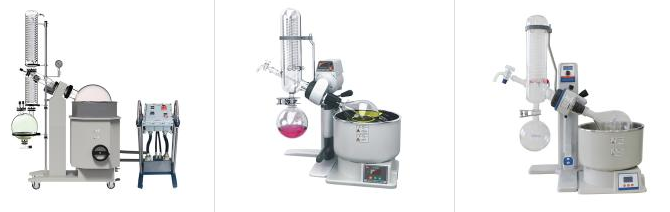
First, let's look at the main piece of equipment, the rotary evaporator itself. We will also discuss glassware in this section, as it is often included when purchasing a rotary evaporator.
For Water Baths, you can choose between uncoated stainless steel or PTFE-coated stainless steel. The latter are designed to increase durability and reduce corrosion.
As mentioned above, glassware is also usually included. Typically, you get an evaporating flask, a condenser, and a collecting flask. When shopping for a system, you may want to choose the type of glassware that comes bundled with your rotary evaporator.
Condenser: You can usually choose between vertical and diagonal condensers.
Collection Bottles: You can choose between standard or safety-coated glassware.
Chiller or other source of coolant
The condenser section of the rotary evaporator is used to cool the evaporated solvent and transfer it to a collection bottle.
Certain applications, such as when using low boiling point solvents, require the use of dry ice condensers. Some people only use dry ice condensers because it's more convenient - if they have a source of dry ice, they don't need a cooler. However, if you are not using a dry ice condenser, you will need to supply coolant to the condenser. Typically, the coolant is provided by a cooler, some examples are shown below.
This cools the liquid (coolant), such as water, and provides a circulating supply of this liquid to the condenser. This means that there is always coolant flowing through the condenser, ready to condense evaporated solvent.
When choosing a cooler, an important factor to consider is its cooling capacity. If this is lower than your rotavap's ability to heat at the desired coolant temperature, it may not be able to keep up.
Another important thing to consider is the pressure that will be created when the coolant is pumped through the condenser. Glassware can crack at too high a pressure, so you may need to use a cooler with a pump that has a lower maximum pressure output than the glass is rated for.
Vacuum Pump
A Vacuum Pump is an important part of a rotary evaporator setup as it reduces the pressure within the system. This lowers the boiling temperature of the solvent, allowing for faster evaporation. One implication is that you can use a lower temperature bath than you would otherwise. This could mean you can skip switching to oil and switch to water. It also means you reduce the risk of reactions with temperature-sensitive compounds in your mixture. Finally, working at cooler temperatures is beneficial from a safety standpoint.
A hearty pump for a rotary evaporator system should be chemically resistant and oil-free to ensure the longest possible service life. Diaphragm pumps (or Diaphragm Pumps) are commonly used.
The pump you choose for your application also depends on the required pump speed. Factors that affect this include solvent evaporation, the temperature of the Water Bath, and the volume of the flask used.
Multiple rotavapor systems can be connected to a single pump using a distribution box. The switch box also doubles as a vacuum controller (more on that below), allowing you to control the pressure in up to three systems independently.
Some pumps incorporate cooler systems so you only need one piece of equipment for both functions.
Vacuum Controller or Regulator
A vacuum controller or regulator is needed to help ensure proper pressure levels within your system. If it is too high, the Vacuum Pump will not be able to speed up the evaporation. If the pressure is too low, you may see bumps or blisters.
Additionally, precise control over system pressure means you can find the perfect pressure for your desired evaporation rate and create repeatable processes more easily. Plus, it might mean you don't have to make other adjustments like changing the Water Bath temperature to achieve your desired evaporation rate.
Some rotary evaporator models have built-in vacuum controllers, although this feature usually drives up the price considerably.
If your rotavapor does not include a controller, you can use a digital vacuum controller, a manual vacuum regulator, or even a vacuum valve with a Woulff bottle:
Or, if you don't have the budget for a vacuum controller or regulator at all, or need a quick fix, you can use tees, shutoff valves, and gauges to review.
In some cases, a vacuum controller is not required. For example, if the minimum pressure of the Vacuum Pump hits the sweet spot for the solvent, then you can go without solvent. Also, if you are using an RPM regulated pump, the pump will stop once the desired vacuum is reached. It then runs intermittently at low speed to keep the vacuum constant. This eliminates the need for a controller.
tubing connecting parts
To make connections between certain parts of your rotary evaporator system, you need tubing. Specifically, you need it to go from the vacuum to the condenser, and from the cooler to the condenser and back again.
- 1How to choose a suitable rotary evaporator for distillation and purification experiments?
- 2How to protect samples when using a rotary evaporator?
- 3How to choose a rotary evaporation Vacuum Pump?
- 4Why can't a rotary evaporator maintain a vacuum and how to deal with it?
- 5Why is rotary evaporation more efficient than standard distillation?
- 6How does a rotary evaporator work?
- 7How do I decide whether to use a fume hood on a rotary evaporator?
- 8How to clean the rotary evaporator?
- 9How to speed up the rotary evaporation process of the rotary evaporator?
-
![HUXI HR-21A Rotary evaporator 22ml/min]() HUXI HR-21A Rotary evaporator 22ml/min$ 1293.00
HUXI HR-21A Rotary evaporator 22ml/min$ 1293.00 -
![HUXI HR-21M Rotary evaporator 22ml/min]() HUXI HR-21M Rotary evaporator 22ml/min$ 1042.00
HUXI HR-21M Rotary evaporator 22ml/min$ 1042.00 -
![YIHENG BRE-50 Rotary evaporator volume 50L]()
-
![YIHENG BRE-20 Rotary evaporator volume 20L]()
-
![YIHENG BRE-10 Rotary evaporator volume 10L]()
-
![YIHENG BRE-05 Rotary evaporator volume 5L]()


