How to choose a digital multimeter?
These modern tape measures combine the functions of a voltmeter, ammeter, and ohmmeter into one unit.
As one of the widely used electronic testing instruments, the digital multimeter (DMM) is better known as the modern tape measure. However, instead of handling a single function (i.e. linear measurement), a DMM combines the functions of multiple instruments (such as voltmeter, ammeter, and ohmmeter) into a single unit.
DMMs are used in electrical engineering design, maintenance, quality control, inspection and/or any application requiring electrical repair and diagnostic testing. A basic digital multimeter works on energized and de-energized circuits and measures alternating current (AC), alternating current (AC), direct current (DC), direct current (DC), resistance, continuity, and diode. Specialized models can measure capacitance, frequency, temperature, pressure and vacuum (some of these measurements require special accessories).
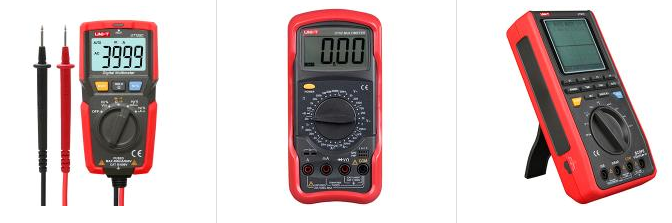
How to choose a multimeter?
When selecting a DMM for a specific application, consider the following three points:
Resolution refers to how accurately a meter can make measurements. By knowing the resolution of your meter, you can determine whether it is possible to see small changes in the signal being measured. The terms digit and count are used to describe the resolution of a meter. DMMs are grouped by the count or number they display. 3½ digit gauges can display three full digits ranging from 0-9 to one-half digits, the latter displaying only a "1" or leaving it blank. The 3½-digit gauge can display up to 1,999 counts, while the 4½-digit gauge can display up to 19,999 counts. Some DMMs may have enhanced resolution to provide higher counts across their digital range.
Accuracy is the maximum allowable error in the reading. This shows how close the DMM's displayed measurement is to the actual value of the signal being measured. Accuracy is usually expressed as a percentage of reading. An accuracy of one percent of the reading means that for a display of 100 volts, the actual value of the voltage could be between 99 and 101 volts.
Autoranging (or "dial") is a useful feature that allows the user to quickly move from the instrument's various measuring scales while maintaining accurate readings.
Another important consideration to consider when choosing a digital multimeter is whether it is a True RMS (Root Mean Square) meter. True RMS meters accurately measure non-sinusoidal AC signals. A typical DMM is not a true RMS meter, the former will give misleading voltage readings when measuring anything other than a DC signal or a pure sine wave AC signal.
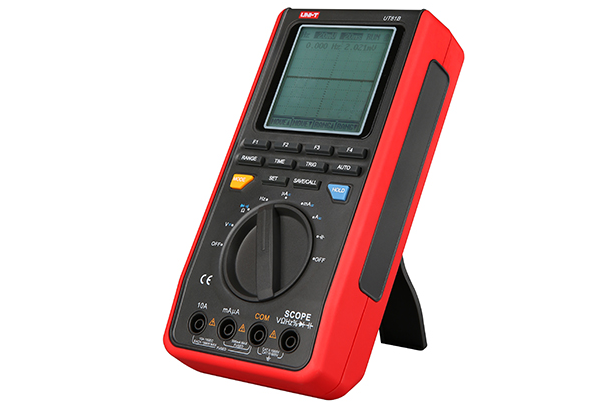
No matter which multimeter you choose, use electrical testing equipment with care, respect, and in accordance with the manufacturer's instruction manual. As with all electrical test equipment, personnel using a digital multimeter should receive training in its proper operation.
Great care must be taken when working with current (AC or DC) and voltage. To avoid catastrophic consequences, electrical safety work procedures should be established and followed when energized.


- 1How to replace the battery and fuse of the multimeter?
- 2How to measure the digital multimeter? What are the precautions?
- 3How to tell if the multimeter is properly calibrated?
- 4Application Scenario Collection of Ulide Industrial Digital Multimeter
- 5Ulide Multimeter Selection Guide
- 6What is a Digital Multimeter? (principle, purpose)
刘志强 - 《电子技术与软件工程》
- 7Pointer Multimeter Usage Points
蔡立英 - 《青海电力》
- 8How to choose a Multimeter
彭杨 - 《图书情报导刊》
- 9Multimeter measurement principle
严明忠 - 《中小企业管理与科技旬刊》