Can single angle gloss measurements be converted to other angle measurements?

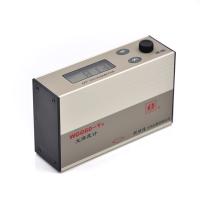
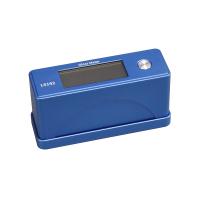
Is there a way to convert a gloss measurement at one angle to a gloss measurement at a different angle? For example, you may have a single-angle gloss meter and be asked to report gloss to a customer at different angles.
The table below can be found in the BYK-Gardner catalog and can be used in various PowerPoint presentations, but should be shown and explained otherwise.

In this case study, 13 samples were visually ranked from matte to high gloss and measured using 3 specified gloss geometries. Images courtesy of BYK-Gardner.
We state that if the gloss measured on the 60° meter is less than 10 GU, the 85° meter should be used. Why? Look at the picture above. Samples 1-13 visually had about the same gloss difference. This means that, to the human eye, the difference between samples 2 and 3 looks about the same as the difference between samples 6 and 7 or between 12 and 13. However, when measured, the gloss curve at a 60° measurement angle drops significantly by less than 10 GU. Likewise, the curve flattens as the gloss exceeds 70 GU. Between 10 and 70 GU, each sample is spaced approximately 15 GU apart (10, 25, 40, 55, and 70). But below 10 GU, the first 5 samples are unevenly spaced, with a maximum of only 10 GU.
If one looks at measurements below 10 GU (at 60°) using an 85° measurement angle, the samples again have spacing close to 15 GU: 3, 18, 30, 47, and 60 GU. Also, once the 60° meter hits 70 GU, the curve flattens out and we lose 15 GU of spacing. Switching to a 20° measurement angle gives us a gloss of about 25 GU (70 GU at 60°) and increases the scale to 40, 55, 70 and 88 GU. The visual spacing of the gloss panels again correlates well with the numbers obtained on the gauges.
But how do you convert a 60° gloss reading (say 0.5 GU) to an 85° gloss reading to meet customer requirements. The 85° measurement range for this sample is 3 GU to 10 GU. Specifications are usually tighter than this. What is the 20° gloss value for a sample measuring 10 GU at 85°? What about the 20° gloss value of a sample measuring 45 GU on an 85° meter? I think you can see the problem.
None of these values can be converted. The only way to measure gloss correctly and accurately is to use a proper gloss meter.

- 1Gloss inspection method of slurry inks
- 2Principle and Application of Glossiness Tester
- 3Working Principle and Application of Metal Gloss Meter
- 4Basic principle and application analysis of insulating paint gloss Detector
- 5Working principle and application analysis of film Glossmeter
- 6Principle and application analysis of microporous gloss meter
- 7 FZ/T 01097 Analysis of fabric gloss test method
- 8Evaluation and Application of Optical Properties of Powder coatings
- 9Coating coatings - Determination of surface gloss and Gloss meter