How does temperature in liquids and gases change their viscosity?
As the temperature increases, molecular exchange generally increases as molecules move faster at higher temperatures.
Gas viscosity will increase with temperature. According to the kinetic theory of gases, the viscosity should be proportional to the square root of the absolute temperature, and in practice, the viscosity increases faster.
In a liquid, the molecular exchange will be similar to that which occurs in a gas, but there is another considerable attraction, cohesion, between the molecules of a liquid (which are much tighter than those of a gas). Both cohesion and molecular exchange forces contribute to liquid viscosity.
The effect of increasing the temperature of the liquid is to reduce cohesion while increasing the rate of molecular exchange.
The former effect leads to a decrease in shear stress, while the latter leads to an increase in shear stress. The result is that the viscosity of the liquid decreases as the temperature increases. At high temperatures, the viscosity increases in gases and decreases in liquids, and so does the drag force.
The effect of rising temperature
The effect of increasing temperature will be to slow down the sphere in the gas and speed up the sphere in the liquid. When you consider liquids at room temperature, the molecules are held tightly together by attractive intermolecular forces such as van der Waals forces.
These attractive forces are responsible for viscosity, as individual molecules are hard to move because they are tightly bound to their neighbors.
An increase in temperature results in an increase in kinetic or thermal energy and the molecules become more mobile.
Attractive binding energy is reduced and thus viscosity is reduced. If you continue to heat the liquid, the kinetic energy will exceed the binding energy and the molecules will escape from the liquid and possibly become a vapor.
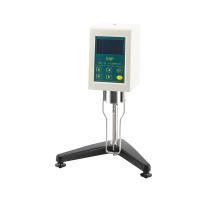

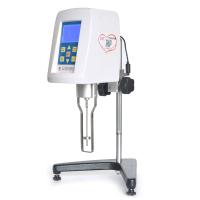
- 1Viscosity of polypropylene (PP) amide measured by NDJ Viscometer
- 2Which Viscometer to Choose for Licorice Extract Viscosity Testing? How to Test?
- 3Application of Rotational Viscometer in juice viscosity test
- 4Coating viscosity determination - viscosity cup Yiwen
- 5Working Principle, Classification and Application of Capillary Viscometer
- 6Principle, application and selection of ZAHN5 viscosity cup
- 7Corrugated fibreboard starch viscosity cup its principle, application and selection introduction
- 8Decryption paints original juice viscosity cup, principle, application and selection
- 9Wood lacquer viscosity cup, principle, application and selection introduction