Rhopoint Gloss Meter Testing in Special Scenarios FAQ
Q1: How to measure small surface area with a gloss meter?
An instrument has been used to resolve differences in gloss across the hologram to measure the gloss on coins, steering wheels and extruded pipes.
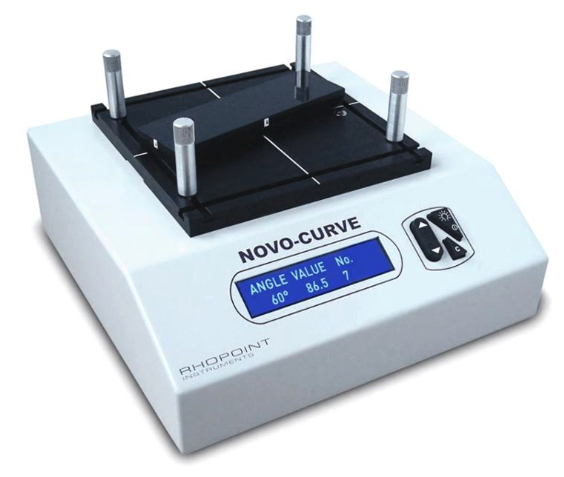
The Novo-Curve Gloss Meter has a very small measuring spot, only 2mm, which is used to measure the gloss of very small parts or resolve the gloss difference in small areas.
To obtain readings equivalent to a standard gloss meter on slightly irregular surfaces, it is recommended to take an average from multiple readings.
Q2: How to use a gloss meter to measure irregular surfaces?
When measuring irregular or textured surfaces, a smaller measurement area can provide different gloss values compared to a standard gauge with a larger measurement area. For comparable results, take 10 measurements on the Novo Curve Gloss Meter and use the statistical function to calculate the average reading.
Q3: How to measure the glossiness of a curved surface?
All standard gloss meters are designed for use on flat surfaces, if they are used on a curved surface the measuring beam will reflect off the instrument Detector causing incorrect readings. The more curved the surface, the greater the error.
The solution to this problem is to use very small regions. The light is scattered slightly by the curved surface, however, as long as the reflected beam remains narrow enough to remain within the instrument's Detector, the reading will be correct. The Novo-Curve gloss meter is designed for this purpose, specifically for measuring very small diameter cylinders and spheres. The Novo-Curve gloss meter was jointly developed with the National Physical Laboratory (NPL).
Q4: How often should instruments and standard tiles be recalibrated?
It can be seen that a standard tile that has been kept in very good condition can become contaminated and vary by as much as 2 GU within three years.
Standard tiles used in "working" conditions will require periodic calibration or inspection.
The interval between two recalibrations should be considered as the minimum interval. If at any time a calibration standard becomes permanently scratched or damaged, it needs to be recalibrated or replaced immediately.
International standards state that it is the tile, not the gloss meter, that is calibrated and traceable, however, it is recommended that the instrument is also sent to an approved service center to verify its operation on an annual or bi-annual basis, depending on Operating conditions.
Q5: How should I recalibrate the instrument?
Gloss meters are very stable and do not require frequent calibration. To tell when calibration is required, simply place the gloss meter on its calibration plate and take a test reading. If the reading is less than 0.2 GU of the assigned calibration value, no recalibration is required.
Q6: How to clean the reference tiles?
Novo Gloss (Rhopoint) standards are made of optical glass that has been polished to the desired gloss. Samples should be handled with care, avoid contact with the measurement surface, and wear gloves when appropriate.
Before calibrating, the tile should be inspected to make sure it is clean and in good condition. If necessary, wipe tile with a soft clean cloth dampened in warm soapy water and dry with a lint-free cloth.




- 1Gloss inspection method of slurry inks
- 2Principle and Application of Glossiness Tester
- 3Working Principle and Application of Metal Gloss Meter
- 4Basic principle and application analysis of insulating paint gloss Detector
- 5Working principle and application analysis of film Glossmeter
- 6Principle and application analysis of microporous gloss meter
- 7 FZ/T 01097 Analysis of fabric gloss test method
- 8Evaluation and Application of Optical Properties of Powder coatings
- 9Coating coatings - Determination of surface gloss and Gloss meter