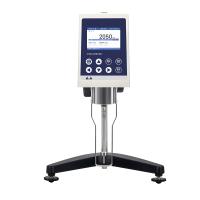
Precautions for the use of Rotational Viscometer
1. Since viscosity is a function of temperature, when the instrument is working at room temperature, the temperature fluctuation should be controlled within ±0.1°C, otherwise it will affect the accuracy of measurement. A constant temperature bath can be used if necessary.
2. Keep the rotor surface clean.
3. Since the hairspring has a certain linear region, please pay attention to the torque % value when measuring, which should be between 10% and 95%. When the % value is too high, the viscosity will display the overflow symbol "EEEEEE". Replace the rotor or change the speed, otherwise it will affect the accuracy of the measurement.
For example: test the sample with NDJ-8S type viscometer, use the No.1 spindle and 60 revolutions per minute combination test, if the viscosity shows "EEEEE", then the speed should be reduced. If the viscosity still shows "EEEEE" when it has been reduced to "0.3 revolutions per minute", it should be tested with a smaller rotor (smaller surface area). For example, when the tested samples are in the same rotor condition, the % values at different speeds are all between 10% and 95%. Whichever is the larger percentage is taken. Other models of machine test and so on.
4. Be careful when loading and unloading the rotor, lift the universal joint slightly upwards, and do not use too much force. don't give up
The rotor is subjected to lateral force, and the rotor must not be pulled down, so as not to damage the shaft tip.
5. Since the connection between the rotor and the universal joint is a left-hand thread, please remember the direction of rotation (as shown in Figure 13) when loading and unloading the rotor , so as not to damage the universal joint.
6. The universal joint should be kept clean.
7. The instrument should be lowered slowly, and it is better to hold it by hand to avoid damage to the axis due to vibration.
8. When the instrument is being transported or moved, the universal connector should be covered with a protective cap.
9. Many suspensions, emulsions, polymers and other high-viscosity liquids are "non-Newtonian" liquids, and their apparent viscosity values change with shear speed and time, so in different It is normal for the results to be inconsistent when measuring the rotor, rotational speed and time. (For example, the results of measuring non-Newtonian fluids will have certain deviations even under the same rotor and the same speed) This is all determined by the nature of the fluid, not a problem with the instrument test.





- 1Rotational viscometer - principle, classification, application and calibrating
- 2Application of NDJ-8S digital Rotational Viscometer in viscosity measurement of cosmetic raw materials
- 3NDJ-5S digital Rotational Viscometer accurate measurement of natural oil viscosity
- 4Application of HBDV-1H swirl/spin High Temperature Viscometer in Viscosity Determination of Plastic Particles
- 5Rotational viscometer selection guide: How to choose the right viscosity equipment for you?
- 6Principle, type and accuracy control of Rotational Viscometer
- 7Which Viscometer to Choose for Licorice Extract Viscosity Testing? How to Test?
- 8Application of Rotational viscometer in Waterborne Polyurethane Adhesive
- 9Application of Rotational Viscometer in cellulose material