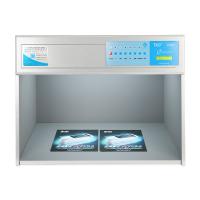
Use of Colorimeters
A Colorimeter is any instrument used by chemists to determine or specify color. A Colorimeter can determine the concentration of a substance in a solution based on the intensity of its color. If you are testing a colorless solution, add a reagent that reacts with the substance and produces a color. This Colorimeter has a wide range of applications, including laboratory research, water quality environmental analysis, soil composition analysis, monitoring of hemoglobin content in blood, and analysis of chemical substances used in various industrial environments.
general principles
When light of a particular color (or range of wavelengths) passes through a chemical solution, the solution absorbs some of the light and transmits some of it. According to Beer's Law, the concentration of absorbing material is proportional to a quantity called "absorbance", which is defined mathematically below. So if you can determine the absorbance of a solution of unknown concentration and compare it to the absorbance of a solution of known concentration, you can find the concentration of that substance in the solution being tested.
math equation
The ratio of the intensity of transmitted light (I) to the intensity of incident light (Io) is called transmittance (T). In mathematical terms, T = I÷Io.
The absorbance (A) of a solution (at a given wavelength) is equal to the logarithm (base 10) of 1÷T. That is, A = log(1÷T).
The absorbance of a solution is directly proportional to the concentration (c) of the absorbing material in the solution. That is, A = kc, where "k" is a constant of proportionality.
The first expression T = I÷I0 represents how much light passes through the solution, where 1 represents the maximum light transmission. The next equation, A = log(1÷T), expresses the absorption of light by taking the inverse of the transmission graph, and then taking the common logarithm of the result. Thus, an absorbance (A) of zero means that all light passes through, 1 means 90% of the light is absorbed, and 2 means 99% of the light is absorbed. The third expression, A = kc, tells you the concentration (c) of the solution in terms of absorbance (A). For chemists, the importance of this cannot be overstated: a Colorimeter can measure the concentration of an unknown solution by the amount of light passing through it.
Parts of a Colorimeter
A Colorimeter has three main parts: a light source, a cuvette that holds the sample solution, and a photocell that detects the solution that passes through. To generate colored light, the instrument can be equipped with colored filters or specific LEDs. The light transmitted by the solution in the test tube is detected by a photocell, which produces a digital or analog signal that can be measured. Some Colorimeters are portable and can be used for field testing, while others are larger benchtop instruments that can be used for laboratory testing.
use the instrument
With a conventional Colorimeter, you will need to calibrate the instrument (solvent only) and use it to determine the absorbance values of several standard solutions of known concentrations of solutes. (If the solute produces a colorless solution, add a reagent that reacts with the solute and produces a color.) Choose the filter or LED with the highest absorbance. Plot the data to obtain a graph of absorbance versus concentration. Then, use the instrument to find the absorbance of the test solution and use the graph to find the concentration of the solute in the test solution. Modern digital Colorimeters can directly display the concentration of the solute, eliminating most of the above steps.
Uses of Colorimeters
In addition to being valuable for basic research in chemistry laboratories, Colorimeters have many practical applications. For example, they test water quality by screening for chemicals such as chlorine, fluoride, cyanide, dissolved oxygen, iron, molybdenum, zinc, and hydrazine. They can also be used to determine the concentration of plant nutrients (such as phosphorus, nitrate and ammonia) in soil or hemoglobin in blood, and to identify substandard and counterfeit drugs. In addition, they are used by the food industry as well as by paint and textile manufacturers. Among these disciplines, Colorimeters check the quality and consistency of colors in paints and fabrics to ensure that every batch looks the same.





- 1How the Colorimeter works
- 2Test method for color of adhesive resin - Platinum cobalt colorimetric method
- 3Colorimeters vs Spectrophotometers: Understanding the Differences Between Color Measurement Techniques
- 4The principle and use of Colorimeter
- 5What is a Colorimeter? Types of Colorimeters
- 6What types of Colorimeters are there?
- 7Functional Comparison of Colorimeter and Spectrophotometer
- 8Advantages of Spectrophotometers: Why Are Colorimeters Not Enough?
- 9Difference Between Colorimeter and Spectrophotometer
-
![TILO T60 (5) five light source lighting booth configuration D65, TL84, CWF, F, UV five light sources]()
-
![TILO T60 (4) four light source Standard Light Booth, equipped with D65, TL84, F, UV four light sources]()
-
![TILO P60 (6) six light source lighting booth configuration D65, TL84, CWF, F, UV, U30 six light sources]()
-
![HANNA HI775-26 alkalinity HR reagent, used with HI775 alkalinity Colorimeter]()
-
![HANNA HI783 Ion Meter Seawater (mg) Tintometer]()
-
![HANNA HI784 Ion Meter Tintometer]() HANNA HI784 Ion Meter Tintometer$ 225.00
HANNA HI784 Ion Meter Tintometer$ 225.00