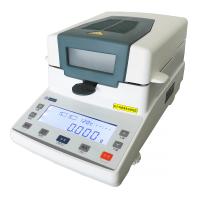
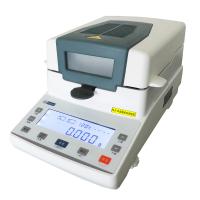
What is the difference between halogen and infrared Moisture Meters?
Halogen and metal heating
Thermogravimetric moisture analyzers dry samples efficiently by transferring energy through radiation (transfer of energy in the form of waves or particles through the medium (in this case the sample)) and convection (transfer of heat through mass motion). Compared to Below, conventional Drying Ovens primarily use convection to dry samples. Both metal and halogen heating elements radiate energy in the infrared spectrum. (Both methods are used in the OHAUS MB series.)
Infrared (IR) radiation is the part of the electromagnetic spectrum that lies between microwave energy and visible light. Infrared includes thermal radiation with wavelengths in the frequency range of 0.75 microns (the long wavelength limit of visible red light) to 1.5 microns (the boundary on microwaves). Infrared energy is invisible to the human eye. The red light often associated with infrared heating is actually reflected red light from the visible spectrum.

Some moisture analyzers use metal heating elements, which are simply low resistance pieces of metal that convert electricity into heat. This heater is ideal for environments where the use of glass components is prohibited due to regulatory or safety concerns, such as food processing. Metal heaters are not desirable because they are very hot, take much longer to heat up than halogen heaters, are therefore difficult to control and do not provide good reproducibility in a moisture analyzer.
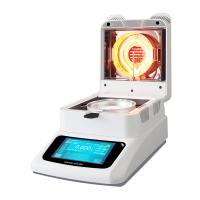
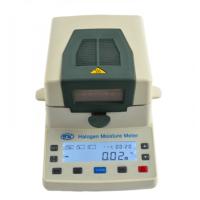
Halogen radiators contain a tungsten heating element in a compact glass tube that contains a halogen gas to preserve the tungsten element. Halogen radiators emit infrared radiation in the short wavelength range of 0.75-1.5 microns. The compact nature of the halogen radiator improves heating/cooling response time, shortens the time for the heating unit to reach full heating power, and ultimately reduces the time to complete sample drying. It also allows for better control during heating.
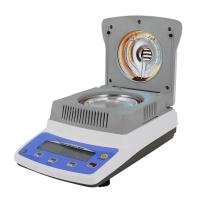
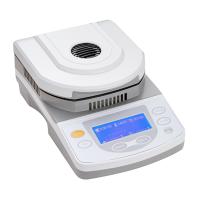




- 1Halogen Moisture Meter comprehensive analysis: types, application scenarios and scientific selection methods
- 2Principle and application of electronic halogen moisture Tester
- 3Difference between Halogen Moisture Meter and Karl Fischer Moisture Titrator
- 4Knowing Halogen Moisture Meter, reading this is enough
- 5Halogen Moisture Meter common faults and solutions
- 6What is the difference between a Moisture Meter halogen lamp and an infrared lamp?
- 7What is the difference between a halogen Moisture Meter and an infrared Moisture Meter?
- 8Application of Halogen Moisture Meter in Quality Control of Grain and Flour
- 9Jingqi DHS Halogen Moisture Meter Operation Manual