What role does the application of color in industrial buildings play in improving production efficiency and ensuring safe production?
In industrial buildings, people have paid attention to color as a means to improve labor productivity, reduce accidents and improve dispatch rate. In the past, most of our factory buildings were produced with clean water specially prepared with white paste as the background; and these walls were polluted by raw soil, and at the same time blocked by various vertically and horizontally arranged pipelines, equipment and products. The products and The device is also darkened. Such an environment gives workers a dull and crowded feeling, which will affect the improvement of work efficiency and product precision. Against this gray background, there is a gray carriage driving, and a gray dangling crane hangs under the carriage. People can't see its exact position or grasp its moving direction for a while, which makes people feel extremely unsafe. .
Appropriate use of warning colors and environmental colors in industrial production can make workers energetic, happy, and sharp-eyed, which is conducive to preventing quality accidents and work-related accidents and ensuring production safety.
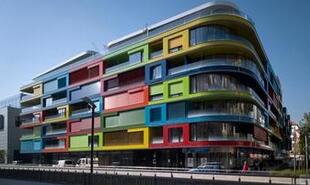 There is a certain regularity in the use of color in industry
 There is a certain regularity in the use of color in industry
(1) In industrial buildings, using some eye-catching colors of danger signals and safety signs in relatively harmonious colors can attract people's attention the most. Therefore, in order to make people pay attention to a certain color, a large area of other colors must be used to set it off; if the color that is noticed is infinitely enlarged, it will be counterproductive.
(2) Use color to remind people of safety in living and working environments: the application of color in this respect has been very common, green as a safety color, red as a warning color is widely used. For equipment with different functions and pipelines with different purposes, they should be painted with different colors, so that operators can avoid operating errors. For those painted with warning colors, people can avoid those dangerous areas early. If all the pipes are painted black, it will give people a dull, depressing and unsafe feeling.
(3) For industrial buildings and places of manual labor, the use of color should be aimed at preventing people's visual fatigue. Do not use oblique lines and chaotic patterns on the wall to prevent people from feeling that the factory is distorted, thereby reducing interfere with production.
(4) If the bright contrast between the working parts and the background color is not strong, the psychological burden of the workers will be too heavy, and the energy and vision will not be adjusted and rested. Working in this environment for a long time will cause fatigue and reduce work efficiency.
- 1The importance of color in emulsion paint
- 2How to mix paint?
- 3Why doesn't medical furniture have to be painted white?
- 4How to choose the color of furniture?
- 5How to configure the color of the ceiling?
- 6Why should the walls and floor finishes of the living room use moderately sub-toned re-colors?
- 7How can the layout make the small room "bigger"?
- 8What does color have to do with safety?
- 9The effect of color on paint painting and the principle of interior color and shadow adjustment