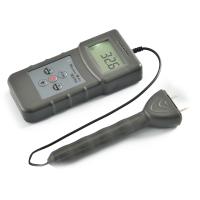
Why do Moisture Meters need quantitative moisture readings?
在水分测试说明和“操作方法”指南中,您可能会遇到术语“定量水分读数”和“定性水分读数”。这些术语中的每一个是什么意思,为什么要定量和定性地读取水分?
定性和定量水分读数之间的差异
1、定量水分读数表示样品材料的水分含量,这是通过使用经过专门校准以测试该材料中水分的水分计来实现的。例如,当测试木材时由木材水分仪提供的湿度读数,或在测试干墙时由干墙水分仪提供的湿度读数。
2、定性水分读数是使用任意刻度的估计值。定性水分读数的一个很好的例子是参考秤水分仪给出的结果。实际数字只是水分含量的粗略近似值,可能无法转换为准确的水分含量百分比。
定量水分读数与定性水分读数之间的差异可以归结为特异性差异。定量读数是特定的,表示给定材料中水分含量的绝对测量值。定性读数是可以用于比较的估计,但最终对于许多专业人员来说不够精确。
为什么需要定量的水分读数?
为什么进行定量水分测量如此重要?原因可能因一个行业而异。为了突出显示定量水分读数的重要性,以下是来自不同行业的一些示例:
1、农业产业和水分定量读数
在农业行业中,进行准确的水分测量对于优化收割时间并验证收割的农作物已准备好存储重要性无庸赘述。但是,对于某些应用而言,湿度计精度的问题比其他应用更为紧迫。
在农业行业中,准确,定量的水分测量重要性无庸赘述的部分是干草或其他紧密捆扎的草料的存储。如果收集时干草太湿,细菌可能会失控生长。在温和的这个结果是细菌会导致干草分解,失去其营养价值,迫使农民放弃他们的干草。
在最坏的情况下,不断增长的细菌会导致捆成一束的干草自发燃烧,从而在谷仓或干草仓中引起火灾和粉尘爆炸。这显然对农民,牲畜或爆炸的爆炸和弹片半径内的任何人的健康和安全构成威胁。
捆草的称心水分含量取决于捆包的类型。通常,草捆越密,在成为严重的安全隐患之前,其水分就越少。以下是不同类型干草的可接受湿度范围:
小方包。这些棉包往往比其他类型的棉包密度低。称心情况下,这些棉包应具有18%至20%的水分,以很好的平衡质量和安全性。
Generous package. Density is higher than small square bales, but large square bales are less resistant to moisture. The desirable moisture range for these bales is 12% to 16%.
Round hay bales. These bales are similar in density to the large square bales. Therefore, it is usually better to keep their moisture content at 15%.
Without quantitative moisture readings, it is nearly impossible to determine that the moisture content of tightly packed hay is within acceptable moisture limits. If the bale is too dry, the nutritional value of the hay will be compromised by the loss of leaves. If the bale is too wet, the bale may catch fire.
Therefore, in the case of measuring hay moisture, it is necessary to have accurate readings.
Quantitative readouts are also useful for other crops such as cotton, tobacco and grains to prevent spoilage or release free dry weight when these crops are sold.
Why Floor Installers Need Quantitative Moisture Readings
Another industry that would benefit from quantitative moisture measurement is the flooring industry. Wood floor installers often require accurate measurements of the moisture content of the wood they are working with as well as an accurate assessment of relative humidity (RH) conditions at the installation site.
Why is quantitative moisture measurement so important? The main reason is that, being a hygroscopic material, wood tends to absorb or release moisture until it reaches equilibrium with the environment. This is known as the equilibrium moisture content (EMC) of the wood, and this value will vary from one job site to another, so floor installers need to check the RH conditions of their wood and each job site.
If a wooden floor is installed too far from the EMC values of the current installation location, a number of failures can occur, including:
Discoloration. In some wood floors, moisture can cause dark or faded spots. This destroys the appeal of the floor and can be a harbinger of other floor failures.
Warped. As the wood begins to absorb moisture, the wood will begin to warp and pull away from the floor. In most cases, the intervals are small. However, in some rare and extreme cases, the wood may completely separate from the floor if there is an external source of moisture.
crowned. When the center of a wood floor has more moisture than the edges, the center will swell and form a small bulge. This is called "crowding".
cupping. When there is more water at the edges of a plank than in the center, the edges may rise as the plank expands. This can also cause the boards to press against each other, creating a wavy appearance.
Continuous water condensation. As wood floors release excess moisture, it may condense on the wood surface.
For a floor installer, any of these issues can cause a callback, which involves wasting a lot of time, labor, and resources replacing damaged wood floors.
Therefore, it is important to perform quantitative moisture measurements on the %MC of wood floors. Also remember: Quantitative measurements of RH conditions should be made at the job site to help determine the EMC of the wood.
Considerations: Since wood floor installers can handle many types of wood, having a "wood Moisture Meter" alone is not enough. Even at the exact same moisture content, different types of wood will have different readings. Therefore, if the goal is to achieve quantitative moisture measurements, it is important to consider the correction for wood species. Some high-end wood Moisture Meters have built-in species corrections, while others require manual adjustments using species correction tables.
Why Restoration Professionals Need Quantitative Moisture Measurements
In the restoration industry, clients rely on restoration professionals to remove any and all excess traces of moisture from structures so they can be used again. Whether the property being restored is residential or commercial, lingering traces of moisture can cause the following hazards:
Mold growth. Most people don't think the growth of black mold and other fungi in dark, damp places is dangerous until they start to smell musty, and people with asthma and other respiratory conditions start suffering side effects of mold spore exposure. If too much moisture remains in the building material after drying/tearing off, it may allow mold to grow in the structure, which can be a hazard to respiratory health.
potential structural failure. Excessive moisture in a structure can weaken certain building materials. For example, wooden beams can rotate, making them easily break under heavy loads. Water can corrode iron-rich metals, impairing the performance of wooden pegs and other metal objects used to hold structures together.
Pest infestation. Pockets of water hidden deep within wooden structural beams and other building materials attract pests such as termites, rodents and cockroaches. These pests can spread disease and eat structural materials, causing potential hazards to the structure's occupants.
The worst moisture levels (qualitative moisture readings) can usually be found using a reference hygrometer. But it's hard to call certain materials one way or another when they're just a little wet.
This can lead to disassembly/tearing of the recyclable material, or incomplete tearing due to inability to properly identify wet material.
Another problem in restoration efforts is the need to document dry work. In many cases, a restoration professional's ability to be billed for their services in a timely manner depends on the insurer's willingness to pay property damage claims. However, the insurer will want to verify that restoration work is necessary before any payments are made.
When documented, submitting quantitative moisture measurements to insurance companies can help justify the work. Hopefully this will help smooth out the insurance claim process so the restoration company can collect the money.
Qualitative moisture measurements, while useful, are not as reliable as the more accurate quantitative moisture readings used for this purpose.
Ensure Moisture Meter accuracy for quantitative readings
Of course, in order for the Moisture Meter readings to be truly quantitative rather than qualitative, the accuracy of the Moisture Meter needs to be ensured.
Ensuring the accuracy of your hygrometer consists of the following parts:
Choose the right hygrometer. In order to obtain quantitative moisture measurements, the Moisture Meter needs to be properly calibrated for the material being used - a hay Moisture Meter will not produce accurate results on wood and vice versa.
Maintain the hygrometer. Maintenance plays an important role in ensuring the accuracy of your hygrometer. Broken pins/scan boards, dead batteries, and damaged circuit boards can't work with high accuracy and efficiency. The importance of maintaining your meter to making quantitative moisture measurements cannot be overemphasized.
Check the accuracy of the meter. Even a well-maintained Moisture Meter can lose calibration after years of use. Therefore, regular checking of the Moisture Meter's calibration using a moisture content standard (MCS) or a built-in calibration check is important to verify that the Moisture Meter is giving accurate measurements.




- 1What is the difference between a Moisture Meter halogen lamp and an infrared lamp?
- 2Testing methods for several important properties of powder coatings
- 3Analysis of the principle of infrared moisture determination
- 4What is the difference between a halogen Moisture Meter and an infrared Moisture Meter?
- 5Principles of two different measurement techniques for moisture determination
- 6Moisture Analysis: What is a Moisture Analyzer?
- 7Moisture Meter Selection Considerations
- 8Three signals that need to be replaced with a new Moisture meter
- 9How does the Moisture meter ensure the sound structure in the restoration?