How to improve the measurement accuracy of gloss meter?
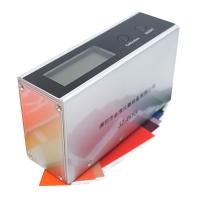
How to improve the measurement accuracy of the gloss meter? Gloss meter is a precision instrument for measuring the light reflection ability of the surface of an object. The difference in the structure of different instruments will lead to deviations in measurement accuracy. This article mainly introduces the techniques and methods to improve the accuracy.
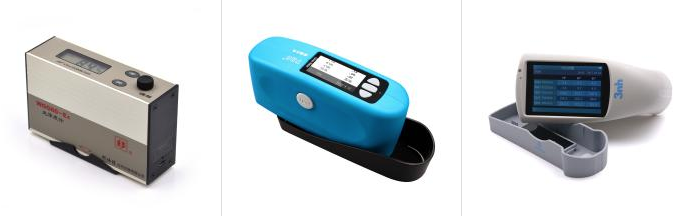
During measurement, the light source irradiates the object under test at a specified angle, and measures the reflected light at its specular reflection angle under certain receiving conditions. The reflected light irradiates the photoelectric conversion device photocell, through which the photoelectric signal is converted into photocurrent and sent to the operational amplifier circuit. The calculation method circuit amplifies the weak photocurrent output by the photocell and changes it into a voltage signal that the A/D converter can receive, and then sends it to the A/D converter. The A/D converter converts the voltage signal into a digital signal and sends it to the single-chip microcomputer, and the single-chip microcomputer stores, calculates and processes the digital signal.
The gloss meter uses a relative comparison method to measure the glossiness of an object. Firstly, the zero drift measurement value Dt is obtained in the absence of light, and then the standard plate and the sample to be tested are measured respectively to obtain the corresponding measured values Dsc and Dc, and the actual values of the standard plate and the sample to be tested are obtained after subtracting Dt from Dsc and Dc. Measured values, and then check the nonlinear correction table with the actual measured values of the standard plate and the measured sample, that is, obtain the reflected luminous flux values of the standard plate and the measured sample. As the gloss calibration value of the standard plate is known, it is pre-stored in the corresponding memory, and the gloss value of the tested sample can be obtained through calculation.
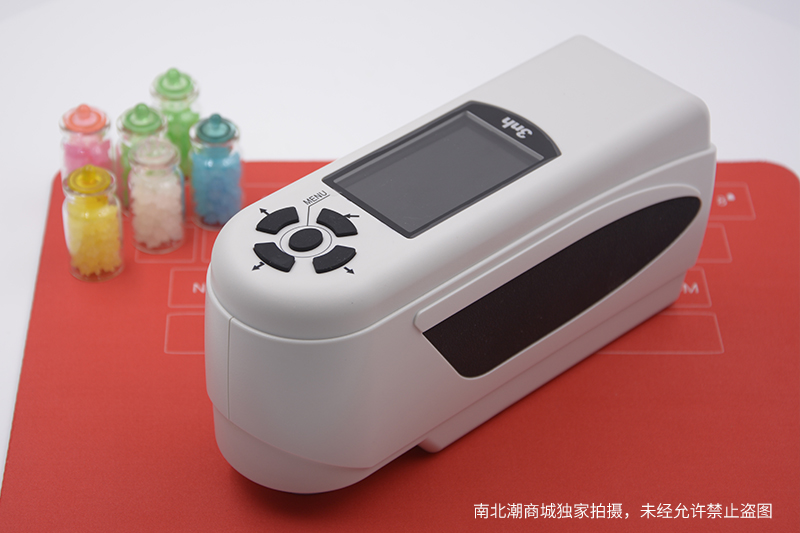
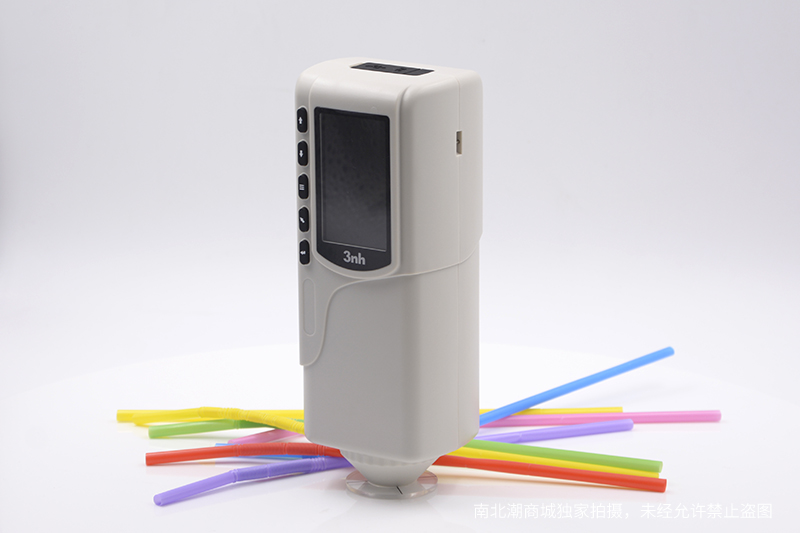
How to improve the measurement accuracy of gloss meter?
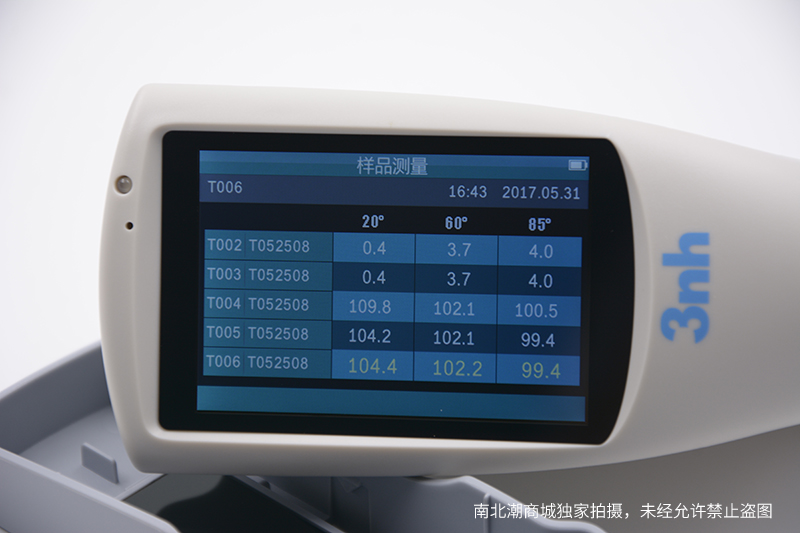
Intelligent gloss measuring instruments are widely used in various industries. In the field of industrial materials, it can identify the true and false of the target by measuring the glossiness of the target material. In the gloss measurement system, zero drift and nonlinearity are two important factors affecting the test accuracy. The intelligent gloss measuring instrument introduces single-chip microcomputer technology into the traditional gloss measuring instrument, and uses the method of combining software and hardware technology to correct the zero drift and nonlinearity, which not only simplifies the circuit design, but also has a good correction effect, which greatly improves the system. test accuracy and stability.
1. Automatic zero calibration technology
The traditional way to eliminate dark current and zero drift is to use sensors and amplifiers with excellent performance, and to use compensation circuits and correction circuits. These methods not only make the hardware circuit very complicated, but also the function of the compensation circuit composed of the hardware circuit is limited and partial, and it is impossible to automatically eliminate the dark current and zero drift in real time and effectively. The intelligent gloss meter uses a programming method combining software and hardware to eliminate dark current and zero drift, which is the so-called automatic zero calibration technology.
2. Nonlinear correction
The nonlinearity of the system means that the output of the test system has a nonlinear relationship with the input signal, and this nonlinearity is usually produced by sensors and various components. In the gloss measurement system, the nonlinearity of the system is mainly produced by photocells, A/D converters, etc. The existence of the nonlinearity of the system will cause certain errors in the dynamic monitoring of the measurement in a large range. The traditional method of nonlinear compensation usually uses hardware circuits to form various compensation circuits, such as commonly used information feedback compensation circuits, logarithmic amplifiers, anti-logarithmic amplifiers, etc., which not only increases the complexity of the circuit, but also makes it difficult to achieve satisfactory results. compensation effect. The glossiness intelligent measurement system uses computer software technology to complete the nonlinear compensation of the measurement system. The compensation process is relatively simple and the accuracy is high, and the design of the hardware circuit is simplified.

- 1Principle and Application of Glossiness Tester
- 2Working Principle and Application of Metal Gloss Meter
- 3Basic principle and application analysis of insulating paint gloss Detector
- 4Working principle and application analysis of film Glossmeter
- 5Principle and application analysis of microporous gloss meter
- 6 FZ/T 01097 Analysis of fabric gloss test method
- 7Evaluation and Application of Optical Properties of Powder coatings
- 8Coating coatings - Determination of surface gloss and Gloss meter
- 9The Importance and Method of Gloss Measurement of Paint Film