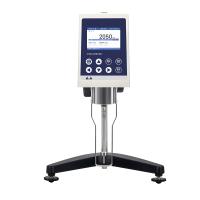
The basic knowledge of viscometer is enough to read this article
Definition of Viscosity
A viscometer is a physical property analysis instrument for measuring fluid viscosity. Viscosity is a physical characteristic of a fluid substance, which reflects the internal friction between molecules when the fluid is subjected to an external force. The viscosity of a substance is closely related to its chemical composition. In industrial production and scientific research, the composition or quality of substances is often monitored by measuring viscosity.
For example, in the production process of polymer materials, the viscometer can be used to monitor the viscosity of the synthesis reaction product, and automatically control the reaction end point (it can be understood as judging what substance is based on the viscosity, and can also directly affect its performance, so it is a coating ink. one of the important indicators). Others such as petroleum cracking, lubricating oil blending, automatic control of the production process of certain foods and drugs, monitoring of crude oil pipeline transportation process, quality inspection of various petroleum products and paints, etc., all need viscosity measurement.
common unit of viscosity
(1) International units: Pa s (Pascal second), mPa s (milliPascal second)
(2) Common units: P (poise), cP (centipoise)
(3) Conversion: 1cP=1mPa·s 1P=1000mPa·s=0.1Pa·s 1M=1 million 1M=1000000mPa·s
1dPa·s=100mPa·s 1Pa·s=1000cP=1000mPa·s=10P=10dPa·s
Relationship between Dynamic Viscosity and Kinematic Viscosity
Kinematic viscosity = dynamic viscosity / sample density
You can use the viscosity conversion tool developed by Beichao: https://tool.nbchao.com/cst/
type of fluid
(1) Newtonian fluid
The viscosity value does not change with the change of stirring rate. Examples: water, honey, thinner solvents, and silicone oil.
(2) Non-Newtonian fluid
Viscosity values change (lower or higher viscosity values) as the stirring rate changes.
For example: certain high molecular polymers, petroleum, mud, coal water slurry, ceramic slurry, paper pulp, paint, ink, toothpaste, silkworm silk regeneration solution, well cleaning fluid and well completion fluid for drilling, magnetic slurry, some photosensitive Material coating liquid, foam, liquid crystal, high sand content flow, debris flow, mantle, etc., tomato juice, starch liquid, egg white, apple pulp, concentrated sugar water, soy sauce, jam, condensed milk, agar, potato pulp, melted chocolate, dough, rice flour Groups, and various minced food materials such as minced fish and minced meat are also non-Newtonian fluids. (commonly known as: pole climbing effect)
Types of Viscosity Testing Instruments
(1) Outflow method
Apply 1-cup: the outflow time is less than 20s, apply 4-cup: the outflow time is less than 150s
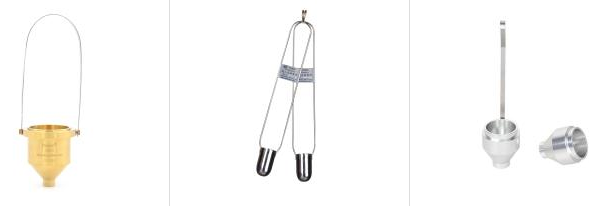
(2) Falling ball viscometer (Heboler viscometer)
Commonly used to test clear liquid products
(3) Bubble method (Garner tube: Dana-Holder viscometer)
Commonly used for testing clear liquid products.
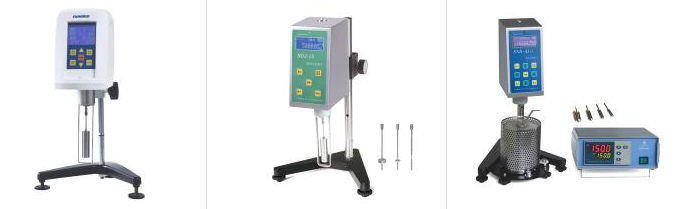
(4) Rotational viscometer method
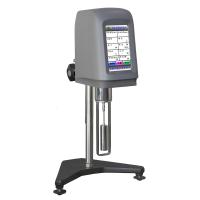
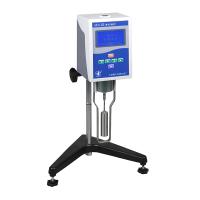
To detect the dynamic viscosity (absolute viscosity) of non-Newtonian fluids, experience recommends commonly used models (NDJ series viscometers and familiar Brookfield viscometers)
Viscosity properties
Viscosity properties, also known as rheological properties, have three different cases of viscosity properties.
(1) Viscosity in storage state (Brookfield viscosity)
The storage needs to maintain a high viscosity to prevent sedimentation (quality problems). Usually, a Rotational Viscometer is used to adjust the viscosity range of the finished product (DV series viscometer and NDJ Rotational Viscometer can be selected).
(2) Viscosity when the paint is stirred (KU viscosity)
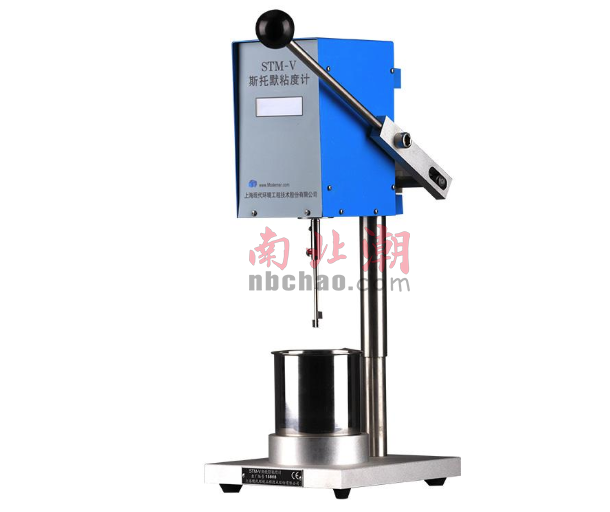
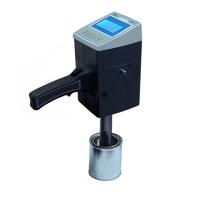
It is directly related to the performance of the paint. The difficulty of stirring the paint will affect the user's mood (a very intuitive problem). The viscosity is low when stirring, and it is more convenient to use. Usually a Stormer viscometer is used. (Generally, the viscosity is detected during the experiment to adjust)
(3) Viscosity when the paint is applied ( ICI viscosity)
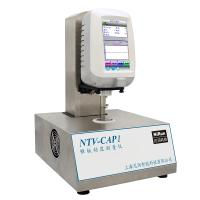
Reflected under the conditions of painting, spraying, brushing, rolling, etc., it has low viscosity and good performance. Generally, a cone-plate viscometer is used as a standard measuring instrument.
Classification of different viscometer models
1) Rotational viscometer: DFY, FDY (to detect starch); NDJ, SNB, VY, DV, RVDV, LVDV, LDV, RDV, etc.
2) Stormer viscometer: STM, QNZ, DV
3) Plate viscometer: PN
4) Falling ball viscometer: QNQ, LBN-II
5) Others: YDN
Viscometer Application
1. Laboratory
(1) Scientific research (research and development): falling stick viscometer, falling ball viscometer (more precise instrument), Stormer viscometer.
(2) Experimental testing (Quality Inspection Department): Rotational Viscometer, Tu-1 cup, Tu-4 cup.
2. Production line
(1) Coating cups: Zion cups, immersion Viscosity Cups, ISO Viscosity Cups, Ford cups, etc.



- 1Rotational viscometer - principle, classification, application and calibrating
- 2Application of NDJ-8S digital Rotational Viscometer in viscosity measurement of cosmetic raw materials
- 3NDJ-5S digital Rotational Viscometer accurate measurement of natural oil viscosity
- 4Viscosity of polypropylene (PP) amide measured by NDJ Viscometer
- 5Application of HBDV-1H swirl/spin High Temperature Viscometer in Viscosity Determination of Plastic Particles
- 6Rotational viscometer selection guide: How to choose the right viscosity equipment for you?
- 7Principle, type and accuracy control of Rotational Viscometer
- 8Which Viscometer to Choose for Licorice Extract Viscosity Testing? How to Test?
- 9Application of Rotational viscometer in Waterborne Polyurethane Adhesive