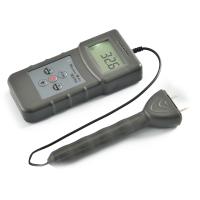
Moisture Analysis: What is a Moisture Analyzer?
We start by explaining why a moisture analyzer is needed. The food industry is one such example. As stated in Food Quality and Safety, "International and national standards define thresholds for the amount of moisture allowed in commercially sold products." Moisture analyzers are widely used to meet these standards. They go far beyond the food industry to affect a wide variety of products such as pharmaceuticals, plastics, paints, wood, bird food, soybeans, fertilizers, cement, detergents, shampoos... and many more.
So, what is moisture?
good question. For the purposes of this article, moisture is anything that evaporates when heated. Besides water, it can also include fats, greases, alcohols and solvents. Note that some volatile substances may be released during moisture analysis. Procedures should be developed to take this into account. Do not perform analysis on flammable or explosive materials or materials that may be hazardous when heated.
What is a Moisture Analyzer?
A moisture analyzer, also known as a moisture balance, is a programmable benchtop laboratory instrument used to measure the moisture content of small samples of manufactured or processed products. Moisture analysis can be performed before product packaging, during processing or after. They combine an analytical balance with a heater to dissipate moisture from the product being measured. Unlike large oven dryers that do batch drying on the production line, moisture analyzers are used to confirm that the batch dryer is doing its job correctly, or needs to be adjusted on the production line.
How does water balance work?
Today, most moisture analyzers operate on the so-called thermogravimetric principle, a method of determining loss on drying (LOD). The loss represents the moisture given off during drying, while the weight change is recorded with an analytical balance. Program the test program to achieve moisture balance and continuously calculate the weight change as the drying operation is performed. Due to the small sample size, the analysis can be done very quickly. Drying temperatures are provided by infrared or halogen heaters, the latter technique being the most popular as it can be used to determine the moisture content of almost any substance. It also dries faster than infrared.
Microwave drying is another technique, but these instruments are larger and more expensive than halogen-heated moisture analyzers.
Researchers and quality control personnel can choose between soft (slow), standard and elevated (high) heat rate drying profile management without ramp programming. Simplify report generation by pressing the Key-Select™ mode until the display shows the desired report, then releasing the key to send the report to a printer or output to a computer via RS232.
Moisture analyzers for specific tasks
You can specify a moisture analyzer designed to simplify a specific task. For example, the aforementioned XM60 is recommended for moisture measurement in the food industry
Companies committed to providing high quality injection molded products realize that the moisture content of their resin feedstock is of paramount importance to product quality. The DSC 71P is an excellent moisture analyzer for testing low moisture plastics. To save you time, it has default programs to test 75% of commonly used resins.
As a final example, moisture content measurement in the wood, paper and pulp industries can be done with several models.
Moisture analyzers are easy to use, but…
Moisture analyzers with large LED displays are relatively easy to use. But operators need to be familiar with and follow the precise steps necessary to obtain accurate readings for the specific product being analyzed. Although their operation may vary for a particular model, the following is a typical analysis sequence:
Create a program for the product to be tested and program the balance. Include each of these steps in your company's operating manual.
Place the sample plate on the moisture balance sample plate holder and tare the balance
Spread the recommended amount of product evenly over the sample plate and record the weight.
Close the lid of the moisture balance to start the procedure.
The display panel of the device is constantly updated with the process status. The analysis is automatically terminated when drying is complete and the dry weight has stabilized, or after a fixed time specified by the operator or manually.
At the end of the moisture weighing, all relevant data about initial weight, residual weight, test parameters and results can be printed out via the interface. When the moisture analyzer is connected to a PC, the data acquisition software allows the operator to graph results over time, providing valuable information on drying speed and dry weight stability. The results of the individual tests can be stored in computer memory for subsequent comparisons.
Note that moisture analyzers need to be calibrated periodically and every time they are moved from one location to another. The weight and temperature recalibration procedure is detailed in the user manual.



- 1What is the difference between a Moisture Meter halogen lamp and an infrared lamp?
- 2Testing methods for several important properties of powder coatings
- 3Analysis of the principle of infrared moisture determination
- 4What is the difference between a halogen Moisture Meter and an infrared Moisture Meter?
- 5Principles of two different measurement techniques for moisture determination
- 6Why do Moisture Meters need quantitative moisture readings?
- 7Moisture Meter Selection Considerations
- 8Three signals that need to be replaced with a new Moisture meter
- 9How does the Moisture meter ensure the sound structure in the restoration?