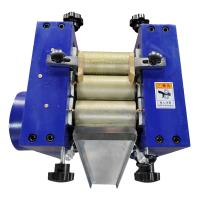
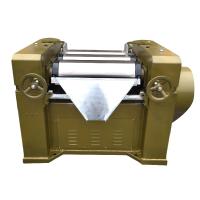
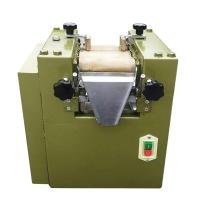
Several major operation points when the three-roll Grinder is dispersed
1. The role of premixing
The premixing of millbase is very important, and it has been proved theoretically. Because the paint slurry is relatively large, a machine with a larger power is required for stirring . First add enough paint that can wet all the pigments (the ratio is based on previous experiments or accumulated empirical data) into the mixing tank, then add all the pigments, after the stirring is started, the initial wetting begins, the air is discharged, and a spherical shape is formed Thick slurry with strong structure will generate a large shear force between the pigment/paint, stir until the spherical shape becomes a fluid slurry (only a few minutes), and then adjust it to be suitable for three-roll mill grinding with paint the viscosity. It should be a uniform structure, no blocky pigment, no air, and a good wet paint paste.
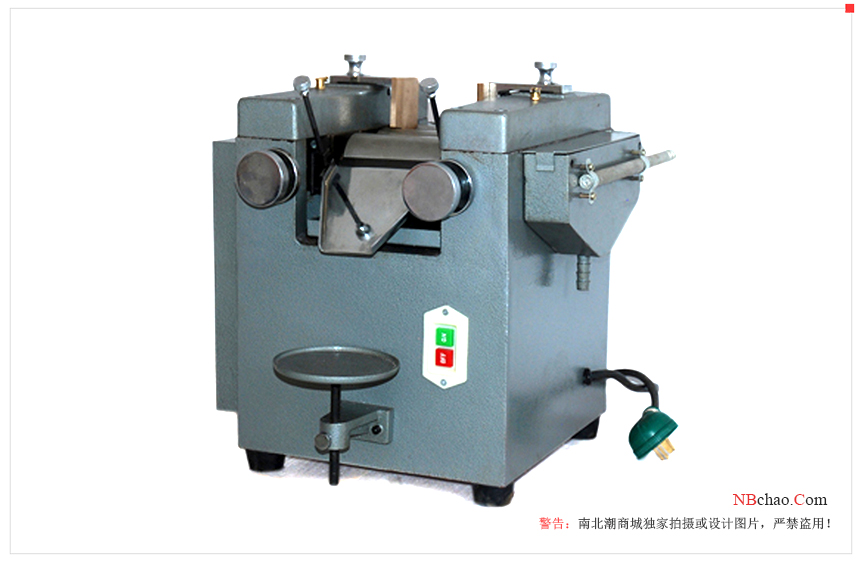
Click on the picture to see more products
2. Adjustment of roller spacing
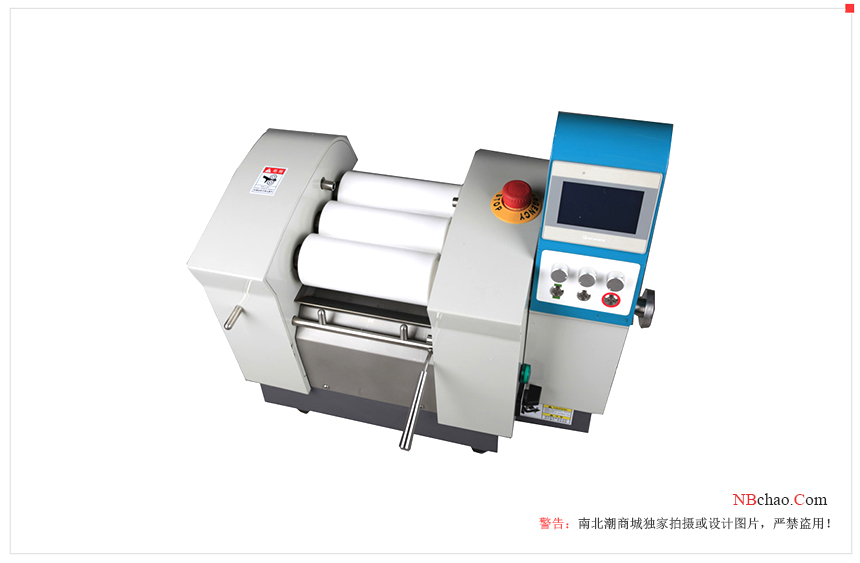
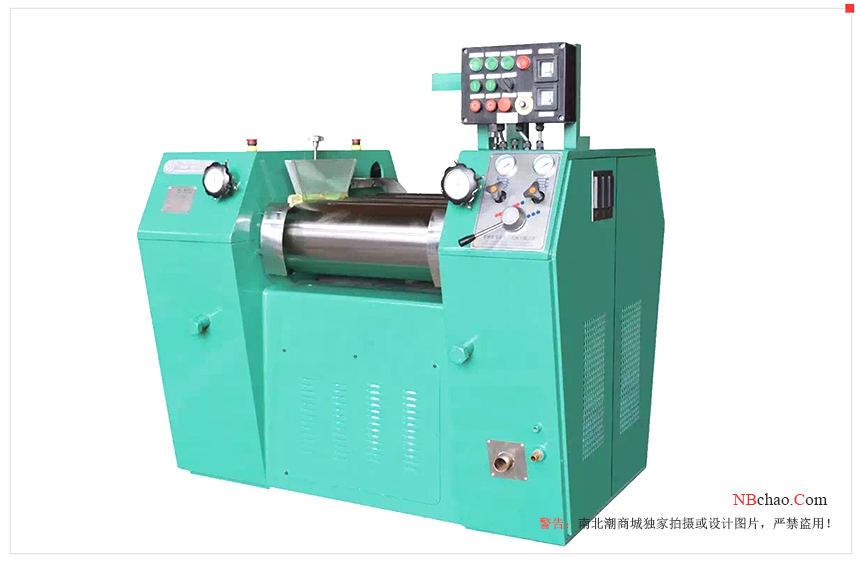
The three rollers drive the paint paste through its two dispersion lines to evenly distribute the pigment particle clusters in the paint . It is the function of dispersing the pigment groups in the paint paste into fine particles. The completion of this role reflects several comprehensive functions of this machine.
Reasonable utilization of the two dispersing lines of the three-roll machine, the first dispersing line (feeding groove) is formed between the middle roller and the rear roller, and the second dispersing line is formed between the middle roller and the front roller, which runs with the rollers The slurry first passes through the first dispersing line, and then through the second dispersing line, scraping off the slurry on the roller surface with a scraper. It is required to adjust the spacing of the first dispersing line to be greater than that of the second dispersing line . If this is not adjusted, the mechanical function cannot be fully exerted.
3. Operation with buckets full of buckets
Under normal operating conditions, the distance between the rear roll and the middle roll of the three-roll machine is about 51 μm, the average 325-mesh sieve is 44 μm, and the remaining pigment is about 0.5% in the 325-mesh sieve. It can be seen that after the millbase is pre-mixed, the larger particles are also within the size range of the roll gap .
First consider the large particles near the middle roll, which flow in the opposite direction through the center of the roll. Due to the flow of the paint slurry, the large particles are repelled back to the upper part of the feeding ditch, but the small particles near the middle roll are often brought to the feed slot. In the middle, the small particles continue to pass through, so that 99.5% of the pigment in the mill paste passes through the roller mill. A dispersed millbase is formed. Large and hard particles remain in the feeding ditch. If you continue to grind the hard particles at the end, it will not only damage the grinding, but also mix with a large amount of paint pulp, which will also affect the fineness. The operation of full bucket and remaining bucket is to keep the remaining 5% paint pulp in the feeding ditch for separate collection and processing. In order to save equipment and time and ensure the quality of dispersion.
4. Filtration of impurities
It is difficult to avoid bringing impurities into the paint pulp. If these impurities are not removed, the output of the single machine will be seriously reduced. The function of removing impurities in the three-roll machine is completed between the middle roll surface and the rear roll surface. When the millbase is put in, a moving millbase film is formed at the part in contact with the roller surface, and the moving direction and fast speed of this layer of moving millbase film follow the movement direction and speed of the middle roller surface and the rear roller surface. Speed happens. But the moving paint pulp can not completely pass through the first dispersing line, and a part of it is blocked and cannot pass through. In this way, the pulling force generated by the different rotation speed of the rollers stirs the blocked paint pulp, forming a middle roller and a rear roller . The reaction force of the paint paste remaining on the top impacts from the bottom to the top, and the function of the three-roll machine to filter out impurities is thus generated.
5. The necessity of double joint
三辊机所产生的运动着的漆浆的反作用力也使粗的粒子向两边推移,由于辊子直径是中间大两边小,在同一时间中间所作的功大于辊边所作的功,中间产生的反作用力大,使粗粒向辊边推移,并且因两边问距大于中间间距的原因,所以同一辊面上的漆浆中间细度好,两边细度差。需要把两边的漆浆与中间的漆浆分开,以免好坏混淆,以提高单机产量,这就是三辊机操作所说的“双接边。接边的宽度一般为辊长的1/10~2/10,不同颜料有所不同,由当时测细度来决定。如辊面由于长期使用而磨平,此现象将随之减弱。磨辊应修理。
6.刮刀的合理使用
要求刮刀能尽量把前辊带过来的漆浆全部刮下来,以提高单机产量。
选择刮刀时,注意以下几点。直、薄、硬而不脆、质地均一、富有弹性。合适的刮刀装在刮刀架上,平落在调好的辊面上不加外力,应该是严密无缝,否则需更换,机械运转时刮刀不可过紧,如把刮刀紧成弯曲状时刮漆效能降低,普通使用的固定角度与辊子摩擦。使刀刃处磨成斜面。这时刮刀与辊子的切线变为宽线,由于接触面加大,使压强下降,刮漆效果也降低,应更换新刀。如刮刀仍很直,可以不换,反过来使用也可以,这就是三辊机操作所说的“反刮刀"。
7.研磨的道数
辊磨研磨时辊距是先松后紧,由试验可以看出,经一次研磨,除大于60μm的颗粒外其他无任何变化,因此绝大多数颜料是在辊磨上分散而不是粉碎。分散设备只能把颜料聚集体和附聚体解聚,井将其湿润。仅仅依靠增加辊间压力或缩小辊距以期通过1~2道研磨,达到希望的研磨细度是不适应的。使用三辊机获得精细分散的正确途径是多道研磨。
- 1Application of three-roll Grinder in homogenizing treatment of lithium-based grease
- 2The working principle of the three-roll Grinder
- 3What kind of grinding paste is the three-roll Grinder suitable for?
- 4Perchloroethylene putty production process
- 5Architectural coatings factory production equipment
- 6Brief description of emulsion paint production process
- 7Pigment Dispersion Equipment: Overview of Three Roller Machines
郑顺兴 - 《涂料与涂装科学技术基础》