What is a spectrometer? Classification of spectrometers
Broadly speaking, a spectrometer is any instrument used to measure changes in a physical property over a given range, the spectrum. In the case of a mass spectrometer this might be a mass-to-charge ratio spectrum, in an NMR spectrometer it is a change in the frequency of a nuclear resonance, or in a spectrometer it is the change in the absorption and emission of light at a wavelength.
A common type of spectrometer used in research is the spectrometer. When someone simply says "spectrometer" without an additional qualifier, they usually mean an optical spectrometer, and this diverse family of spectrometers is the focus of this article.
How does a spectrometer work?
The purpose of any optical spectrometer is to measure the interaction of electromagnetic radiation with a sample (absorption, reflection, scattering) or the emission of electromagnetic radiation from a sample (fluorescence, phosphorescence, electroluminescence). A spectrometer involves electromagnetic radiation that falls within the optical region of the electromagnetic spectrum, which is light that spans the ultraviolet, visible, and infrared wavelength regions of the spectrum.
To obtain great information, the interaction or emission of light should be measured in terms of wavelength, so a common feature of all spectrometers is the mechanism for selecting the wavelength. In low-cost spectrometers or where exact wavelength selection is not important, optical filters are used to isolate wavelength regions of interest. However, to accurately select wavelengths and generate spectra, dispersive elements that separate light into its component wavelengths are required. In all modern spectrometers, this dispersive element is a diffraction grating, where constructive and destructive interference are used to spatially separate polychromatic light incident on the grating (Figure 2).
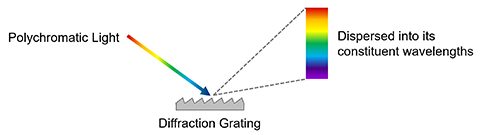
Figure 2: Dispersion of light into its constituent wavelengths by a diffraction grating.
Diffraction gratings are a key component of a monochromator, a device used to select specific wavelengths of light from a polychromatic light source. In a monochromator, the diffraction grating is rotated to change the wavelengths that are aligned with and pass through the exit slit. In all Spectrophotometer s there is an excitation monochromator (see next section) to select the desired excitation wavelength to reach the sample from a white light source (Fig. 3 Excitation monochromator), and by scanning the monochromator and measuring Signal change to measure spectral excitation wavelength
In order to detect the light emitted by the sample, there are two methods. The first is an emission monochromator, which works on the same principle as above, except that the light source is light emitted by the sample, and the monochromator selects the wavelength of light that reaches the Detector (Figure 3 Emission monochromator). The second method is to detect the spectrum of the scattered light "at once" using an array Detector (such as a CCD camera) called a spectrometer (Fig. 3 spectrometer). At least one emission monochromator or spectrometer is found in all fluorescence Spectrophotometer s and Raman spectrometers (see section below).
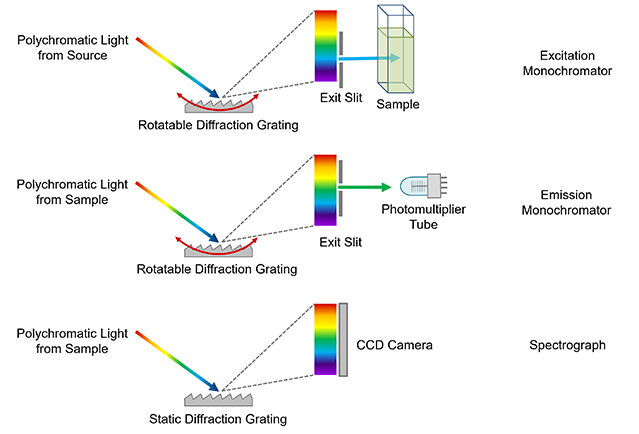
Figure 3: The basic principles of operation behind monochromators and spectrometers.
Types of spectrometers
Now that the key components of a spectrometer have been identified, the different types of spectrometers, their role and basic design can be discussed. Three common optical spectrometers are introduced: Spectrophotometer , spectrofluorometer and Raman spectrometer.
Spectrophotometer (also known as UV-Vis spectrometer)
The term Spectrophotometer can refer to quite a variety of instruments that measure light, with the exact definition depending on the field of science or industry. In all cases, the term "photograph" is used to denote that a spectrometer is used to quantitatively measure the intensity of light with a wavelength. In academic research (especially chemistry and biology laboratories), the term Spectrophotometer is used exclusively to refer to a Spectrophotometer that measures the absorption of light by a sample, and that definition will be used here.
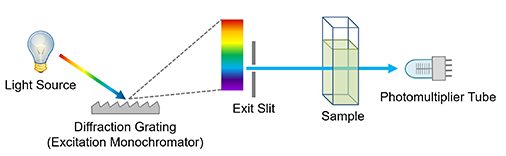
Figure 4: Simplified diagram of a single-beam Spectrophotometer .
The stylized layout of a basic single-beam Spectrophotometer is shown in Figure 4. It consists of a white light source, usually a combination of a deuterium arc lamp covering the arc range and a tungsten halogen lamp covering visible light. or a single xenon arc lamp to cover the entire range. Then there is an excitation monochromator, which selects the wavelength of light that reaches the sample. This light is then either transmitted through the sample (as shown in Figure 4) for transparent samples (such as solutions), or reflected off the surface for opaque samples. The intensity of the transmitted or reflected light is then monitored using a Detector, usually a photomultiplier tube or silicon photodiode.
In addition to stand-alone Spectrophotometer s, Spectrophotometer functions can also be integrated into other Spectrophotometer s as other functions. An example is the FS5 Fluorescence Spectrophotometer, which comes standard with a transmission Detector and has all the features of a single-beam Spectrophotometer in addition to being a fluorescence Spectrophotometer .
A common measurement made in a Spectrophotometer is to measure the absorption spectrum of a sample. A scanning excitation monochromator records the change in intensity of light transmitted through the sample on a Detector. This was then repeated with a reference sample and the absorbance spectrum calculated for a solution of fluorescein in phosphate buffer, as shown in Figure 5.
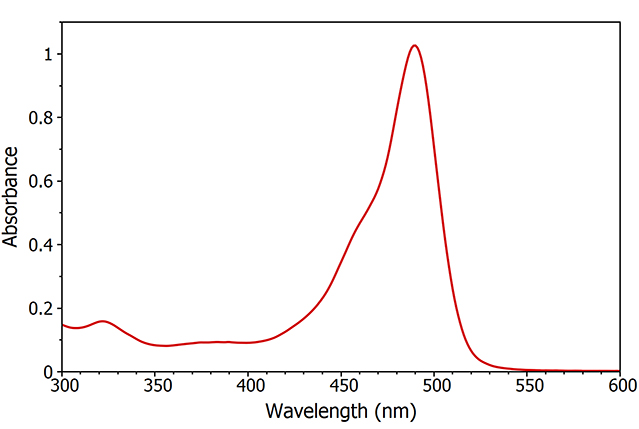
Figure 5: Fluorescein absorption spectrum measured by a spectrofluorometer.
A more advanced version of the Spectrophotometer is the transient absorption spectrometer, which measures the change in the absorption spectrum over time and is invaluable for viewing temporary species created by chemical reactions or transient photoexcited states.
Spectrofluorometer (also called Fluorescence/Photoluminescence Spectrometer)
A spectrofluorometer is used to measure the fluorescence emission (or more generally, photoluminescence) of a sample. Spectrofluorometers and fluorescence/photoluminescence spectrometers are interchangeable, and different manufacturers refer to them by different names. The general convention is that a spectrofluorometer is a compact benchtop instrument similar in size to a Spectrophotometer .
The layout of a typical steady-state spectrofluorometer is shown in Figure 8. The excitation side of a spectrofluorometer is equivalent to a Spectrophotometer : a white light source and an excitation monochromator. Xenon-arc lamps are used as the light source because their high brightness is, of course, important for measuring the faint fluorescence emission. The sample is illuminated with a selected excitation wavelength, causing it to fluoresce. Fluorescence emission is collected by an emission monochromator oriented at 90 degrees to the excitation monochromator, with selected wavelengths reaching a Detector. Usually a photomultiplier tube.
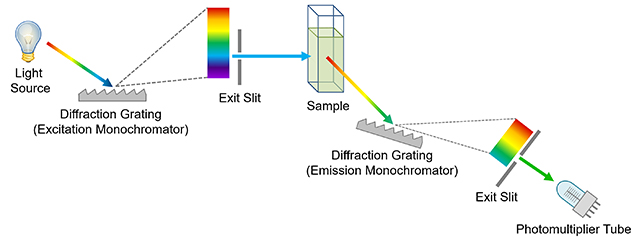
Figure 8: Simplified diagram of a spectrofluorometer.
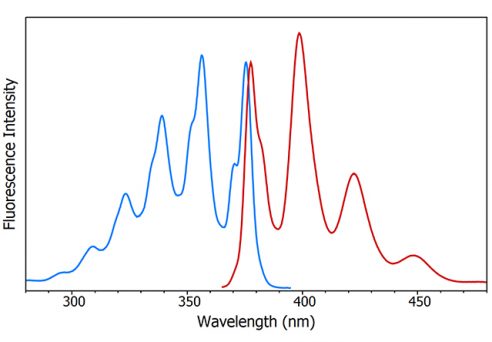
Two common spectral measurements made in a spectrofluorometer are excitation and emission spectra. To measure the excitation spectrum, set the emission monochromator at the wavelength of strong fluorescence emission, scan the excitation monochromator over the wavelength range of interest, and monitor the change in fluorescence intensity on the Detector (Figure 9 blue curve), Thus revealing the absorption characteristic of the sample. The emission spectrum is the opposite of this. Set the wavelength of the excitation monochromator so that the sample has a strong absorption capacity, and sweep the emission monochromator across the wavelength region of interest, and the detected fluorescence changes (red curve in Figure 9) reveal the fluorescence characteristics of the sample.