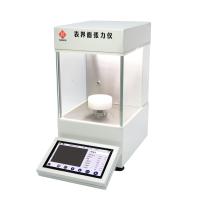
3 Ways to Measure Surface Tension
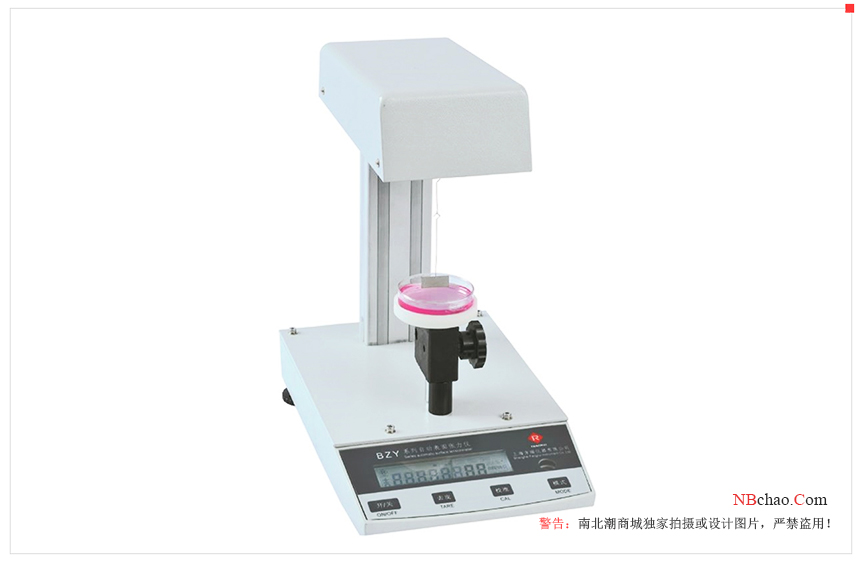
Surface tension and interfacial tension play a key role in several industrial processes including, for example, cleaning agents, coatings, and oil recovery, among others. Surface tension measurements are made when developing new paint formulations or evaluating the quality of detergents. There are three main methods used to measure equilibrium surface and interfacial tension. Both methods are based on force tensiometers. The platinum ring method (also known as the DuNoüy ring method) and the platinum plate method (also known as the Wilhelmy method), while the third is an optical method: the pendant drop method.
Dunui Ring
The DuNoüy ring method uses a platinum ring as a probe. Platinum rings are placed on measuring hooks attached to highly sensitive balances. Immerse the ring under the interface by moving the platform on which the liquid container is placed. After immersion, the height of the platform decreases and the ring pulls on the interface, allowing the liquid meniscus to follow. If the container is lowered any further, the meniscus will tear off the ring. Before this event, the volume of the meniscus (and therefore the applied force) passes a maximum value and begins to decrease before the actual tearing event. The calculation of surface or interfacial tension is based on the measurement of the maximum force and the circumference of the ring.

Figure 1. The different phases of the experiment can be identified from the force versus time curve:
1) At the beginning, the ring is above the interface and the force is zero.
2) The ring touches the interface with a slight positive force due to the adhesion between the ring and the surface.
3) The ring needs to be pushed through the interface (less negative force due to surface tension).
4) The ring breaks through the interface, and the measured positive force is small due to the support line of the ring.
5) When lifting through the interface, the measured force starts to increase.
6) The power is constantly increasing.
7) Reach maximum force.
8) After the maximum value is reached, the force decreases slightly until the sheet breaks or the ring is pushed back below the surface.
william board
The Wilhelmy plate method uses a rough platinum plate as a probe. The calculations in this technique are based on the perimeter of a fully wetted plate in contact with the liquid. In this method, the position of the probe relative to the surface is important. When the liquid surface comes into contact with the probe, the instrument will detect the exact moment of contact by recording the change in force on the probe. This position is marked "Zero Immersion Depth". The board is then immersed to a set depth below this value (usually a few millimeters into the interface). Force is recorded when the plate is then returned to zero immersion depth.
Similarly, measurements can be made by replacing the Wilhelmy plates with platinum rods. The measuring principle remains the same, but the small diameter of the probe makes it possible to measure smaller sample quantities as well. At the same time, however, the measurements are not as accurate as the standard Wilhelmy flat-panel technology.
pendant droplet
Measurements of surface and interfacial tension can also be performed optically using pendant drop shape analysis. The shape of the droplet suspended from the needle depends on the balance of forces including the surface tension of the liquid under study.
The solution of the Young-Laplace equation can be found using modern computational methods of iterative approximation. Thus, the surface or interfacial tension between any two immiscible fluids of known density can be determined. For optical tensometry, the size of the droplet is important and the shape of the droplet should be tear or pendant.
- 1Working principle of mechanical liquid meter interfacial tensIon Meter
- 2Comparison of Liquid Surface/Interfacial Tension Testing Methods: Plate vs. Ring Method
- 3Selection guide for Surface Tensiometers
- 4Application principle and precautions of platinum ring Surface Tensiometer
- 5Analysis of the difference between contact angle meter and Surface Tensiometer
- 6The working principle, application and operation steps of surface tensIon Meter
- 7Fangrui surface tensIon Meter test data deviation, how to solve?
- 8Comparison of Fangrui's different series of automatic watch interfacial tensIon Meters
- 9What is the measurement principle of surface tension?