Specific measurement method of salt content of Defelsko PosiTector SST
The PosiTector SST Soluble Salt Tester by DeFelsko is a simple, durable, and accurate way to measure salt contamination according to the ISO 8502-6/9-Bresle method. This article outlines the Bresle method for measuring salt contamination, compares three different patch options offered by DeFelsko, and explains how to perform the test.
background
Before applying a protective coating, the steel substrate needs to be carefully prepared and cleaned to ensure that the coating meets performance requirements and avoids premature failure. As part of surface preparation, blast cleaning is often used to remove oxidation and existing coatings in steel. Once bare steel surfaces are exposed, there is an ever-present risk of contamination from water-soluble salts naturally present in the environment.
Soluble salts are not visible to the naked eye. If they are allowed to remain on the substrate in sufficient quantities, they can absorb moisture through the coating, causing premature failure of the coating due to osmotic blistering or peeling. In some cases, the blasting media itself can become contaminated with water-soluble materials such as chlorides or sulfates, which can then be transferred to the steel surface during cleaning, which can eventually cause the coating to fail prematurely.
Bray Law
In order to avoid premature coating failure due to salt contamination, the importance cannot be overemphasized to ensure that the amount of soluble salt present on the blast cleaned surface does not exceed acceptable levels. Water-soluble salts are tested according to ISO 8502-9. As part of the method, extraction of soluble salt contaminants for analysis was performed according to ISO 8502-6 (Bresle method).
The Bresle method samples the surface by "surface extraction". In a nutshell, the method involves placing a quantity of water in a chamber on a surface. The water dissolves soluble salts present on the surface, thereby increasing the conductivity of the water. The measured increase in conductivity determines the concentration of soluble salts. Note that there is no "industry standard" for acceptable levels of surface contamination. Therefore, project specifications need to indicate the maximum amount of soluble salt that can remain on the surface when the paint is applied.
DeFelsko's Measurement Solutions
When used in conjunction with the Bresle Method PosiPatch or the Bresle Method DeFelsko Patch, the PosiTector SST Soluble Salt Tester Conductivity Probe greatly simplifies the process of measuring soluble salt contamination. It represents a simpler approach using Bresle's method. As with all DeFelsko products, each kit includes everything you need to start measuring. The PosiTector SST probes are factory calibrated and the calibration includes a long form certificate of qualification traceable to NIST.
When attached to a PosiTector Standard or Advanced Gauge Body, the PosiTector SST Conductivity Probe guides the user through the three simple steps required to make a conductivity measurement. It features a dedicated test cell optimized for the range, resolution and test volume of the Bresle method. The built-in temperature sensor compensates for the accuracy of the reading and records the sample temperature during each measurement.
DeFelsko's PosiSoft suite of software solutions automatically calculates, displays salt conductivity and surface density changes and saves them to memory for further reporting. No math, unit conversions or volume and temperature adjustments required. Test times are automatically measured and stored. When "Blay Mode" is disabled, the PosiTector SST becomes a regular conductivity meter, making it ideal for testing abrasives according to ISO 11127-6 and ASTM D4940-15.
patch options
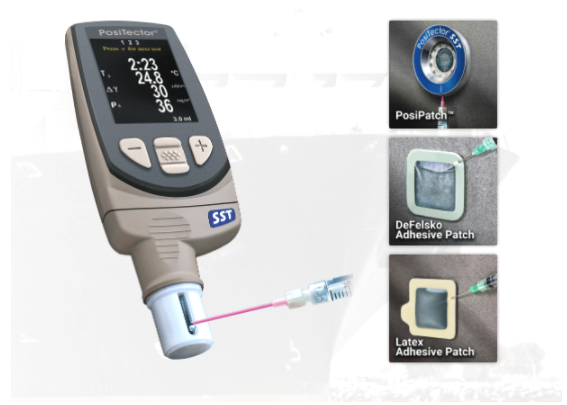
DeFelsko offers three patch options ideal for testing against the Bresle method.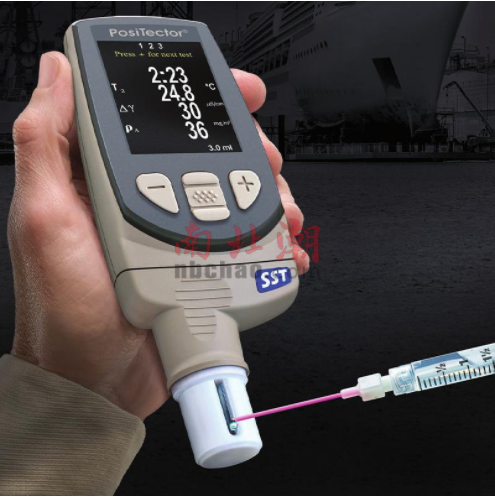
• DeFelsko PosiPatch — reusable patch with standard or flexible magnetic loop
• DeFelsko Adhesive Patches—self-adhesive polyurethane patches
• Latex patches—latex patches have easy-open tabs and low-tack adhesive for easy removal
While the PosiTector SST probe can be used with any test patch that meets the requirements of the Bresle method, the DeFelsko adhesive patch and the revolutionary PosiPatch offer many advantages.
The DeFelsko adhesive patch is low-cost, latex-free, and adaptable to virtually any surface geometry. It has a low-tack adhesive that creates a tight seal while being easy to remove without leaving any foamy residue.
The revolutionary DeFelsko PosiPatch further simplifies the Bresle method. It is functionally equivalent to the Bresle patch, but does not require adhesives as it is secured to the surface by a rigid or flexible magnetic retaining ring. It features a built-in port that allows fluid injection using a blunt polypropylene dispensing needle, eliminating sharp needles from the test. It features a patented breathable membrane that automatically releases trapped air when water is injected and then agitates the water as it is pumped. It is also reusable, and one PosiPatch can be used for multiple tests, making it the lowest cost per test patch available.
In our tests on freshly blasted steel with a typical size of 50-100 microns (2-4 mils), the PosiPatch was reused dozens of times with no noticeable wear or leaks. The lifespan of the patch will vary with use - if it is dragged along the substrate, the lifespan will be shortened.
We consider 10 uses to be a very conservative estimate of longevity, and still the lowest cost per test of any commercially available Bresle method patch. The table below compares the cost-per-test of various options using competitive prices found online.
If execute 10 tests, then reuse PosiPatch:
When latex patches are required, DeFelsko offers ISO 8502-6 compliant latex patches with easy-tear labels and low-tack adhesive with TearGuard™ technology.
PosiTector SST measurement process
Step 1: Obtain background (blank) measurements.
Pour at least 4 mL of deionized water into a clean cup to prevent contamination of the water source.
Fill the syringe with deionized water from the cup.
The PosiTector SST automatically displays previous background measurements. Press the minus button on the PosiTector to use the previous measurement. To take a new background measurement, fill the test cartridge with water from the syringe and press the plus button to save the new measurement.
Draw water back into the syringe to remove all solution from the test cell.
Invert the syringe to expel air and excess solution until three milliliters of solution remain in the syringe.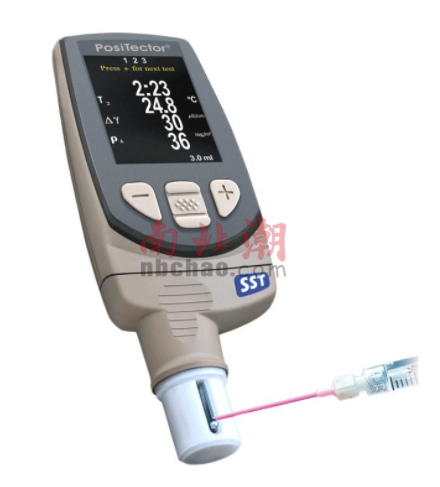
Step 2: Prepare the sample.
If using a PosiPatch, place it into the magnetic ring first, being careful not to touch the inside.
Place the magnetic ring on the surface and use the port to inject water into the patch. The air inside the patch escapes automatically through the breathable membrane.
If using a DeFelsko patch or a latex patch, remove the backing and foam center from the patch, being careful not to touch the inside. Press it firmly against the surface, making sure most of the air escapes.
Pierce the top of the patch around the foam perimeter so that the needle penetrates the center of the patch. Fill the patch about halfway with water. Then, suck the air out of the patch.
Remove the syringe from the patch and expel the air. Pour the rest of the water into the patch.
Once water has been injected into either patch, press the plus button on the PosiTector SST to start the test timer. Use the syringe to repeatedly infuse and withdraw water. ISO 8502-6 recommends that the process be done at least four times, and that the testing time should be agreed between the parties involved. Usually, two minutes is enough.
Step 3: Record the measurements.
To complete the measurement, fill the PosiTector SST's test cell with water and press the plus button.
The initial background reading is automatically subtracted from the final reading and test results are displayed in µS/cm (conductivity) and mg/m2 or µg/cm2 (surface density) along with test time and sample temperature - required Information by most standards.
Press the plus button again to start a new test. If memory is enabled, all results are stored for future download to one of DeFelsko's PosiSoft solutions, making it easy to organize measurement data and create professional, fully customizable reports. After saving readings to PosiTector memory, four free PosiSoft Solutions can manage data and create reports.
The patch can now be removed from the surface. DeFelsko adhesive and latex patches peel off surfaces more easily with less residue than traditional Bresle patches. Discard it after testing.
The PosiPatch lifts off surfaces cleanly with absolutely no residue. Simply use the syringe to rinse with deionized water and re-use several times until worn out or dirty.
in conclusion
The PosiTector SST Osmometer makes salt contamination measurement and reporting a faster, simpler process and more accurate. The DeFelsko Adhesive Patches, Latex Patches, and the innovative and reusable PosiPatch are gratifying solutions for measurements according to the ISO 8502-6-Bresle method.


- 1Differences between several common water quality testing equipment
- 2What is a salinity meter?
- 3JENCO 6308 cst conductivity meter operating instructions
- 4TASI655 Digital Salinometer Operating Instructions