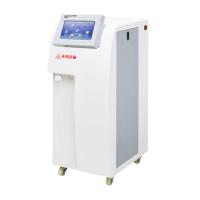
How does an ultrapure water machine prepare ultrapure water?
Now that water pollution is getting more and more serious, many families choose water purifiers, direct drinking machines or pure water machines to ensure the safety of drinking water. When purchasing, it is necessary to distinguish between two similarly named devices, water purifiers and ultrapure water. Although their names are very similar, their functions are completely different. Ultrapure water has been treated. Do not drink water directly. In order to let everyone better understand ultrapure water, let us introduce it now.
What is ultrapure water - the working principle of ultrapure water equipment
Ultrapure water is the water produced by the American scientific and technological circles in order to develop ultrapure materials (semiconductor original materials, nano fine ceramic materials, etc.) by applying distillation, deionization, reverse osmosis technology or other appropriate supercritical fine technology. Except for water molecules (H20), there are almost no impurities, and there are no organic substances such as bacteria, viruses, and chlorinated dioxins. many ions.

What is ultrapure water - how is ultrapure water made
Pretreatment : including sand filtration, multi-media filtration, softening, chlorination, pH adjustment, activated carbon filtration, degassing, etc. Filtration can remove particles with a size of 1 to 20 microns, softening and adjusting pH can prevent fouling of reverse osmosis membranes, and adding chlorine is to sterilize. Activated carbon filtration is to remove organic matter and free chlorine, and degassing is to remove CO2 dissolved in water.
Desalination : including electrodialysis, reverse osmosis, ion exchange. The principle of electrodialysis is to use cation and anion exchange membranes to selectively permeate ions under the action of an external DC electric field, and the desalination rate can reach more than 95%. Reverse osmosis is the reverse process of osmosis. Pressure is applied to the concentrated solution to make the solvent pass through the semi-permeable membrane from the concentrated solution to the dilute solution. The desalination can reach 98%, and 99% of the bacterial particles can be removed. and organic matter dissolved in water.
The principle of ion exchange is that when water passes through a cation exchange resin, the cations in the water are adsorbed by the cation exchange resin, and the exchangeable cations on the resin, such as H ions, are replaced into the water and combined with the anions in the water to form corresponding inorganic acids, as shown here A kind of water containing inorganic acid, when passing through the anion exchange resin layer in the next step, the anions in the water are adsorbed by the anion exchange resin.

Fine treatment : Exchangeable anions on the resin such as OH- ions are replaced into water and combined with H+ ions in water to form water, including ultraviolet sterilization, terminal membrane filtration and ultrafiltration. Ultraviolet sterilization is that the nucleic acid of the organism absorbs the energy of ultraviolet light to change the structure of the nucleic acid itself, destroying the function of the nucleic acid and killing the bacteria. The more bactericidal spectral wavelength is 2600 Angstroms. Various membrane filtration can remove particles with a diameter larger than 0.2 microns, but they are not as effective as reverse osmosis and ultrafiltration for removing organic matter.
Ultrafiltration is the separation of various selective molecules. In ultrafiltration, water flows under pressure through a coiled or hollow fiber membrane rod. The pore diameter of the membrane is in the range of 10-200 angstroms, and the thickness of the film is 0.1-0.5 microns. It is attached to the inner wall of a medium-porous fiber rod. Ultrafiltration can remove bacteria and particles of 0.05 microns.
Based on the above, I have introduced some knowledge of ultrapure water for you. Ultrapure water is mainly used in electronics, chemical water, chemical agents and some conductor production industries. It is essentially the same as the pure water machine used in our family. The difference is that the water treated with ultra-pure water is poisonous and harmful, and cannot be drunk. Please pay attention.


- 1How to clean the laboratory water purifier?
- 2What are the criteria for selecting laboratory purified water equipment?
- 3Precautions for cleaning ultrafiltration membranes in biopharmaceutical pure water equipment?
- 4What are the advantages of using ultrapure water equipment for the power industry?
- 5Ultra-pure water machine - triple filter element replacement method
- 6What should I do if the solenoid valve of the experimental ultra-pure water machine encounters these failures?
- 7Detailed purchase method of laboratory ultra-pure water machine [dry goods]
- 8What is the difference between "water intake flow" and "water intake flow rate" in laboratory ultrapure water machines?
- 9How to choose the right high-quality experimental ultra-pure water machine?