Principle and Test Technique of Adhesion Test by Pull-out Method
The pull-off method is a peeling test method. This method is a step ahead of the comprehensive measurement method. It mainly measures the work required for the paint film to fall off from the bottom plate, or pulls the paint film away from the bottom plate for a certain area in the vertical direction. The required force can quantitatively express the size of the adhesion of the coating film.
The adhesion measured by the pull-off method refers to applying a vertical and uniform tensile force on the cemented surface of the sample at a specified rate to determine the force required for the adhesion between coatings or between coatings and substrates. Expressed in MPa. This method can not only test the degree of adhesion between the coating and the substrate, but also detect the interlayer adhesion between the coatings, and examine whether the matching of the coating is reasonable, and comprehensively evaluate the overall adhesion effect of the coating. There are two commonly used methods.
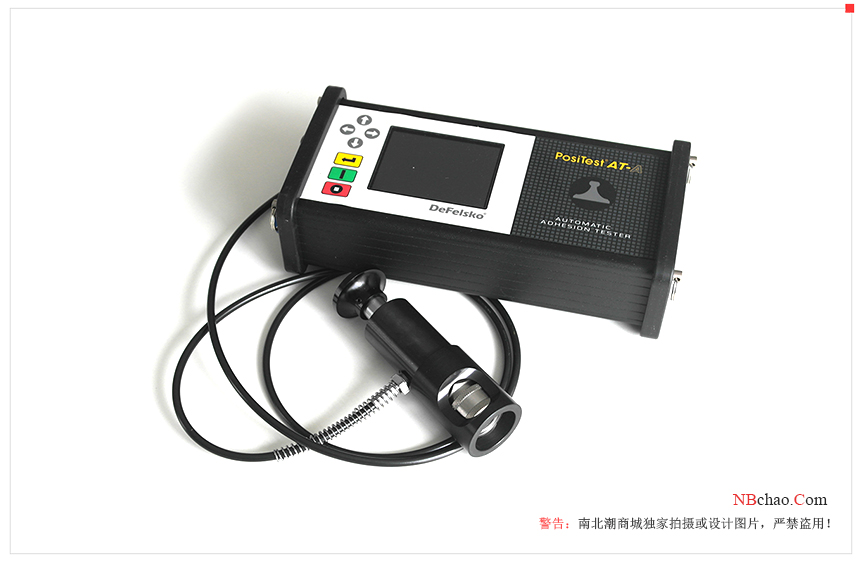
One is to stick an aluminum test slider on the coating, use a mechanical Tensile Testing Machine to pull the slider off, and read the pulling force of the aluminum tip. Examine its adhesion and failure mode. According to ASIM D4541, ISO 4624 and other international standards.
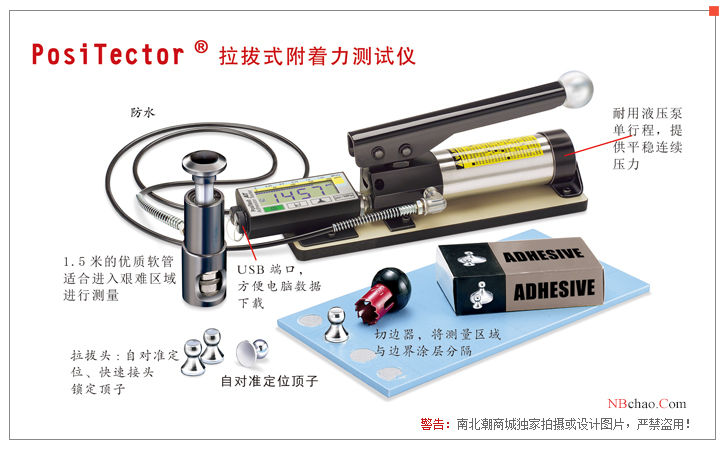
When experimenting, pay attention to the following points:
① Carefully select the area where the test slider is installed. The surface of this area needs to be flat to ensure that the surface is in full contact with the slider, and the area is larger than the size of the Tester feet. Generally, the area should be more than 10cm in length and width.
②Use an appropriate solvent to remove grease and dust on the surface of the object to be tested, and lightly polish the coating surface with fine sandpaper to promote the adhesion of the test slider, but do not wear the coating film too much. Clean and lightly abrade the thinner test face of the test slider with solvent to roughen the surface.
③Adhesives are mixed in an appropriate proportion, which requires extremely strong adhesion, such as epoxy two-component structural strands, it is necessary to carefully ensure that the adhesive is compatible with the test coating, and the bonding strength is greater than the strength of the test coating.
④Apply a thin layer of glue on the test area, and at the same time apply the same thin layer of glue on the joint surface of the test slider, press the test slider on the glue-coated part of the test area, and turn the slider slightly to ensure that all To contact, press a flat weight on the test slider.
⑤ According to the curing instructions of the adhesive, ensure a sufficient time interval, usually measured after 24 hours.
⑥ After bonding and curing, use a matching cutter to cover the slider and carve out a circle that penetrates the substrate to remove excess adhesive without affecting the test slider.
⑦Slide the clip at the lower part of the Tester to and insert it into the groove of the slider. The operator needs to ensure that the meter is placed on the surface of the coating film smoothly and vertically.
⑧Before the pull-off operation, adjust the pull indicator to "0" reading, and count until the pull head is disengaged. When it still cannot be pulled apart, the maximum pulling force is used for counting.
Another method is to apply a vertical uniform tensile force on the bonding surface of the sample at a specified speed to measure the force required per unit area between the coatings or when the coating and the substrate are pulled apart. A general Tensile Testing Machine can be used for the test. The test piece is the butt joint of two metal test columns (as shown in Figure 3-7). The adhesive can be 502 adhesive or epoxy two-component adhesive. During the measurement, the tensile machine clamps it and stretches it at a speed of 10mm/min until it is destroyed, and its adhesion and failure form are examined. According to the national standard GB/T5210-85 "Determination of Coating Film Adhesion Pulling Method".
When combining samples, attention must be paid to the concentric butt joint of the upper and lower test columns. For the combined sample of the coated test piece, after curing, use a sharp knife to cut through the coating and adhesive along the circumference of the test column to the substrate.
There are three types of coating failure that may be detected by adhesion pull-off testing.
(1) Adhesion failure, the damage between the coating and the substrate, and the composite coating interface, this value is the adhesion between the coating and the substrate.
(2) Cohesive failure, the coating itself is pulled off, and this value is used as the value of interlayer adhesion.
(3) If the adhesive layer breaks off from the coating or the test slider or breaks off inside itself, it is considered to be the failure of the adhesive; at this time, the adhesion between the coating and the substrate or between the coating and the coating will be exceeds the experimental value. It shows that the bonding strength of the adhesive cannot meet the requirements, and the adhesive with higher bonding strength can be replaced, so as to quantitatively express the adhesion of the coating method
(4) Adhesion failure, if the adhesive is detached from the unpainted test column, or completely detached from the topcoat of the coating under test.
-
![KOSON KS-T Manual pulling method coating adhesion Tester, top 50mm]()
-
![KOSON KS-T intelligent drawing adhesion instrument, top 10mm]()
-
![KOSON KS-T Intelligent Adhesion Tester Spindle 14mm]()
-
![KOSON KS-A Automatic Digital Display Adhesion Tester]()
-
![KOSON KS-T smart Adhesion Tester]() KOSON KS-T smart Adhesion Tester$ 1086.00
KOSON KS-T smart Adhesion Tester$ 1086.00 -
![KOSON KS-M coating adhesion Detector 50mm]()
-
![KOSON KS-M coating adhesion Detector 20mm]()
-
![KOSON 20mm kit for KS-M coating adhesion Detector]()




- 1What causes adhesion test failure?
- 24 test types for measurement of coating strength
- 3Standard Test Method for Adhesion
- 4Coating structure and adhesion principle
- 5Graphite and carbon laboratory testing instrument solution
- 6Rules for Testing Methods of Several Routine Properties of Industrial Product Coating Film Quality
- 7How to choose the right powder coating synthetic resin?
- 8Three test methods for coating film application performance
- 9How to obtain a coating with better adhesion, these factors are important!
-
![QFH cross-cut Tester QFH-A600 JFL Adhesion Tester organic coating adhesion]()
-
![TRUIT TR 5001/1 adhesion Cross Hatch Cutter 1mm/6 teeth]()
-
![TRUIT TR 5001/2 Cross-cut adhesion instrument 1mm/11 teeth]()
-
![JFL QDX film multi-purpose Detector film thickness, Hardness, adhesion and other performance detection]()
-
![RUNJIE RJ-M Adhesion Tester 14mm]() RUNJIE RJ-M Adhesion Tester 14mm$ 1237.00
RUNJIE RJ-M Adhesion Tester 14mm$ 1237.00 -
![TIANDIXINGHUO TC-M50 Touch screen manual puller kit diameter 50mm]()