What is the 180 ° peel strength test (metal-metal)
The 180° peel test is to measure the strength of a standard sample when it is pierced at a 180° peel angle. Commonly used rigid materials include metal, plastic, and wood, and flexible materials include metal, rubber, composites, and plastics. Only metal-to-metal tests are discussed here.
principle
The 180° peel method applies stress to the force required to produce a specified rate of rupture in the bonded metal-to-metal bonded joint.
equipment
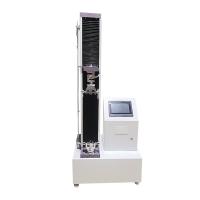
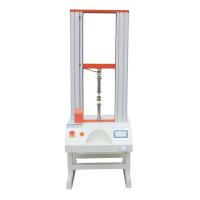
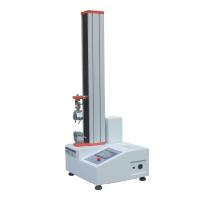
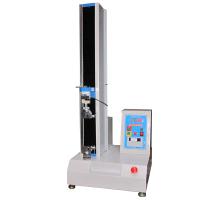
Tensile testing machine with a drawing device capable of automatically recording the breaking load and a gripper capable of clamping the specimen.

experiment procedure
(1) Sample preparation The sample size is shown in Figure 1. Other requirements such as sample preparation and test conditions are the same as those for the T-peel strength test. Rigid metal LY12CZ aluminum alloy, thickness 2mm; width 25.0mm±0.5mm, length 200mm. Flexible metal LY12CZ aluminum alloy, 0.3mm thick, 350mm long. Adhesive layer thickness is usually <0.2mm. If the sample , the remaining glue on the edge needs to be removed after curing, and the dislocation of the glued surface along the width direction is not more than 0.2mm. No less than 5 samples .

Figure 1. Specimen dimensions and fixtures for 180°peel strength (in mm)
(2) Test conditions, parking time in the laboratory environment, the free end of the sample is peeled off for a certain length, the sample is clamped as shown in Figure 8-60, and the loading speed is (100±10) mm/min, the effective peeling The length is about 125mm, and other regulations are the same as the T-peel strength.
result evaluation
The test results are calculated according to formula (8-25):
σ=F/B
Where σ——180°peel strength, KN/m;
F——peeling force, kN;
B——sample width, m.
Calculate the average peel strength, the minimum peel strength, the maximum peel strength, and the arithmetic .

Influencing factors
The factors affecting the peel strength are the same as the T peel strength.

- 1Tensile machine application in various industries
- 2Technical analysis of key parameters of Tensile machine: Scientific selection from force measurement accuracy to Power system
- 3Tensile machine purchasing guide [dry version]
- 4Talking about the performance test of epoxy resin film coated on PET
- 5ASTM D5019 Single-layer roofing film reinforced CSM board (chlorosulfonated polyethylene (PE)) standard interpretation
- 6Common problems and solutions in tensile testing
- 7What is tensile strength testing and which products can be tested?
- 8Factors Affecting the Performance and Accuracy of Tensile Testing Machines
- 9Classification of Tensile Testing Machines
-
![Patek Jushi LY-7012C Tensile Tester 1000KG]()
-
![BaidaJUSHI LY-7012A Small Tensile Testing Machine 200KG]()
-
![CHINA NBC-1024-2 Tensile Tester 5T]() CHINA NBC-1024-2 Tensile Tester 5T$ 6635.00
CHINA NBC-1024-2 Tensile Tester 5T$ 6635.00 -
![CHINA NBC-6820 Ring type initial tacking machine Tensile Tester]()
-
![CHINA NBC-1023-1 Computerized Double Column Tensile Testing Machine]()
-
![CHINA NBC-1021 Touch screen single column Tensile Strength Tester 10KG]()