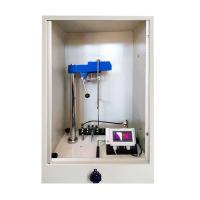
What hardness affects the swing rod damping test?
The pendulum Hardness Tester will obtain different test results due to the influence of different factors during the pendulum damping test. The test result of the pendulum hardness is actually the damping time, so what factors will affect the test damping time?
When the swing rod is swinging, there are two kinds of resistance that hinder the swing: one is the swinging support ring, and the friction is proportional to the positive pressure. The positive pressure of a single pendulum (Koenig pendulum and Perthaz pendulum) is higher than that of a double pendulum, because the pendulum rod has a larger mass and a smaller ball diameter. The other is air resistance, which is related to the shape of the pendulum, the speed of movement, and the density of the air. The damping time value is actually the time it takes for the pendulum to overcome frictional resistance and air resistance. The pendulum damping test has the following influencing factors:
(1) The influence of paint film thickness: the greater the paint film thickness, the lower the hardness value. This is because the thicker the paint film, the greater the frictional resistance, which reduces the swing time of the pendulum.
(2) The influence of the flatness of the paint film surface: particles and scratches on the paint film surface will affect the swing of the pendulum, resulting in a reduction in the swing time of the pendulum.
(3) The impact of the instrument steel ball: If the steel ball is damaged, the frictional resistance will increase, resulting in a decrease in the swing time of the pendulum.
(4) The influence of temperature and humidity: high temperature will make the paint film soft, and high humidity will make the paint film astringent, which will increase the friction resistance on the paint film surface and reduce the swing time of the pendulum.
(5) Influence of air flow: The swing rod will shake when the air flows, so the glass cover of the instrument should be closed during operation.
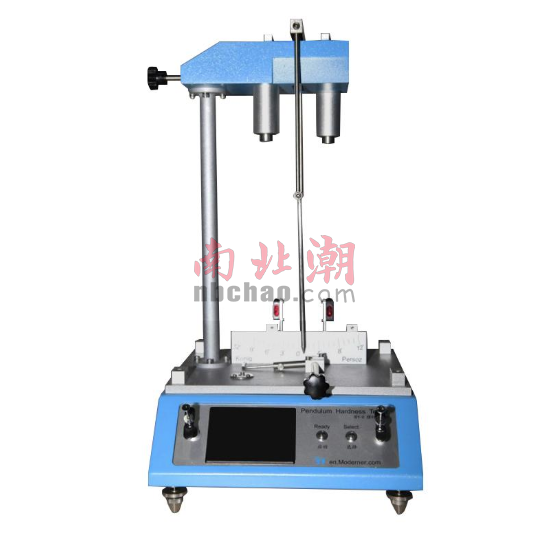
- 1Paints and varnishes Pendulum damping test method under ISO 1522
- 2GB/T1730 Interpretation of Koenig and Persaz pendulum damping test
- 3Swing bar hardness testing: a method for evaluating film hardness
- 4Pendulum damping test method for the determination of film hardness
- 5Film hardness testing method: pendulum hardness, pencil hardness, etc
- 6How much do you know about the difference between Konig pendulum and Persoz pendulum of Pendula Hardness Tester?
- 7Pendula Hardness Tester calibrating steps
- 8Determination method of paint film hardness - swing rod hardness, scratch hardness, indentation hardness
- 9How to calibrate the swing rod Hardness Tester?