Test method for moisture heat resistance of films
1 Definition, Purpose and Significance
The heat and humidity resistance of the paint film refers to the resistance of the paint film to the outdoor high temperature and high humidity environment. When the environmental temperature is high, humid air and saturated water vapor will cause damage to the substrate protected by the coating. The damage mechanism is mainly: when the water penetrates the paint film and reaches the metal substrate, it will generate electricity chemical corrosion. At the same time, the paint film itself will also absorb part of the water and swell, reducing the adhesion between the paint film and the substrate. However, when commercial temperature and high humidity conditions coexist, the speed of water vapor diffusing into the paint film will be significantly accelerated, and it is easy to cause blistering, rust, peeling, discoloration and other damage phenomena on the substrate coated with the paint film. The heat and humidity resistance test of the paint film is also a common corrosion resistance test, which is generally carried out at the same time as the aging resistance and salt spray resistance tests. Recently, it is still widely used in the pretreatment of substrates, corrosion resistance evaluation and comparative tests of coating systems or their combinations.
2 related standards
GB/T 1740-79(89) Determination of resistance to heat and humidity of paint film
3 Test method introduction
3.1 Principle of formula test
Due to the consideration of uncontrollable outdoor uncertain factors and the need to shorten the test time, many industrial product standards have adopted the test method of moisture resistance of paint film to simulate the outdoor high temperature and high humidity environment to evaluate the corrosion resistance of paint film. The purpose is to simulate the high-temperature, high-humidity and high-corrosion environment in nature in the laboratory, and to evaluate the high-temperature and high-humidity resistance of the paint film by observing the samples during and after the test.
3.2 Test equipment
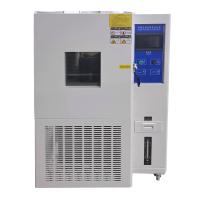
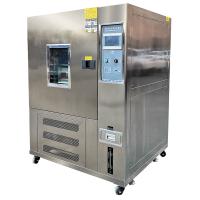
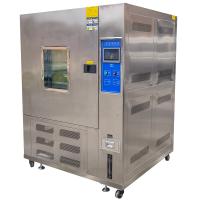
At present, it is widely used at home and abroad to use the temperature and humidity control box to carry out the humidity and heat resistance test. The equipment is generally composed of solution bottle, heating storage, humidifier, temperature, hygrometer and controller, test junction and pipeline, test plate rack and so on. When the test solution is injected into the heating storage tank and preheated, pumped into the humidifier for atomization and blown into the test box with adjustable temperature and humidity by the fan, a constant temperature and humidity environment is formed in the body.
3.3 Operation points
3.3.1 Test conditions
Temperature in the box: (47:t1 )°C, relative humidity: (96:t2)%, test water: at least GB6682 level 3 water.
3.3.2 Preparation, maintenance and pre-treatment of samples
The selection, treatment, preparation method, and curing time of the sample substrate for the heat and humidity resistance test are generally required in the relevant product standards, and can also be negotiated between the entrusting test party and the inspection agency. You can also refer to the provisions in GB/T 1765-89 "Preparation Method of Paint Film for Determination of Humidity and Heat Resistance, High Salt Resistance and Weather Resistance (Artificial Acceleration)" to prepare and maintain the sample. The backside and the circumference of the tested panel can be coated with the tested sample or a coating system known to have better anti-corrosion properties.
3.3.3 Commissioning, testing and inspection of prototypes
When the curing period of the test panel is over, except one of them is set aside as a standard panel, the remaining three panels can be put into the test box for testing. The samples should be hung vertically on the sample support, no contact between the samples and between the samples and the box, no stacking of the samples, no condensation on the surface of the samples during the test. After each inspection of the sample, the position of the sample on the test plate rack should be changed, such as the exchange of the front row, middle row and rear row.
The test time can refer to the provisions of the relevant product standards or the entrusted test party and the inspection agency agree that a damage index is the test end point, such as: the degree and grade of blistering, rust, and peeling, etc. Common tests are also multiples of 24 hours. During continuous tests, check the sample every 48 hours, and check it every 72 hours after the first inspection. When inspecting the sample, the test sample can be taken out of the box and compared with the standard plate under sufficient light or light, and the blistering, rust, peeling, and discoloration of the test sample can be judged according to the provisions of the GB/T 1766-1995 standard The degree and level of damage. Model Zhou Guo and Kong Zhouguo: There will be no assessment within the Smm, and the final result will be based on the commercial blocks with the same grade among the three test panels.
3,4 Factors Affecting the Results of Humidity and Heat Resistance Test
3.4.1 During sample inspection, fingerprints should be avoided on the surface of the sample to avoid accelerated corrosion.
3.4.2 The stacking of the test samples will cause the water droplets on the upper sample to fall on the lower sample, which will affect the test results.
3.4.3 If the template is placed too crowded, it will easily cause the contact between the template and the box, and may cause galvanic couples and poor gas circulation inside the box.
3.4.4 The damage or failure of the heat insulation layer of the test box will cause the temperature difference between the inside and outside of the box, resulting in cold water droplets on the top of the box to fall on the test sample, resulting in test errors.
3.4.5 The time for checking the sample vibration should be as short as possible (≤0.5h), too long will affect the test results
- 1GB/T 10586-2006 Detailed explanation: Core technical indicators and acceptance specifications for damp heat Test Chamber
- 2Humidity cabinet test equipment
- 3Damp heat testing chamber and low-Temperature Test Chamber
- 4Analysis of epoxy weathering resistance and detection method
- 5Application of Constant Temperature and Humidity Chamber in Lithium Battery
- 6Humidity chamber FAQ and its solution
- 7Humidity chamber FAQ, calibration method, precautions
- 8Humidity chamber FAQ calibration method
- 9Humidity chamber FAQ and correct calibration method