Determination of leveling and sagging of coatings
Leveling is an important item in the construction performance of coatings. It is separated from coating construction and is specially listed as a testing item . Leveling refers to the ability . The leveling of the coating film is the combined effect of gravity, surface tension and shear force. Therefore, the premise of leveling is whether the coating can wet the surface of the workpiece, that is, whether it has good fluidity, which is related to the composition, performance and quality of the coating. construction method etc. In addition, if additives such as silicone oil and cellulose acetate are added to the coating , the leveling property of the coating film can also be directly improved.
The national standard GB/T 1750——1979 (1989) "Determination of Leveling of Coatings" stipulates the measurement method brushing method and spraying method. The time required for the film is rated in minutes.
The determination method of the brushing method is to adjust the sample to the construction viscosity according to the provisions of GB/T 1727--1992 "General Preparation Method of Paint Film", and brush it on the tin plate to make it smooth and even, and then Use a brush to wipe a brush mark longitudinally in the middle of the coating film, and observe how long it takes for the brush mark to disappear and the coating film to return to a smooth surface. Whether it is qualified or not is determined by the product standard. Generally, a coating film with good leveling property can be finished within 10 minutes. Leveling. Spraying method Observe the time for the painted surface to reach a uniform, smooth, wrinkle-free (no orange peel or goose skin) state, and also evaluate whether it is qualified according to product standards.
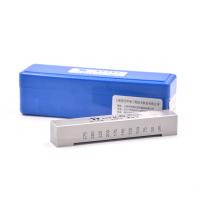
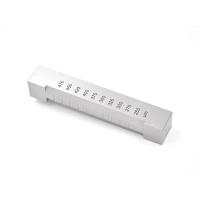
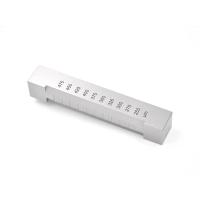
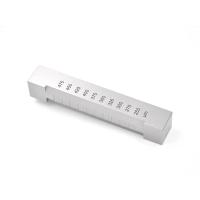
The US ASTMD2801-1994 method for testing the leveling of coatings stipulates that using a leveling test scraper with several gaps of different depths, the coating is scraped into several pairs of parallel strip coatings of different thicknesses, and the complete and partial flow together is observed. The number of strip coatings, compared with the standard graphics, is represented by 0~10 grades, 10 grades represent complete leveling, and 0 grades represent the worst leveling. This method is suitable for white and light-colored paints. ASTM D 4062——1999 (2003) specifies the method for testing the leveling of water-based and non-aqueous light-colored architectural coatings using Leneta leveling test blade.
Sagginess
When the liquid paint is applied on the vertical surface, due to the influence of gravity, before the wet film is dry, part of the surface of the wet film tends to flow down, resulting in thinning of the upper part and thickening of the lower part, and serious formation of spherical and corrugated shapes , this phenomenon shows that this kind of coating is easy to sag, or its anti-sag property is not good, which is the performance that the coating should avoid. It is mainly caused by the unsuitable flow characteristics of the coating, or the coating is too thick to exceed the possible limit of the coating, or the coating environment and construction conditions are not suitable.
The sagging speed of the coating is inversely proportional to the viscosity of the coating and proportional to the square of the coating thickness. The sagging property of the coating film does not meet the standard requirements , and it is difficult to obtain a flat and uniform coating film after drying, which affects the decorative appearance and various protective properties. Therefore, the sagging of the coating also needs to be tested. The general measurement method is to apply a certain thickness of coating film on the test panel, place the test panel vertically , observe the flow and fall of the wet film, record it, and check whether it meets the product standards. CHINA's national standard GB/T 9264--1988 "Determination of Sag Properties of Paints" test method, using a Sag Tester to measure the sag properties of paints, with vertical placement and no flow to the next thickness of the film The film thickness is the non-sag reading. The larger the thickness value, the less likely the coating is to sag.
- 1Waterborne architectural coatings detection method
- 2Types, applications and evaluation methods of levelling agents
- 3Working mechanism and selection considerations of anti-shrinkage agent
- 4Coating performance testing: leveling & sagging
- 5Coating surface tension and its effects
- 6Coating leveling and sagging
- 7Key Factors and Evaluation Methods of Coating Constructability
- 8Sag problems and their solutions
- 9Coating performance testing: ensuring the efficiency and mass of the painting process