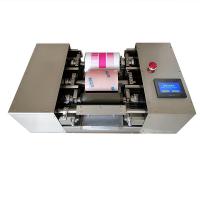
What is flexographic printing? What are its characteristics?
First, the definition of flexographic printing
Flexography is a printing method that uses a flexographic printing plate to transfer ink through an anilox roller.
Flexographic printing plate is a letterpress made of rubber plate, photosensitive resin plate and other materials, so flexographic printing belongs to the category of letterpress printing.
Flexographic printing was originally called "aniline printing drama", named after the use of volatile inks made of aniline dyes for printing. Because aniline is toxic, and the aniline printing at that time was mainly used to print food packaging bags, the scope of application was greatly limited. And because traditional printing methods (such as letterpress, lithography, and gravure printing) are named according to the layout structure characteristics of the printing plate, only flexographic printing is named after the ink used, and aniline dyes are no longer used now. Instead of aniline dyes, dyes or pigments that are not easy to fade and have strong light resistance are used instead of aniline dyes. Therefore, at the 14th Packaging Conference in October 1952, aniline printing was renamed "Flexography", which means flexible plate printing. It is also correspondingly renamed as flexographic printing.
Second, the characteristics of flexographic printing
Flexographic printing has the characteristics of embossing, offset printing and gravure printing. In terms of its printing plate structure, its graphic part is raised, higher than the blank, and has the characteristics of embossing; in terms of its printing suitability, it is a flexible rubber surface that is in contact with the printing paper, and has offset printing characteristics; in terms of its printability As far as the inking mechanism is concerned, its structure is simple, and it is similar to gravure printing and has gravure printing characteristics. In addition, flexographic printing also has the following characteristics:
1. The flexographic printing plate uses polymer resin material, which is soft, bendable and elastic
The Shore hardness of the flexographic printing plate is generally between 25 and 60. The printing plate has high printing durability, generally more than several million impressions. It belongs to light pressure printing (empress printing pressure 50kg/cm², gravure printing pressure 40kg/ cm² , flat printing pressure 4~10kg/ cm² , surface flexo printing pressure only 1~3kg/ cm² ), so flexographic printing is especially suitable for corrugated cardboard etc., the printing of substrates that cannot withstand the pressure of large Indian dramas.
2. The plate-making cycle is short , the plate-making equipment is simple , and the plate-making cost is low
Under normal circumstances, the cycle of making a pair of multi-color gravure cylinders is 5~10 days, while the production of flexographic printing plates is about 5 hours. The cost of plate making is 1/10 of that of gravure printing.
3. The printing material is very wide, and the flexographic printing process is almost not limited by the printing material
Printing is possible on smooth or rough surfaces, absorbent and non-absorbent materials, thick and thin substrates. It can print paper and cardboard, corrugated cardboard, plastic film, aluminum foil, self-adhesive paper, cellophane, metal foil, etc. of different thickness (28~450g/m² ) . There are more types of printing materials than gravure printing, and offset printing except paper, other printing materials cannot be printed or the printing effect is not good.
4. The structure of the machinery and equipment is simple, the cost is low, and the investment in equipment is small
Due to the relatively simple structure of the flexographic printing machine, the equipment investment is lower than that of the offset printing machine or gravure printing machine of the same scale. For the printing equipment of the same color group, the price of the flexographic printing production line is 40%~60% lower than that of the offset printing machine. 1/3 of the price,
5. It has a wide range of applications and can be used for printing packaging and decoration products
Flexographic printing can not only print various composite flexible packaging products, folding cartons, cigarette packs, trademarks and labels; it can also print newspapers, books, magazines and envelopes, etc.
6. Pollution-free, fast-drying ink can be used
The flexographic printing production line can use water-soluble or UV ink, which has no pollution to the environment and no harm to the human body. Flexographic ink is the only non-toxic ink approved by the American Food and Drug Association among all inks at present. Therefore, flexographic printing is also known as green printing and is widely used in food and drug packaging.
Each printing color group is equipped with an infrared drying system. Through the infrared hot air drying device, the ink layer can be dried within 0.2~0.4s, which will not affect the overprinting of the next color group.
7. Fast printing speed, high efficiency and short production cycle
Flexographic printing equipment usually uses roll-type materials, which can be used for double-sided and multi-color printing. Generally, the printing speed of unit-type narrow-width flexo printing machine can reach 150m/min, the printing speed of satellite-type wide-width flexo printing machine can reach 350m/min, and the printing speed of gravure printing is only 90~130m/min. In particular, flexo printing machines can be connected with post-press processing equipment such as glazing, hot stamping, creasing, and die-cutting to form a continuous post-press processing production line with strong comprehensive processing capabilities. Therefore, the production cycle is shorter than other printing processes, which saves labor in subsequent processes, avoids the waste of turnover between processes, and realizes high-speed multi-color printing. Therefore, people call the flexographic printing machine a printing and processing production line. However, in lithographic offset printing, it is often necessary to use more personnel and multiple equipment to complete the same job in three or four processes.
8. High economic benefit
The cost of flexographic printing plates is only 10%~20% of gravure printing, ink consumption is 1/3 less than gravure printing, power saving is 40%, and the reject rate is only 1%~2%, which is lower than gravure printing and offset printing. Thereby reducing the production cost.
9. Flexographic printing has a large amount of ink, and the printed product has a full background
Flexographic printing is especially suitable for printing antique and dull images. However, flexographic products have a large dot gain and are not as rich in layers as gravure printing and offset printing. However, at present, the screen printing plate can print 175L/in color printing products.