Why is coefficient of friction testing important?
The COF or coefficient of friction test is used to determine the friction force between two materials. CoF tests are performed on various materials such as: plastics and polymers, lubricants, tiles, etc.
After friction test coefficients, values vary by test material. General: If the CoF value is low, it is said that there is little to no friction between the two test materials and vice versa.
CoF values typically range from 0 to 1, with a value of zero indicating no friction at all between the two materials, and a value of 1 indicating friction equal to normal force.
Why is the coefficient of friction test important?
CoF values are of great value in the plastic polymer manufacturing industry.
Co-efficiency friction tells us the force with which two materials slide against each other.
Scenario 1: High CoF value
If the CoF value is high, a common problem observed is polymer interference or dragging in the metal drum. There is also the possibility of damage to goods and slowdowns in production. This in turn negatively impacts the company's bottom line.
Scenario 2: Low CoF value
On the other hand, if the CoF value is low, a common problem observed is excessive friction, resulting in poor film feeding. This sometimes produces an unpleasant squeaking sound. Insufficient friction can also cause the film to slide off the conveyor belt.
Both situations are unhealthy for the company in the long run. Therefore, it becomes very important for a company to come up with a decent CoF value in the R&D lab, which can be standardized by the manufacturing unit.
Coefficient of Friction Test for Plastics and Polymers
CoF testing is performed on a variety of materials such as plastics and polymers, lubricants, rubber, tiles, and more.
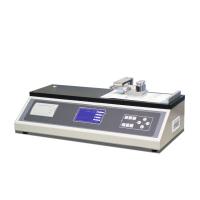
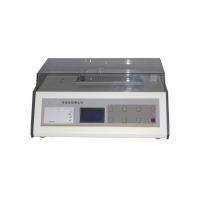
We specialize in CoF testing of plastic and polymeric materials in our instrument focus.
CoF testing of plastics and polymers can be performed between plastic to metal and plastic to plastic.
The ASTM standard for COF testing is ASTM D 1894.

Standard procedure for CoF testing:
Step 1: Sample mounted on sled (weight – 200g +/- 5g)
Step 2: The sled weight and test sample are placed on the surface (metal or plastic) and attached to the loading unit.
Step 3: The surface can be set to room temperature or a certain temperature (according to the desired test conditions).
Step 4: To start the test, drive the sample a distance of at least 150 mm and record a minimum average force of 100 mm, starting from the initial peak force.
Step 5: Remove the test sample from the sled and your machine is ready for the next sample test.
Common results determined in CoF testing are friction static force and friction dynamic force
static force of friction
Electrostatic force is usually the first peak in the graph.
Technically, this is the force that holds an object to a certain point.
Static force is calculated by dividing the initial peak force by the weight of the sled
Momentum|Frictional Momentum
Kinetic force or dynamic force is the average force from the initial peak to the end of the graph.
Frictional dynamics were calculated by dividing the average force during the test period by the weight of the sled.
Factors Affecting CoF Test Results.
Mounting samples on sleds (could lead to human error)
sample age
Test Speed/Movement Rate
Load Cell Calibration
The inclination of the surface (CoF tests can also be done from different angles)
surface temperature


- 1Application of Friction Tester in Rubber
- 2Application of Friction Coefficient Meter in Spinning & weaving products
- 3Friction Coefficient Meter How to test the aluminum foil resistance coefficient of friction?
- 4Application of Friction Tester in Coatings
- 5Difference between static friction coefficient and dynamic friction coefficient
- 6Benefits of using friction coefficient Testers in the plastics industry
- 7What is the coefficient of friction and how is it determined?
- 8Application and Maintenance of Friction Coefficient Tester
- 9Test method of dynamic friction coefficient and static friction coefficient


