EPK Coating Thickness Gauge FAQ
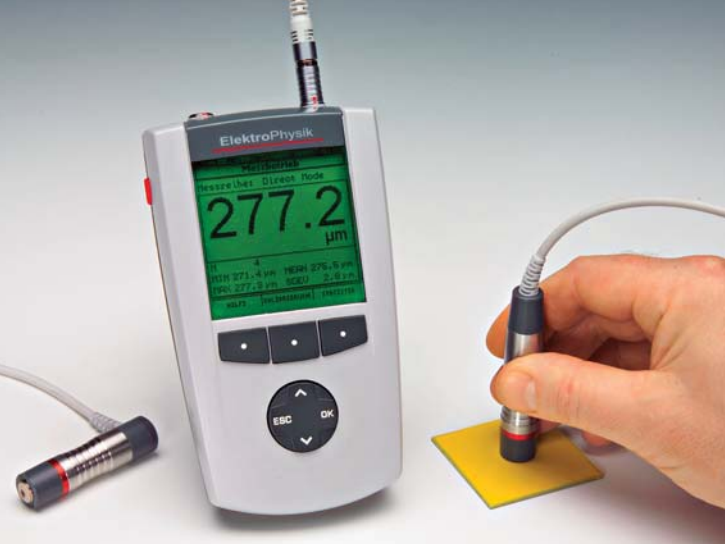
Germany EPK is a brand of imported Thickness Gauges. It provides different types of coating Thickness Gauges to solve different coating thickness measurement problems, especially for some special applications. The following are EPK coatings in several special thickness measurement environments Answers to Thickness Gauge Selection Questions.
Can nickel coating thickness be measured?
Actually, it depends on the nickel layer.
There are two different methods of plating nickel on substrates:
In the case of electroless nickel (also known as electroless nickel), the material to be coated is placed in a solution saturated with nickel. The nickel in solution then precipitates on the material. Typically, the solution also contains a phosphor. Once the percentage of phosphor is higher than 10%, the nickel layer is no longer ferromagnetic. Electroless nickel plating on ferromagnetic steel can be measured with the MiniTest with magnetic inductive sensor. If the steel is non-ferromagnetic, it can only be measured using destructive (coulometry) methods.
In the case of galvanized nickel coatings, the substrate (at the cathode) and the nickel (at the anode) are present in an electrolytic bath through which electricity is applied so that the nickel is deposited on the substrate. Galvanized nickel is always ferromagnetic and its thickness (up to 50 µm) can be measured with our MikroTest NiFe50 on steel and non-ferrous metals of the type MikroTest Ni.
Is all steel magnetic?
uncertain. The term "steel" refers to malleable iron with a carbon percentage between 0.01% and 0.02%. It does not contain any other substances. This means that this steel (also known as carbon steel) is magnetic.
If there are no other substances in the steel (such as different metals), it is called a metal alloy. However, it is still marked as steel.
Steel is the main type of stainless steel and is the general term for anti-rust steel. Stainless steel mainly contains more than 10% chromium and other substances such as nickel, titanium or molybdenum, so it is more resistant to corrosion.
Stainless steel is an alloy of chromium steel, and this composition is also magnetic. Chromium steel is still slightly magnetic when alloyed with nickel. Once some molybdenum is added, stainless steel will completely lose its magnetism.
If you are unsure whether your material is magnetic or non-magnetic, we can support you.
How to calibrate on rough surfaces?
Our MiniTest 650 (example) is ideal for rough surfaces. When measuring on blasted surfaces, readings tend to be higher than the actual coating thickness. This is due to the physical properties of the blasted surface. In this case it is recommended to use the statistical prgram and calculate the mean thickness of the peaks as follows:
Method A (Rz > 20 µm): This method is applied to surfaces with minimum roughness class min. 20 microns (0.8 mils).
Pressure gauges shall be calibrated according to the method described in the manual (3.2.2). For calibration, first use an uncoated sample that has not been blasted. Its surface should be smooth, and its radius of curvature and base material should be the same as the object to be measured later.
Now, take an uncoated but blasted sample (also has the same requirements as the later measurement object, see point 1) and take about 10 readings to get the average Xo.
After this, take approx. Take an additional 10 readings on coated blasted samples of the same mass to obtain the mean value Xm.
The difference (Xm-Xo)±s gives you the average value of the coating thickness (Xeff) over the peak, where "s" is the higher standard deviation of the two values Xm and Xo: Xeff = (Xm-Xo)±s
How to measure small parts?
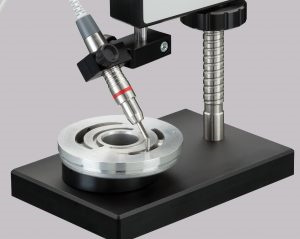
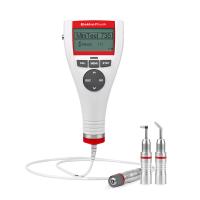
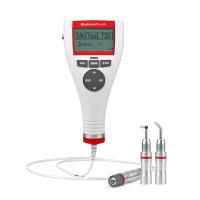
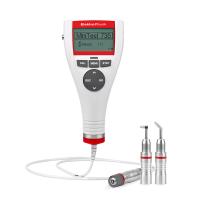
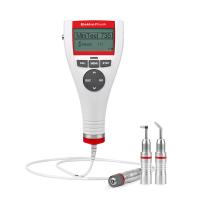
Choose the Micro Probe to measure coating thickness even on small parts like gaskets or nuts. Due to the different construction types of our probes (0°, 45° or 90°), measurements on inaccessible surfaces are possible. Using our precision standards, microsensors can be easily and properly positioned, ensuring the accuracy of your measurements.




- 1Nondestructive measurement Coating thickness
- 2Principle, application and selection of traffic coatings Coating Thickness Gauge
- 3Principle, Application and Selection of Eddy current Coating Thickness Gauge
- 4Principle, Application and Type Selection of Electronic Coating Thickness Gauge
- 5Explore the principle, application and selection of phosphating layer Coating Thickness Gauge
- 6Principle, Application and Type Selection Analysis of Chrome Coating Thickness Gauge
- 7Principle, Application and Selection of Coating Thickness Gauge for inner wall of small pipe
- 8Basic principle and application scenario of steel Coating Thickness Gauge
- 9Principle and Application Analysis of Coating Thickness Gauge