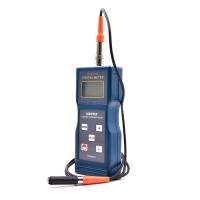
Erosion and Corrosion Coating Thickness Testing of Defelsko Coating Thickness Gauge Solutions
DeFelsko manufactures a handheld, non-destructive ultrasonic Thickness Gauge that measures erosion and corrosion on a variety of substrates.
Metrology Challenge
When evaluating the effects of erosion and corrosion on many types of substrates, the main goal is to non-destructively measure the remaining thickness of the substrate. Depending on the application (i.e. the size of the measurement area), fast sampling and data logging may be required.
A second challenge involves achieving accurate measurements on substrates with rough or curved surfaces, such as tanks and pipes.
In addition to substrate measurements, methods to determine coating thickness may be required to protect substrates from handling and environmental factors.
Substrate Thickness Measurement Solutions
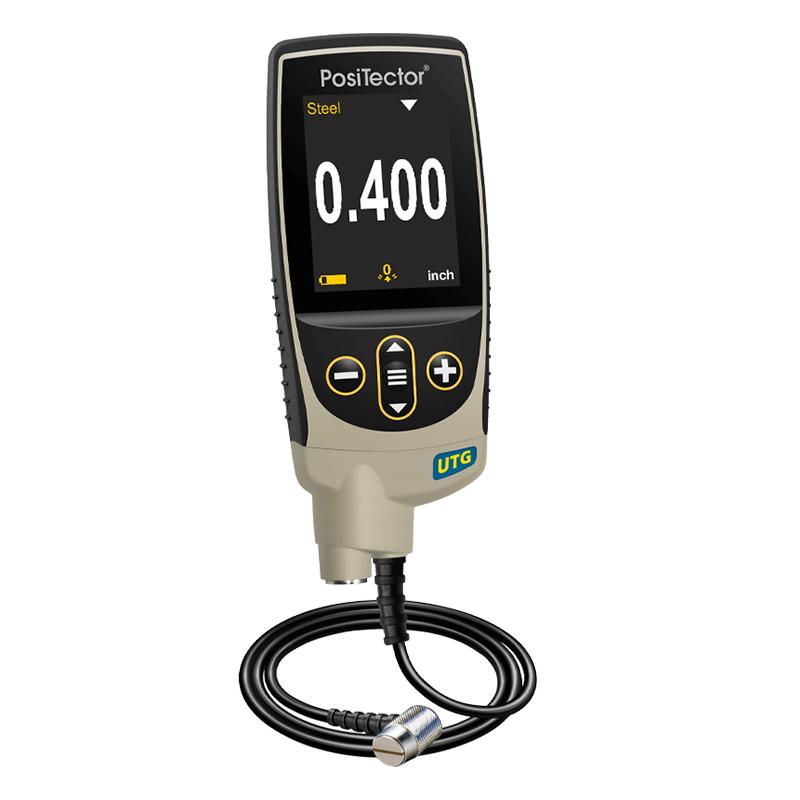
The ultrasonic PosiTector UTG is suitable for non-destructive measurement of steel substrate thickness between 1-125mm (0.040-5.00”). Figure 1 is a photo of the instrument application to measure the leading edge substrate thickness of a refurbished propeller blade. By measuring critical areas of the blade, it is possible to determine the occurrence of severe areas of erosion or corrosion.
The PosiTector UTG features several pre-programmed sound velocities for common substrates such as 1018 steel, stainless steel, cast iron, aluminum and plastics. Users can select a specific substrate from the gage menu, or make simple adjustments for known thickness or sound velocity. To maximize the number of applications, the PosiTector UTG has a sound velocity range of 0.0492 to 0.393 mil/µs (1250 to 10000 m/s)
When multiple measurements are required, the instrument can be placed in scan mode, which can take 20 readings per second while the coupled probe is dragged across the desired measurement area. As shown in Figure 2, the instrument's scan mode displays the total reading as well as the highest and lowest readings. Not only does this provide the user with a sampling of the thinnest and thickest readings taken from the substrate, but these readings can also be stored by the instrument and downloaded to the optional PosiSoft computer software.
Before taking measurements on rough surfaces, it is recommended to remove any foreign debris such as rust or scale. A large amount of couplant is available to reduce surface effects while protecting the sensor surface from abrasion during dragging.
The PosiTector UTG will provide suitable results on surfaces with a radius greater than 50mm (2"). Measurements can be made on surfaces with smaller radii by positioning the probe so that the demarcation line of the probe sensor surface is perpendicular to the curve.
Dry Film Thickness Measurement Solutions
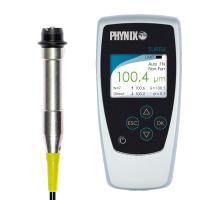
The PosiTector 6000 series gage is an excellent choice for non-destructive measurement of the thickness of protective coatings on metal substrates. For non-ferrous substrates such as aluminum, the "N" series gauges correlate eddy currents generated by an induced magnetic field with coating thickness. For ferrous substrates, such as steel, the "F" series gauges correlate the change in magnetic flux density at the surface as the magnetic probe approaches the substrate. We offer a complete range of gauges and probes, each optimized to measure specific coating thicknesses on a variety of coating/substrate combinations.
Context for Measuring Erosion and Corrosion Effects
What is an application?
Erosion is the process by which a protective coating or substrate is subjected to frictional wear caused by repeated mechanical interactions. Typical causes of corrosion include cavitation, impact of liquid or solid particles, and relative motion in contact with solid surfaces or liquids.
Corrosion is the process by which a substrate and its properties are damaged or worn due to chemical action or change. In metals, corrosion-induced deterioration is usually caused by oxidation processes.
Using ultrasonic Thickness Gauges, you can accurately measure the remaining wall thickness of pipes, pressure vessels, storage tanks, boilers, or other equipment that is susceptible to corrosion or erosion. If within 150°C to 300°C°F) Due to the surface temperature limitations of the instrumentation, most inspections can be performed while the equipment is running, thus avoiding loss of production.
Although many industries are affected by erosion and corrosion, the marine atmosphere is one of the most aggressive and corrosive environments. Corrosion rates are affected by several factors, including seawater, humidity, wind, temperature, air pollutants, and biological organisms. Corrosion is also common in marine applications due to wear from the impact of water and pollutant particles, shock from turbulence in high-velocity liquids, and cavitation from pressure waves generated by air bubbles. Corrosion not only affects the substrate itself, but may also damage the protective coating, increasing the likelihood of substrate corrosion. Ships, piers, pipelines, marine structures and desalination plants are all systems that are subject to varying degrees of marine erosion and corrosion.
Why measure?
Ultrasonic Thickness Gauges are used to measure a wide range of substrates and thickness loss due to corrosion or erosion. Thickness gauges are designed to measure the thickness of metallic (cast iron, steel, and aluminum) and non-metallic (ceramic, plastic, and glass) substrates, as well as any other good ultrasonic conductor, provided their upper and lower surfaces are relatively parallel.
Ultrasonic Thickness Gauges help to quickly check the thickness of large metal structures with small measurement intervals, providing a high-detail thickness map of the scanned surface. Ultrasonic wall thickness measurement is an effective method for monitoring corrosion or the effects of corrosion when access is only available from one side of the substrate.
Companies using non-destructive testing methods minimize safety concerns, ensure compliance with codes, and reduce the frequency of major repairs (and subsequent costs). For example, in marine applications there is a serious risk of substrate damage due to undetected substrate corrosion or erosion. However, the costs associated with corrosion or erosion damage can be more subtle. Consider the case of worn or damaged propeller blades. One possible effect is a reduction in propeller efficiency, which translates directly to reduced horsepower and increased turbulence (vibration). This results in reduced maximum speed and increased fuel consumption. Additionally, cavitation caused by a damaged propeller can create an even more damaging environment for the propeller itself.
In addition to measuring the effects of corrosion and erosion, ultrasonic Thickness Gauges are commonly used for wall thickness measurement; crack, defect, and pitting detection; composite delamination inspection; and evaluation of welded or brazed joints.
Where is the market?
Due to its susceptibility to corrosion and corrosion, many industries can benefit from ultrasonic Thickness Gauge measurements. Industries include structural steel construction and restoration, marine, transportation, chemical production, pulp and paper, oil and gas production and refining, above-ground storage and transmission lines, and power generation.
The users of ultrasonic Thickness Gauges are mainly inspectors, surveyors, maintenance departments and substrate refurbishers.
- 1Nondestructive measurement Coating thickness
- 2Principle, application and selection of traffic coatings Coating Thickness Gauge
- 3Principle, Function, Application and Selection of Multifunctional Ultrasonic Thickness Gauge
- 4Principle, Application and Type Selection of Ultrasonic Thickness Gauge
- 5Principle, Application and Selection of Eddy current Coating Thickness Gauge
- 6Principle, Application and Type Selection of Electronic Coating Thickness Gauge
- 7Principle, Application and Type Selection of Ultrasonic Thickness Gauge
- 8Principle, Application and Selection of Ceramic Ultrasonic Thickness Gauge
- 9Explore the principle, application and selection of phosphating layer Coating Thickness Gauge