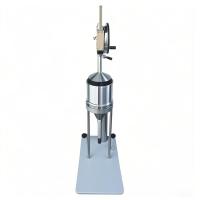
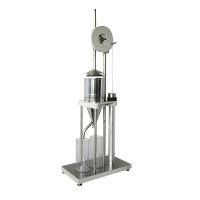
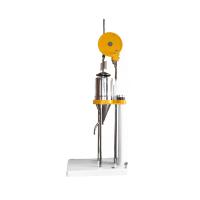
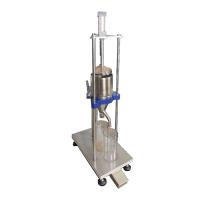
What is the difference between the free meter and the pulp beating meter?
The Canadian Freeness Meter is used to measure the water filtration rate of various pulp water suspensions. Drainage rate reflects how well the fiber has been beaten or refined. The pulp beating Tester is mainly suitable for measuring all kinds of pulp suspensions not greater than 100°SR.
The standard Canadian freeness Tester is widely used in the inspection of the beating process in the papermaking industry, the formulation of the papermaking process, and various papermaking pulping experiments in scientific research institutes. It is an indispensable measuring instrument for the study of pulping and papermaking. The instrument provides a test value suitable for the production control of groundwood pulp; it is also widely applicable to the change of drainage of various chemical pulps in the process of beating and refining; it reflects the surface condition and swelling of the fiber.
Canadian standard freeness refers to the water filtration performance of 1000mL slurry water suspension with a content of (0.3±0.0005)% and a temperature of 20°C measured by a Canadian freeness Tester under specified conditions. The volume (mL) of water represents the CFS value.

The pulp beating degree meter can make good use of raw materials, end the beating process in a timely manner during the production process, and serve as a measure of fiber status in scientific research. Manual control, easy to operate. The structural parameters and technical performance of the instrument are in line with QB/T1054-98 "Pulp Beating Tester", GB/T3332-1982 "Determination of Pulp Beating Degree (Schober-Rigler Method)" ISO5267/1 "Pulp- Determination of water filtration performance Part 1: Schober-Rigler method" and other relevant standards.
The beating degree meter is also called the beating degree meter and the beating degree Tester, which is a special instrument for measuring the water filtration performance of pulp. According to the phenomenon that the beating degree of pulp is inversely proportional to the drainage speed of pulp suspension, this instrument studies the fiber condition and evaluates the beating degree of pulp. The Pulp Freeness Tester is a laboratory routine test instrument designed according to the principle of the Schober-Rigler method. The Schober-Rigler method is a conventional method for measuring the drainage rate of a diluted pulp suspension.
Therefore, the beating degree value tested by the beating degree meter (knocking degree meter) can be converted into the Canadian standard freeness value.
Canadian Standard Freeness and Shore Freeness Conversion Table:
| Canadian Standard Freeness (ml) | Shore beating degree (°SR) | Canadian Standard Freeness (ml) | Shore beating degree (°SR) |
| 25 | 90 | 425 | 30 |
| 50 | 80 | 450 | 28.5 |
| 75 | 73.2 | 475 | 26.7 |
| 100 | 68 | 500 | 25.3 |
| 125 | 63.2 | 525 | 23.7 |
| 150 | 59 | 550 | 22.5 |
| 175 | 54.8 | 575 | twenty one |
| 200 | 51.5 | 600 | 20 |
| 225 | 48.3 | 625 | 18.6 |
| 250 | 45.4 | 650 | 17.5 |
| 275 | 43 | 675 | 16.5 |
| 300 | 40.3 | 700 | 15.5 |
| 325 | 38 | 725 | 14.5 |
| 350 | 36 | 750 | 13.5 |
| 375 | 34 | 775 | 12.5 |
| 400 | 32 | 800 | 11.5 |
-
![Yongxin ZDJ-100 Pulp Beating Degree Tester]()
-
![YINUO YN-YLD01 Standard Freeness Meter, Canadian Freeness Meter 0~1000csf]()
-
![YINUO YN-DJD01 Freeness Tester 0~100 Freeness Tester]()
-
![PUYUN PY-Y811 Pulp Beating Degree Tester]() PUYUN PY-Y811 Pulp Beating Degree Tester$ 1136.00
PUYUN PY-Y811 Pulp Beating Degree Tester$ 1136.00 -
![RUNHU RH-J100 Pulp Beating Degree Tester]()
-
![JINGWEN JW-501 Beating degree Tester]()
-
![QD-3072 Pulp Beating Degree Tester]()
-
![HUAHAN HH-DJ100 Pulp Freeness Tester]()
-
![HENGPIN HP-DJD100 Pulp Beating Degree Tester 1oSR~ 100oSR]()