How to test air permeability with a non-porous paper air permeability meter?
(1) Non-porous paper air permeability meter
① structure
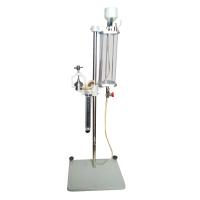
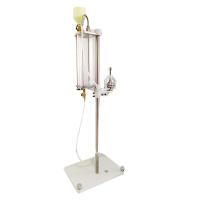
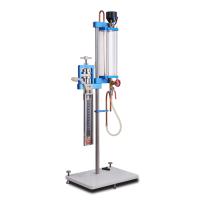
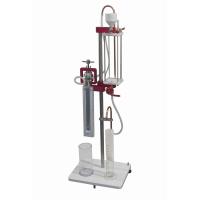
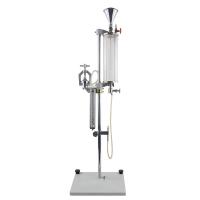
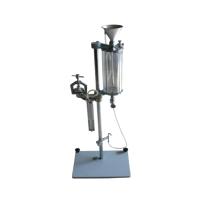
The non-porous paper air permeability meter consists of a fixture, a switch, a burette and a spherical bottle, as shown in Figure 2-20. The function of the spherical bottle is to adjust the water level.
②Air tightness inspection
Open the glass valve, place the spherical bottle on the low shelf, inject distilled water to 75%, adjust the position of the spherical bottle so that the water level in the burette is at the 100mL mark. The spherical bottle is then placed on an elevated stand so that the water level rises to 6.4 mm above zero. Clamp the cellulose acetate film with a thickness of 0.05mm on the jig, place the spherical bottle on the low shelf, and keep the water level of the burette at zero. If non-zero, it should be rescaled. If the drop of the water level within 3 minutes after adjustment is not more than 0.1mm, it means that the airtightness of the instrument meets the requirements.

Figure 2-20 Non-porous paper air permeability meter
1-fixture; 2-glass valve; 3-burette; 4-support; 5-rubber tube: 6-spherical bottle
(2) Test method
①Sample collection and processing. Sampling according to GB450, cut 10 samples of appropriate size along the transverse direction of the paper web, and mark the front and back sides. According to the requirements of GB 10739, carry out temperature and humidity pretreatment on the samples.
②Open the glass valve, place the spherical bottle on the high shelf, adjust the water level of to zero, close the valve, clamp the sample in the fixture, and then place the spherical bottle on the low shelf.
③Open the valve to lower the water level of the burette, and at the same time use a stopwatch to record the number of drops in the water level in the burette after 15s, that is, the air permeability of the sample, in mL/15s.
④Test the remaining samples in turn.
The test results are expressed as the arithmetic mean of all test results (including positive and negative sides).
-
![Yongxin ZQX-1000 paper Porosity Tester Schopper method]()
-
![JINGWEN JW123 paper Air permeability meter]()
-
![YINUO YN-TQD01 Schauber Air Permeability Tester]()
-
![CHINA BLD-TQ20 paper Porosity Meter]() CHINA BLD-TQ20 paper Porosity Meter$ 1117.00
CHINA BLD-TQ20 paper Porosity Meter$ 1117.00 -
![PUYUN PY-H614 paper Porosity Tester Schopper type]()
-
![YINUO YN-TQD03 Battery Separator Porosity Meter Gurley Bentsen Method]()
-
![YINUO YN-TQD02 Electronic Porosity Tester]()
-
![PNSHAR PN-ZQX1000 paper Porosity Tester]()
-
![YANTE YT-TQD1000 paper Porosity Tester]() YANTE YT-TQD1000 paper Porosity Tester$ 1100.00
YANTE YT-TQD1000 paper Porosity Tester$ 1100.00



- 1Porosity Tester verification & maintenance
- 2Application of Porosity Tester in Thermal Paper
- 3How to use the differential pressure method to test air permeability?
- 4What is the measurement principle of microporous paper breathability meter?
- 5Principles and methods of Bendtsen breathability meter test method
- 6Principles and Methods of Gurley Air Permeability Meter Test Method
- 7Principle and method of Schopper air permeability meter test method
- 8What are the common physical properties of paper?
- 9Common tests for corrugated box production
-
![Yunda YD-TQD-A Paper Air Permeance Tester 0~2500mL/min]()
-
![CHINA BLD-TQ20 paper Porosity Meter]() CHINA BLD-TQ20 paper Porosity Meter$ 1117.00
CHINA BLD-TQ20 paper Porosity Meter$ 1117.00
